








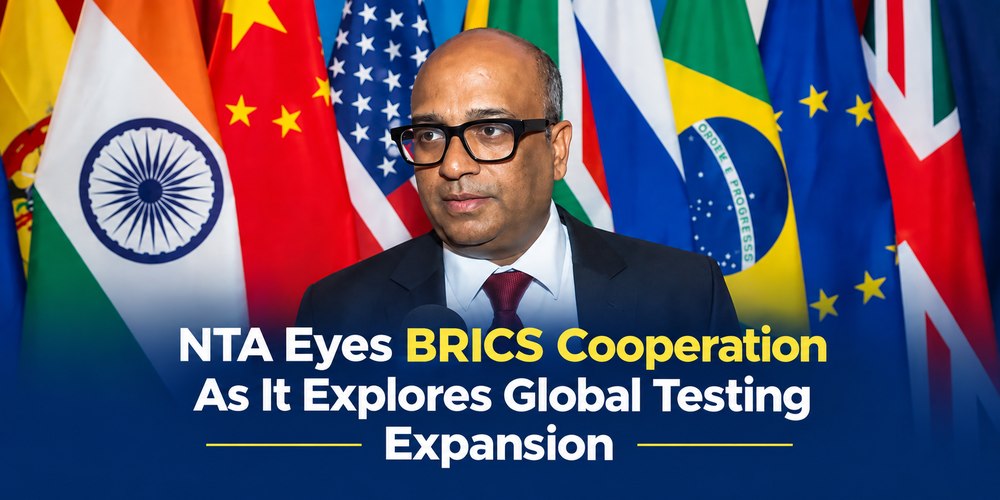
National Testing Agency Plans Global Expansion Beyond India, Eyes Collaboration With BRICS Countries
NTA is strengthening domestic examination systems before exploring international testing and technology partnerships.
The National Testing Agency (NTA) is looking beyond India as it considers expanding its examination framework internationally and exploring potential collaborations with other countries and international organisations, including members of the BRICS grouping. NTA Director General Abhishek Singh said the agency is examining whether its testing architecture could eventually be developed as a “digital public good” that could be adapted and adopted by other countries.
The proposed international expansion, however, remains a longer-term objective. NTA’s immediate focus is on strengthening its examination systems within India, with particular attention to security, transparency, reliability and the reduction of errors and malpractice. The agency intends to consolidate these domestic systems before taking its examination capabilities across borders.
NTA Prioritises Stronger Domestic Examination Systems
Speaking to ANI on the sidelines of the 2026 BRICS Summit in New Delhi, held on September 12 and 13, Singh said that NTA is currently focused on strengthening and consolidating its examination framework in India.
The agency aims to ensure that examinations are conducted in a manner that is fair, transparent and secure, while reducing the possibility of technical errors and malpractice. According to Singh, establishing a reliable domestic framework will be an important prerequisite for any future move towards international examinations.
NTA's international ambitions therefore represent a gradual expansion rather than an immediate overseas rollout. The agency is first looking to strengthen the systems, technologies and processes supporting India's large-scale examinations before considering how these capabilities could be used in other countries.
The eventual objective could see NTA evolve beyond its current role as a testing agency conducting entrance and eligibility examinations for Indian institutions. If its examination architecture can be made secure, scalable and adaptable, the framework could potentially serve as a technology and process model for other countries.
Cross-Border Examinations Could Be the Next Step
According to Singh, cross-border examinations could represent the next stage of NTA's development once its domestic examination ecosystem has been further strengthened.
Such an expansion would require NTA to address a number of practical and regulatory challenges. International examinations involve candidates across different jurisdictions, varying infrastructure standards and potentially different legal and data-protection requirements. Maintaining consistent examination standards across locations would also require robust systems for candidate authentication, question-paper security, testing infrastructure and result management.
The idea of making NTA's testing architecture a digital public good could provide another dimension to this expansion. Instead of simply conducting examinations outside India, the agency could potentially develop technologies and processes that could be adapted to the requirements of other education systems.
Such a model could allow countries with large-scale testing requirements to benefit from India's experience in managing high-volume examinations, provided the technology and framework can meet international standards for security, reliability and accessibility.
BRICS Cooperation Could Focus on Examination Technology
NTA is also considering opportunities to exchange expertise with examination authorities in other BRICS countries. Areas such as question-paper generation, examination security and technology could form part of potential cooperation.
The discussions are particularly relevant because several BRICS countries operate large and complex national examination systems. Sharing expertise could allow testing authorities to compare approaches to securing examinations, managing millions of candidates and using technology to improve efficiency.
Singh referred to China's Gaokao, the country's national college entrance examination, as one example of a large-scale testing system that India can study. The Gaokao involves millions of students and requires extensive coordination, planning, security measures and logistical preparation.
For NTA, cooperation with examination authorities in BRICS countries could therefore extend beyond simply comparing examination formats. It could include exchanging knowledge on the creation and protection of question papers, candidate management, examination-centre operations, technology deployment and measures designed to safeguard high-stakes assessments.
NEET-UG May Shift to Computer-Based Testing
One of the most significant changes under consideration within India's examination system is the expansion of computer-based testing (CBT). NTA already conducts several major examinations digitally, but the National Eligibility cum Entrance Test-Undergraduate (NEET-UG) continues to be conducted in pen-and-paper format.
Singh indicated that NEET-UG is expected to move to computer-based testing “very soon.” The proposed transition is being examined by a high-powered task force led by Nandan Nilekani, with the scale of the examination making the move considerably more complex than a routine change in examination format.
NEET-UG attracts a very large number of candidates, meaning that shifting it to CBT would require substantial testing infrastructure across the country. NTA would need to ensure the availability of secure examination centres, adequate computing capacity, reliable connectivity and technical support at a scale capable of accommodating the examination's candidate volume.
The agency would also need to establish safeguards against potential risks such as impersonation, unauthorised access, technical disruptions, data breaches and other forms of examination malpractice.
NTA Already Uses CBT for Major Examinations
NTA has already established experience with computer-based examinations through several of its major tests. Examinations including JEE, UGC-NET, CUET and NIFT are conducted using computer-based systems.
The agency's longer-term objective is to move all of its examinations towards the computer-based format. Expanding CBT could potentially allow NTA to improve aspects of examination administration, including standardisation, monitoring and data management.
However, the transition also requires careful planning. A nationwide examination conducted digitally depends on reliable infrastructure and adequate contingency arrangements. Ensuring that candidates have equitable access to secure testing environments will be essential, particularly when an examination involves students from diverse geographic and socioeconomic backgrounds.
For an examination as large and high-stakes as NEET-UG, the move would therefore represent a major transformation in how candidates across India undertake one of the country's most important entrance examinations.
Artificial Intelligence to Strengthen Examination Security
Alongside computer-based testing, NTA is exploring the use of artificial intelligence (AI) and data analysis to identify potential examination fraud and irregularities.
According to Singh, the agency is examining ways in which AI could analyse examination logs, datasets and behavioural patterns to identify unusual activity. Such systems could potentially help flag anomalies that require further investigation and strengthen NTA's ability to detect irregularities.
The use of AI could become increasingly important as examination systems become more digital and generate larger volumes of data. Instead of relying solely on manual monitoring, analytical systems could help identify patterns across examination centres, candidate activity and other operational data.
However, effective use of AI in high-stakes examinations would also require careful oversight. Automated systems would need to be designed to distinguish genuine irregularities from legitimate variations in candidate or centre behaviour, with appropriate human review before any consequential action is taken.
Digital Public Good Could Expand NTA’s Global Role
NTA's proposal to explore its testing architecture as a digital public good could potentially broaden the agency's role in international education technology. A digital public-good approach could involve creating secure and adaptable examination infrastructure that can be used or customised by other institutions and countries. India's experience in conducting examinations at a very large scale could provide useful expertise in areas such as candidate registration, digital testing, data management and examination security.
For such a framework to work internationally, however, it would need to accommodate different education systems, examination requirements and regulatory environments. Security, privacy, accessibility and interoperability would also be critical considerations.
The concept nevertheless reflects a broader shift towards using digital infrastructure to strengthen public services. If NTA can demonstrate that its testing architecture is reliable and scalable within India, the framework could potentially become a model for other countries seeking to modernise their examination systems.
International Expansion Depends on Domestic Reform
NTA's plans for global expansion are closely tied to the agency's efforts to improve India's examination ecosystem. The proposed approach follows a clear progression: strengthen domestic examinations, expand technology-based testing, improve security and fraud detection, and then explore international cooperation and cross-border examinations.
The possible transition of NEET-UG to CBT, greater use of AI for detecting irregularities and collaboration with examination authorities in BRICS countries could all contribute to this broader objective.
For now, the priority remains ensuring that India's high-stakes examinations are conducted securely, fairly and efficiently. If NTA can strengthen these systems while developing an adaptable technology framework, its role could eventually extend beyond conducting examinations for Indian students to sharing examination expertise and infrastructure with education systems internationally.
Editor’s Note
NTA's global ambitions signal a potentially important shift in India's approach to examination technology. The agency is not simply considering conducting examinations outside the country; it is exploring whether the systems developed to manage India's enormous testing requirements could become adaptable digital infrastructure for other countries. This is particularly relevant in the BRICS context, where several countries manage large national examinations and face similar challenges involving scale, security, technology and candidate management.
At the same time, international expansion will only be credible if NTA can first strengthen confidence in its domestic examination systems. Moving NEET-UG towards CBT, improving examination security and using AI to identify irregularities could be important steps in that direction. The challenge will be balancing technological ambition with reliability, transparency and equal access for candidates. If NTA can demonstrate that its systems are secure, scalable and dependable at home, its proposed role as a provider of examination technology and expertise internationally could become a more realistic next stage for India's testing ecosystem.
Frequently Asked Questions
1. What is the National Testing Agency planning?
The National Testing Agency is exploring the possibility of expanding its examination framework internationally and collaborating with other countries and international organisations, including BRICS members.
2. Will NTA immediately conduct examinations in other countries?
No. NTA's immediate priority is to strengthen its domestic examination systems. Cross-border examinations are being considered as a longer-term objective.
3. What is NTA's digital public good proposal?
NTA is examining whether its examination architecture could eventually be developed as a digital public good that other countries could adopt or adapt for their own testing requirements.
4. Could NTA collaborate with BRICS countries?
Yes. NTA is exploring potential knowledge and expertise-sharing with examination authorities in BRICS countries, particularly in areas such as technology, question-paper generation and examination security.
5. Will NEET-UG become computer-based?
NTA Director General Abhishek Singh indicated that NEET-UG is expected to move to computer-based testing soon. The proposed transition is being examined by a high-powered task force led by Nandan Nilekani.
6. Which NTA examinations already use computer-based testing?
NTA already conducts examinations including JEE, UGC-NET, CUET and NIFT through computer-based testing.
7. How could AI be used by NTA?
NTA is exploring the use of AI to analyse examination logs, data and patterns to identify potential irregularities and help detect examination fraud.
8. Why is examination security important for NTA's global plans?
A secure and reliable domestic examination system would provide the foundation for NTA to demonstrate that its technology and processes can be scaled or adapted for international use.

Skoobuzz

 Skoobuzz


 Skoobuzz



0 Comments (Please Login To Continue)