








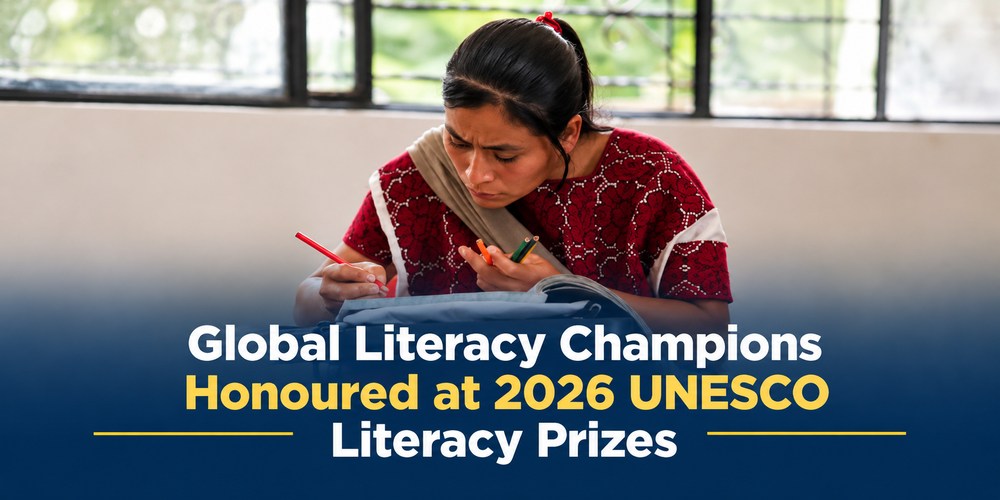
UNESCO Literacy Prizes 2026 Recognise Six Champions of Inclusive Education
Six literacy initiatives recognised for expanding inclusive education among underserved communities
Six innovative literacy programmes from Colombia, Lebanon, Mexico, the Kingdom of the Netherlands, Nigeria and Thailand have been named laureates of the 2026 UNESCO International Literacy Prizes, recognising their efforts to make literacy more accessible, inclusive and relevant to communities around the world.
The programmes were recognised during UNESCO's International Literacy Day global celebration, held in collaboration with the Government of Mexico in the State of Chiapas on September 8 and 9, 2026. This year's celebration was held under the theme “Literacy for people, the planet and prosperity,” which calls for a broader understanding of literacy and stronger lifelong learning systems capable of responding to changing social, economic, environmental and technological needs.
Since their establishment in 1967, the UNESCO International Literacy Prizes have recognised more than 600 individuals, organisations and institutions for innovative and impactful work in literacy. The 2026 laureates demonstrate how locally designed programmes can address challenges ranging from language barriers and displacement to conflict, poverty, disaster preparedness and unequal access to education.
Colombia's Escuelas LEO Promotes Multilingual and Intercultural Literacy
The Escuelas LEO programme by BibloRed in Colombia was launched in 2024 by an organisation managed by Bogotá's Secretariat of Culture, Recreation and Sports. It provides intercultural and multilingual literacy opportunities for communities that have traditionally experienced barriers to education, including Indigenous Peoples, Deaf communities, migrants, displaced populations and LGBTIQ+ groups.
The programme places mother languages and cultural identity at the centre of learning. Through community-led educational activities, participants are encouraged to strengthen their linguistic heritage while developing literacy skills and engaging with people from different cultural backgrounds.
The initiative has recorded growing participation since its launch. Enrolment increased from 320 learners in 2024 to 443 in 2025, highlighting continued interest in an approach that connects literacy with cultural identity, social participation and community cohesion.
By recognising the languages learners already speak, Escuelas LEO demonstrates how literacy programmes can become more inclusive when they reflect the experiences and identities of their communities.
Language Friendly School Programme Supports Multilingual Learners
The Language Friendly School programme, developed by the Rutu Foundation for Intercultural Multilingual Education in the Kingdom of the Netherlands, was established in 2019 to promote language rights and more equitable education.
The programme encourages schools to recognise children's home languages alongside the main language of instruction. Rather than viewing multilingualism as a barrier to learning, it encourages schools to create environments where students' linguistic backgrounds are acknowledged and valued.
The initiative currently operates in around 70 schools across 12 countries and has reached more than 32,000 students through teacher training, school certification and engagement with communities and families.
Its approach aims to support inclusive classrooms while improving learning outcomes and addressing inequalities that can emerge when children's home languages and cultural backgrounds are not reflected in their education.
Nigeria's Project PAL Brings Literacy to Conflict-Affected Children
Nigeria's Project PAL (Primary Accelerated Literacy), developed by the WAER Waters Charity Foundation, focuses on children who are out of school and living in conflict-affected areas of the Niger Delta.
Launched in 2023, the programme provides foundational literacy through solar-powered Literacy Hubs, creating safe spaces where children can learn despite limited access to conventional educational infrastructure. Teaching begins in Indigenous languages before learners transition towards English.
Project PAL also applies a Teaching at the Right Level approach, grouping children according to their actual learning abilities rather than relying solely on their age or school grade. This allows educators to address learning gaps more directly and provide instruction suited to each child's current level.
Between 2023 and 2025, the programme reached 8,500 learners, with 82% achieving functional literacy. The initiative has also helped children find pathways back into formal education while strengthening community involvement in learning.
King Sejong Laureates Receive US$30,000
Each of the three UNESCO King Sejong Literacy Prize laureates will receive an endowment of US$30,000, a medal and a diploma in recognition of their contribution to literacy development.
Three Initiatives Win the UNESCO Confucius Prize for Literacy
The UNESCO Confucius Prize for Literacy, sponsored by the Government of the People's Republic of China, recognises initiatives that promote literacy, including functional literacy and the use of digital tools to support adults in rural communities and out-of-school young people. Three additional programmes were selected for the 2026 award.
Lebanon's Alsama Project Creates Accelerated Education Pathways
The Accelerated Education for Out-of-school Displaced Youth in Lebanon programme, operated by the Alsama Project, supports displaced young people living in refugee camps and low-income communities who have limited or no literacy skills.
The Beirut-based NGO, founded in 2020, has developed an accelerated education model designed to help young people recover education lost because of displacement and other barriers. The programme compresses 12 years of schooling into six years, while foundational literacy and numeracy skills can be developed within an intensive six-month learning period.
Its curriculum combines literacy, numeracy, languages and life skills, providing learners with educational foundations that can support further study, employment and participation in civic and community life.
More than 2,500 learners have participated in the programme so far. Its recognition highlights the importance of flexible education pathways for displaced young people who may otherwise struggle to re-enter traditional schooling.
Chiapas Puede Expands Bilingual Literacy Across Mexico
Mexico's Chiapas Puede State Literacy Programme, established by the Government of the State of Chiapas in 2024, provides bilingual and culturally relevant literacy education across all 121 municipalities of Chiapas.
The programme focuses particularly on historically marginalised communities, including women and Indigenous Peoples, and uses the Matías de Córdova pedagogical model, a phonics-based approach adapted to the linguistic and cultural context of the state.
Chiapas Puede combines face-to-face and digital learning with community-based study circles. Instruction is provided in Spanish as well as Indigenous languages, helping learners access education while maintaining connections with their linguistic and cultural backgrounds.
The programme reaches more than 140,000 learners every year and has set an ambitious goal of reducing the state's illiteracy rate from 13.7% to 4%.
Its scale demonstrates how community-based literacy programmes can operate alongside digital education to reach large populations, particularly where conventional educational opportunities may be limited.
Thailand Links Multilingual Literacy With Disaster Resilience
Thailand's Language for Life: Multilingual Literacy for Disaster Communication and Community Resilience in Hat Yai Learning City programme has been operated by Hat Yai City Municipality since 2016.
The initiative provides community-based multilingual literacy in English, Malay and Chinese, connecting language education with practical issues affecting residents' everyday lives. These include disaster communication, environmental awareness and economic activities.
Developed in partnership with Prince of Songkla University, the programme uses flexible, learner-centred methods designed to strengthen communication skills while promoting social inclusion and community resilience.
Its focus is particularly relevant to Hat Yai, a city exposed to disaster risks. By connecting language learning with emergency communication and other practical needs, the programme demonstrates how literacy can provide communities with skills that extend beyond formal education.
Each Confucius Prize Laureate Receives US$30,000
The three UNESCO Confucius Prize laureates will each receive an endowment of US$30,000, a medal and a diploma. Together, the six laureates demonstrate different ways of approaching literacy.
Their programmes show that literacy can support cultural identity, help displaced young people return to education, create opportunities for children affected by conflict, reduce language-based inequalities and strengthen communities' ability to respond to emergencies.
International Literacy Day Marks Six Decades of Action
The 2026 global celebration of International Literacy Day also marks the 60th anniversary of the observance. UNESCO proclaimed International Literacy Day in 1966, during the 14th session of its General Conference. Since then, the annual observance has highlighted literacy as an important foundation for human dignity, sustainable development, participation and lifelong learning.
The 2026 theme, “Literacy for people, the planet and prosperity,” places literacy within a wider discussion about how education systems can prepare people for changing social and economic conditions while supporting sustainable development.
The six UNESCO prize winners reflect this broader understanding by connecting literacy with cultural inclusion, employment, community resilience, digital learning and social participation.
Global Literacy Challenges Remain Significant
Despite decades of progress, major literacy inequalities continue to affect communities worldwide. UNESCO estimates that approximately 739 million young people and adults still lack basic literacy skills, with women accounting for 63% of this population.
More than 77% of non-literate youth and adults live in sub-Saharan Africa and Southern Asia, including approximately 225 million in sub-Saharan Africa and 347 million in Southern Asia.
The challenge also affects children and young people. Globally, four in ten students do not achieve minimum reading proficiency by the end of primary education, while approximately 273 million children and young people remain out of school.
These figures demonstrate that increasing enrolment alone is not enough. Education systems must also ensure that learners acquire foundational skills and that programmes are designed to reach groups facing linguistic, economic, geographic, social or political barriers.
UNESCO Strengthens Literacy and Digital Learning Worldwide
UNESCO works with governments and partners to strengthen literacy policies, improve data and monitoring systems, and build the capacity of educators and institutions.
During 2024 and 2025, UNESCO's work on literacy and adult learning and education reached more than 460,000 learners and beneficiaries and supported 43 countries. Among these, 22 countries strengthened their literacy and adult learning and education policies and frameworks.
The organisation is also responding to the changing digital environment by supporting countries in addressing digital divides. Its work includes promoting media and information literacy, critical digital skills and equitable access to technology, to ensure that disadvantaged communities are not excluded from the digital transition.
Editor’s Note
The 2026 UNESCO International Literacy Prizes underline an important shift in how literacy is increasingly understood: it is not simply the ability to read and write, but a foundation for participation, identity, resilience and opportunity. The six winning initiatives are particularly notable because they adapt their methods to the realities of the communities they serve. From Indigenous and multilingual learners in Colombia and the Netherlands to displaced youth in Lebanon and children affected by conflict in Nigeria, the programmes demonstrate that effective literacy strategies must take local circumstances seriously. Mexico's large-scale bilingual programme and Thailand's focus on disaster communication further show how literacy can be connected to broader social and community needs.
The figures behind the global literacy challenge make this work especially urgent. With hundreds of millions of young people and adults still lacking basic literacy skills and millions of children outside school, education systems need approaches that go beyond traditional classroom models. The 2026 laureates offer examples of how community participation, mother-language instruction, accelerated education, digital tools and practical learning can help close some of these gaps. Their recognition also reinforces a wider message: lasting literacy progress depends not only on getting people into education, but on ensuring that learning is accessible, relevant and responsive to the realities of the people it is intended to serve.
Frequently Asked Questions
1. What are the UNESCO International Literacy Prizes?
The UNESCO International Literacy Prizes recognise outstanding programmes and organisations that have made significant contributions to improving literacy and expanding access to learning.
2. How many programmes won the UNESCO Literacy Prizes in 2026?
Six programmes from Colombia, Lebanon, Mexico, the Kingdom of the Netherlands, Nigeria and Thailand were selected as 2026 laureates.
3. What is the UNESCO King Sejong Literacy Prize?
The UNESCO King Sejong Literacy Prize, sponsored by the Republic of Korea, recognises contributions to literacy development based on learners' mother languages.
4. Which programmes won the King Sejong Literacy Prize in 2026?
The 2026 laureates are Escuelas LEO by BibloRed in Colombia, Language Friendly School by the Rutu Foundation in the Netherlands, and Project PAL by the WAER Waters Charity Foundation in Nigeria.
5. What is the UNESCO Confucius Prize for Literacy?
The UNESCO Confucius Prize for Literacy, sponsored by China, recognises programmes promoting literacy, including functional literacy and the use of digital tools to support underserved populations.
6. Which programmes received the Confucius Prize in 2026?
The laureates are the Alsama Project's accelerated education programme in Lebanon, Chiapas Puede in Mexico, and Language for Life in Thailand.
7. How much do UNESCO Literacy Prize winners receive?
Each of the six laureates receives an endowment of US$30,000, a medal and a diploma.
8. How many adults and young people lack basic literacy skills globally?
Approximately 739 million young people and adults worldwide lack basic literacy skills, according to UNESCO's figures.
9. When was International Literacy Day established?
UNESCO proclaimed International Literacy Day in 1966, making 2026 the 60th anniversary of the global observance.

Skoobuzz

 Skoobuzz
 Skoobuzz



0 Comments (Please Login To Continue)