








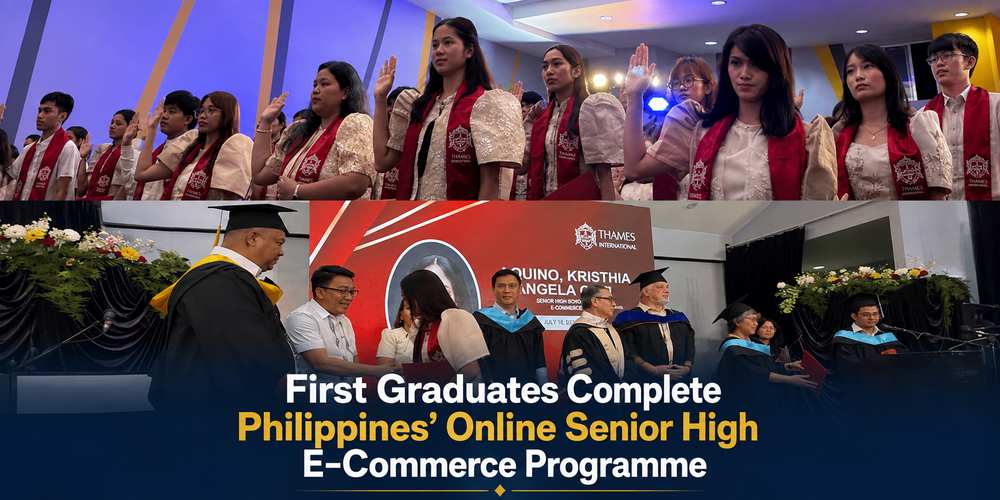
Online E-Commerce Senior High Program Produces First 75 Graduates
The online programme combines senior high school education with e-commerce, digital skills and industry experience.
The Philippines has marked a new milestone in digital education with the graduation of the first 75 students from an online senior high school programme focused on e-commerce and digital skills.
The Senior High School E-Commerce Track, developed through a collaboration between the Department of Trade and Industry E-Commerce Bureau (DTI-ECB), Department of Education (DepEd), and Thames International School, combines the country’s standard senior high school curriculum with specialised training in e-commerce, digital technologies, industry projects and work immersion.
The first cohort of 75 students officially graduated on July 18, 2026, completing a programme designed to prepare young Filipinos for higher education, employment, freelance careers and digital entrepreneurship.
A New Model for Senior High School Education
The programme represents an effort to bring traditional secondary education closer to the realities of a rapidly changing digital economy. Rather than treating digital skills as an additional component of education, the E-Commerce Track incorporates them directly into the senior high school experience.
Students are exposed to areas including e-commerce, digital skills, industry projects and practical work experience, allowing them to connect classroom learning with the demands of the workplace.
The programme is delivered entirely online, allowing students to participate regardless of where they are located. This model could be particularly relevant in a country where access to specialised educational opportunities can vary significantly depending on geography.
Preparing Students for Work, Business and Further Education
The programme is designed to give students multiple pathways after graduation. Rather than preparing learners solely for university, the curriculum aims to equip them with skills that can be applied across higher education, employment, freelancing and entrepreneurship.
DTI-ECB Director Eryl Royce Nagtalon said the partnership provides young Filipinos with practical digital and entrepreneurial capabilities while strengthening their readiness for further education, employment and business. The emphasis on multiple pathways reflects the changing nature of the labour market, where young people increasingly encounter opportunities beyond traditional full-time employment.
Digital platforms have created new possibilities in areas such as online commerce, freelancing and entrepreneurship, making digital literacy an increasingly important component of career preparation.
Industry Experience Forms Part of the Curriculum
A key feature of the programme is its connection with industry. As part of the curriculum, the DTI-ECB helped facilitate work immersion opportunities with micro, small and medium enterprises (MSMEs) as well as corporate e-commerce partners.
This allows students to gain exposure to real-world business environments while developing an understanding of how digital commerce operates beyond the classroom. Work immersion can also help bridge the gap between academic knowledge and practical application, allowing students to develop skills that may be difficult to acquire through classroom instruction alone.
For students interested in entrepreneurship, such experiences can provide an early look at the challenges involved in operating and growing a business in an increasingly digital marketplace.
Why E-Commerce Skills Matter in the Philippines
The programme comes as e-commerce continues to become an increasingly important part of economic activity in the Philippines. According to 2025 data from the Philippine Statistics Authority, cited by the programme's proponents, e-commerce gross value added in the country reached P880.46 billion.
The growth of digital commerce is creating demand not only for entrepreneurs but also for people with skills in digital marketing, online sales, customer engagement, technology and business operations.
Introducing students to these areas during senior high school could therefore help them understand and participate in a sector that is becoming increasingly significant to the Philippine economy.
From Proposal to First Graduating Class
The E-Commerce Track was first proposed in 2021 before being formally launched in 2024 following coordination among the participating government agencies and Thames International School. The graduation of its first cohort represents the completion of an important initial phase for the programme.
Thames International School President and Co-Founder Jaime Noel Santos described the first graduating class as evidence that an alternative model of senior high school education is possible — one that is online, connected to industry and focused on producing graduates who are prepared for the workplace. He also highlighted the potential for the model to expand nationwide through stronger partnerships between government, educational institutions and industry.
Online Education Expands Access
The programme’s fully online format is another defining feature. Students do not need to be physically located near a particular campus to participate, potentially allowing learners from different parts of the country to access specialised training that may otherwise be unavailable in their local communities.
At the same time, online education places greater importance on digital access, student engagement and the ability of institutions to provide effective support remotely. The programme, therefore, offers an interesting example of how digital delivery can be combined with practical learning and industry exposure rather than used simply as a substitute for classroom instruction.
Students Encouraged to Use AI Responsibly
The graduation ceremony also highlighted the importance of emerging technologies in the future of work. Bataan 1st District Representative Antonino “Tony” Roman III, who attended the event, encouraged graduates to continue developing their skills while using emerging technologies, including artificial intelligence, responsibly. For students entering a digital economy, the ability to work with new technologies is likely to become increasingly important.
However, technical familiarity alone may not be enough. The growing use of AI also makes critical thinking, ethical decision-making and responsible technology use increasingly relevant to education and employment.
Plans to Expand Scholarships
Following the graduation of its first cohort, DTI-ECB and Thames International are looking towards the next stage of the programme. The organisations are exploring opportunities to expand scholarships for the 2027–2028 school year.
Potential partners include:
- Local government units
- Non-profit organisations
- Corporate foundations
- Industry organisations
- Other institutions interested in supporting digital education
Expanding scholarship opportunities could help make specialised digital education available to a broader group of students, particularly those who may otherwise face financial or geographic barriers.
What This Could Mean for the Future of Digital Education
The first graduating class offers more than a milestone for one programme. It raises a broader question about what senior high school education should look like in an economy increasingly shaped by technology. Young people entering the workforce today may encounter careers and business models that did not exist when traditional education systems were designed.
Preparing students for that reality may require schools to place greater emphasis on practical digital capabilities, entrepreneurship, adaptability and real-world experience. The E-Commerce Track represents one attempt to do exactly that — bringing together conventional education with industry exposure and digital skills while making the programme accessible through an online format.
Its longer-term significance will depend on whether the model can maintain educational quality, expand access and demonstrate meaningful outcomes for its graduates.
Editor’s Note
Education has traditionally asked students to prepare for the future by learning what the world already knows. But what happens when the future is changing faster than the curriculum? The first 75 graduates of the Philippines’ online E-Commerce Track offer a glimpse of what education could look like when schools begin preparing students not only for existing careers, but for an economy that is still in the process of taking shape.
E-commerce is no longer simply a way of buying and selling. It has changed how businesses are created, how consumers interact with brands and how people earn a living. Freelancing, digital entrepreneurship and online businesses have opened doors that previous generations may not have encountered at the same stage of their lives.
The first 75 graduates are therefore not simply the first students to complete an e-commerce-focused senior high school programme. They are also part of an experiment in what it might mean to prepare young people for a digital economy from the very beginning.
If the model succeeds, its greatest achievement may not be the number of students trained in e-commerce, but the number of young people who leave school believing they have more than one possible future.
Frequently Asked Questions
1. What is the Senior High School E-Commerce Track?
The Senior High School E-Commerce Track is an online programme that combines the standard senior high school curriculum with e-commerce training, digital skills, industry projects and work immersion.
2. Who developed the E-Commerce Track?
The programme was developed through a partnership involving the Department of Trade and Industry E-Commerce Bureau, the Department of Education and Thames International School.
3. How many students graduated from the first batch?
The first graduating cohort consisted of 75 students, who graduated on July 18, 2026.
4. Is the programme fully online?
Yes. The programme operates fully online, allowing students to participate regardless of their location.
5. What career pathways does the programme support?
The programme is designed to prepare students for higher education, employment, freelance work and digital entrepreneurship.
6. Do students receive industry experience?
Yes. The curriculum includes work immersion opportunities, with the DTI-ECB helping arrange placements and experiences involving MSMEs and corporate e-commerce partners.
7. Why are e-commerce skills becoming important in the Philippines?
E-commerce is becoming an increasingly significant part of the Philippine economy. Programme proponents cited 2025 Philippine Statistics Authority data showing e-commerce gross value added of P880.46 billion.
8. When was the E-Commerce Track launched?
The programme was first proposed in 2021 and formally launched in 2024 following coordination between the participating government agencies and Thames International School.
9. Will more scholarships be available?
DTI-ECB and Thames International are exploring expanded scholarship opportunities for School Year 2027–2028, with potential support from local governments, non-profit organisations, corporate foundations and industry groups.
10. How does the programme prepare students for the future?
By combining academic education with digital skills, e-commerce training, industry projects and work immersion, the programme aims to give students both theoretical knowledge and practical experience relevant to a digital economy.

Skoobuzz
 Skoobuzz
 Skoobuzz
 Skoobuzz


0 Comments (Please Login To Continue)