








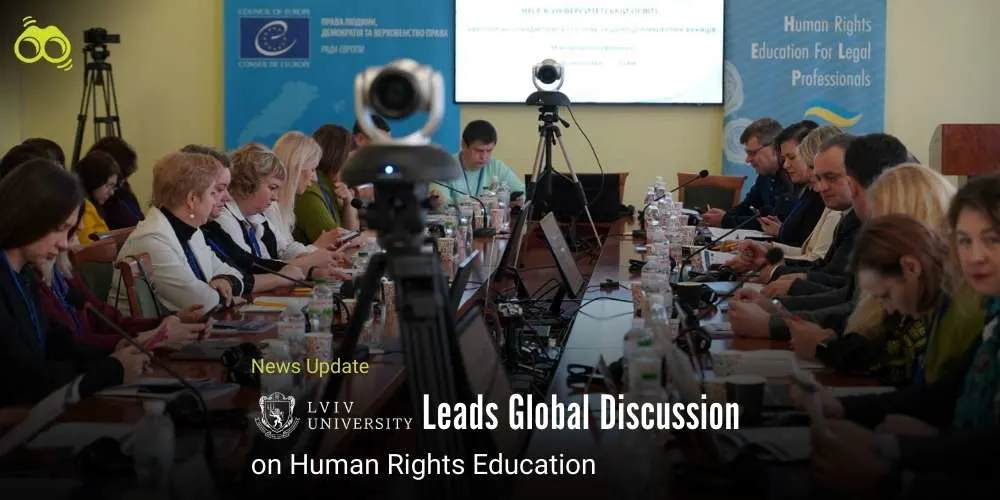
HELP Programme Human Rights Education Expands Across Ukrainian Universities and Law Faculties
International Conference on Human Rights Education Held in Lviv Highlights University Role
Across the continent and beyond, universities have become increasingly important for promoting human rights education in the legal profession and for their future graduates. The real hammer in the nail of this establishment has been the Council of Europe HELP Programme, providing online courses and resources to help integrate European human rights standards into university curricula and national training institutions. The relevance of the programme has gained particular attention because, in Ukraine, educational reform is a challenge closely linked to the prospect of transition toward justice during and after the conflict. By supporting professors, students, and legal practitioners, HELP forges new generations of professionals to advocate better for the rule of law and for human rights.
In this context, the HELP Conference on University Education held on November 26, 2025, in Lviv University of Trade and Economics gathered over 90 in-person representatives and around 70 online participants, thus marking another important step to fine-tune the international cooperation on human rights education in the university domain. As a flagship Council of Europe initiative, the HELP Programme event on human rights education was dedicated to supporting universities and professors in disseminating knowledge on European human rights standards. The Council of Europe HELP Ukraine 2025 project aims at the integration of HELP courses into university and faculty curricula, thus better preparing future professionals to implement these standards.
The opening speech made by the Head of the Department for the Implementation of Human Rights, Justice and Legal Cooperation Standards of the Council of Europe stated that the program was becoming institutionalised. It was emphasised that HELP is now seen as a tool to be embedded in national training institutions and law faculties to assist legal professionals and students in understanding and applying European human rights standards.
The Rector of Lviv University of Trade and Economics stressed the necessity of the initiative and stressed that the university is already integrating numerous HELP courses into its curriculum. In a pre-conference survey, it was reported that over two-thirds of participating universities were using HELP courses systematically or occasionally. Such courses have been most often applied as supplementary materials for independent student work, professional development for academic staff, or as part of practical training. This seemed to show the growing relevance of HELP course integration in law faculties and the wider integration of HELP human rights courses into Ukrainian universities.
Panels of experts discussed the role of HELP and OCEAN programmes in promoting curricula on human rights and strengthening academic partnerships. They shared experiences from Ukrainian universities and from the Law School of Sarajevo University. Training institutions such as the National School of Judges of Ukraine, the Prosecutor's Training Centre, and the High School of Advocacy also explained how they had accredited HELP courses and awarded credits to legal professionals who completed them. The Academy of Justice in Türkiye also presented its adoption of HELP courses in its training curriculum.
Participants also reflected on ongoing challenges in human rights and education, which included implementing judgments of the European Court of Human Rights, the effectiveness of human rights protection during conflict, and the place of legal education in strengthening justice. These discussions underscored the relevance of human rights education for lawyers and the reform of legal education in Ukraine after the war.
The conference then closed with a joint commitment from universities and national training institutions to sustainably implement HELP courses. Among the organising partners were Lviv University of Trade and Economics, the Council of Europe HELP projects for Ukraine, the HELP in Universities Network for academic cooperation, and the OCEAN Programme. The overview of HELP in University Education 2025 illustrated how the initiative shapes humane education reform in Ukraine and human rights integration in higher education across Eastern Europe. With more than sixty topics available in more than 700 language versions on the HELP eLearning platform, professors were encouraged to do the HELP human rights courses online, implement HELP courses into university curriculum, and partner with the Council of Europe for human rights education projects.
In simple terms, the impact of HELP courses on justice training institutions in Ukraine demonstrates how universities and training bodies can adopt the HELP Programme for law faculties and training institutions, ensuring that future professionals are equipped with the knowledge and values needed to strengthen justice and protect human rights.
Editor’s Note:
The HELP in University Education conference of Lviv for 2025 illustrates how higher educational institutions have become global players in the promotion of human rights education for legal professionals. One of the major highlights was the further discussion on the growing relevance of the Council of Europe HELP Programme, which supplies online courses and materials for the integration of European human rights standards into curricula of universities or national training institutions. The important points raised, such as how the reform of education in Ukraine is closely inscribed into the country's transition toward justice in and after conflict. Through empowering professors, students, and legal practitioners, the HELP initiative is assisting in the creation of a new generation of professionals able to enhance the rule of law and ensure human rights protection. The conference showed secondly that universities are not acting alone. With their cooperation through networks such as HELP in Universities and the OCEAN Programme, universities throughout Eastern Europe are sharing experiences and embedding human rights into their teaching. In a broader sense, the initiative connects education to justice. By accrediting HELP courses and allocating credits to legal professionals, the national training institutions in Ukraine and beyond demonstrate that human rights education is not theoretical but practically applicable in professional development. In parallel, this ensures that future judges, prosecutors, lawyers, and academics will be well prepared to apply European standards in their daily work. The Lviv conference underscores a broad commitment to sustainably integrating human rights education into higher education. It illustrates effective cooperation among universities, training institutions, and international organisations to embed justice and fairness values in future professionals.
Skoobuzz asserts that the HELP initiative is more than just courses; it will foster stronger institutions, fairer societies, and a lasting human rights culture across Ukraine and Europe.
FAQs
1. What is the HELP Programme by the Council of Europe?
The HELP Programme is the Human Rights Education for Legal Professionals initiative of the Council of Europe. It offers free online courses and resources to help universities, judges, lawyers, and other legal professionals learn and apply European human rights standards in their work.
2. How do HELP courses help law students and legal professionals?
HELP courses give law students and legal professionals practical knowledge about human rights. They can be used as part of university studies or professional training, helping learners understand how to apply European Court of Human Rights case law and standards in real situations.
3. Which universities attended the HELP in University Education conference 2025?
The HELP in University Education conference 2025 was hosted by Lviv University of Trade and Economics. It brought together more than 90 representatives from universities in Lviv and around 70 participants online, with examples also shared from Ukrainian universities and Sarajevo University Law School.
4. Can online HELP courses be integrated into university curricula?
Yes, online HELP courses can be integrated into university curricula. Professors can use them as mandatory or optional modules, supplementary materials, independent student work, or part of practical training such as moot courts and legal clinics.
5. Why is human rights education important for future professionals?
Human rights education is important because it prepares future professionals to uphold justice, fairness, and the rule of law. By learning these standards early, students and legal practitioners are better equipped to protect communities, strengthen institutions, and respond to challenges during and after conflict.

Skoobuzz

 Skoobuzz

 Skoobuzz
 Skoobuzz
 Skoobuzz


0 Comments (Please Login To Continue)