








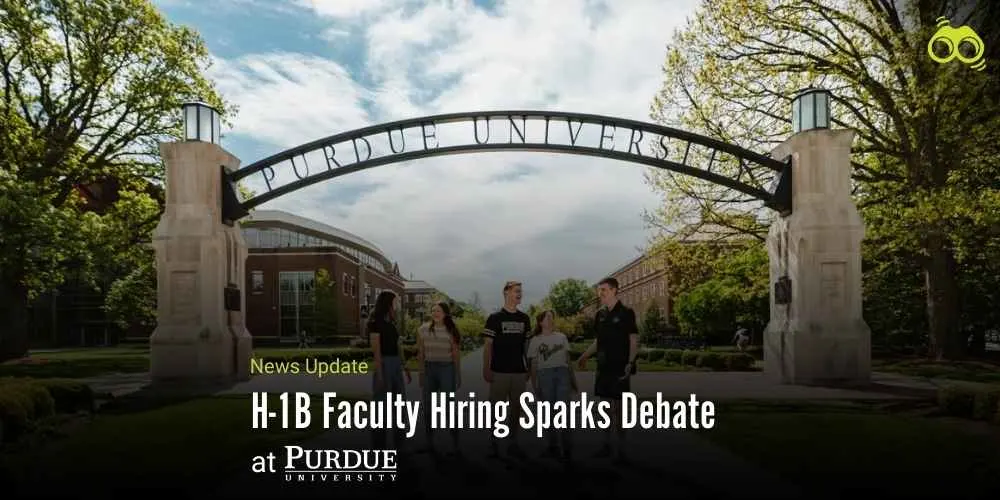
Purdue and Indiana Universities Under Scrutiny for H‑1B Visa Usage
Visa Policy and Academic Hiring Collide in Purdue University Controversy
Purdue H‑1B recruitment of marketing faculty has brought forth a heated issue for Indiana and the United States as a whole. The controversy lies in Purdue’s hiring of foreign national marketing faculty members in H‑1B visa status for the position of marketing faculty for $127,500.
Lawmaker’s Criticism
The row erupted after criticism by one US legislator against Purdue for H-1B teaching staff appointment. A marketing H-1B job advert posted on X by Indiana State Rep Andrew Ireland questioned the need for Purdue to advertise the job since no American is available to fill the position for the same remuneration. Purdue already operates a PhD marketing program.
This is a reflected debate regarding hiring Americans or holding an H-1B visa holder when it comes to academia. The question posed by the posting was straight and pointed: “Can no American do this job?"
Social Response
The posting attracted a torrent of comments. Supporters of the hiring suggested that the university ought to choose the most qualified person for the role, regardless of citizenship. One commentator remarked that, if Andrew Ireland’s reasoning were applied, Princeton might not have hired Albert Einstein, as it could have opted for “some man from Kentucky at the same price.”
Others did not agree with this view, pointing out that the use of the H‑1B visa in recruiting faculty at US universities was intended only for positions that could not be filled by American nationals. Another user added that the visa should not simply be awarded to “the best person,” given the way H‑1B rules were currently being applied.
It is worthwhile highlighting that this dialogue is part of the current issues surrounding the use of the H-1B visa in the United States for higher education and the America First debate on the appointment of faculty members to public universities.
Wider Use of H‑1B Visas
The controversy is not limited to marketing. Reports detail Purdue and Indiana University H‑1B visa usage across specialist roles. Purdue recently hired a senior data scientist under the programme in November. Indiana University also filed to recruit two associate software engineers on H‑1B visas, earning $70,533 apiece between 2026 and 2028.
These cases prove how Purdue and Indiana Universities use H‑1B visas for specialist positions, particularly in data science and technology. They also show the wider trend of US universities hiring foreign nationals on H‑1B, where institutions seek global expertise in specialist areas.
Policy Changes in the United States
The impact of the H‑1B visa policy on university faculty recruitment practices is likely to grow. In its most recent update, the US government announced reforms to the programme. From February 2026, the random lottery would be replaced with a wage‑based, weighted selection system. The H‑1B visa wage floor and selection changes for 2026 would apply to the fiscal year 2027 cycle.
In addition, employers must pay a $100,000 fee on certain new petitions filed after September. Analysts figured that these changes would reshape speciality occupation visa usage in academia, making recruitment complex and costly to engage for universities.
Analysis of The Debate
The Purdue University controversial hire H-1B, with a salary of $127,500, illustrates the friction between universities seeking global talent while politicians demand local hires. Questions such as does Purdue University really need H-B visa teachers for marketing remain at the centre of the debate.
Proponents for this view state that international faculty enrich the teaching and research environment with new perspectives and global networks. Opponents to this have raised concerns for American job opportunities; they have also begun to seriously question whether public institutions should hire foreign faculty if local talent exists. The impact of H-1B reform on the recruitment of universities will be keenly followed, especially in states such as Indiana, where H-1B practices of US public universities are under intense scrutiny.
The Purdue H-1B hiring controversy in Indiana is better than one appointment. It reflects the whole H-1B faculty recruitment controversy within the United States, where universities clamour for international expertise but respond to domestic expectations.
With the adoption of the reforms, the selection of recruitment, compensation, and justification for the appointment of foreign faculty will be influenced by the changes made to the US H-1B visa program and the enhanced weighted selection mechanism. The case shows how the analysis of lawmakers' criticism of foreign faculty hires is intertwined with wider questions about global talent, local opportunity, and the future of American higher education. In essence, this controversy demonstrates how international recruitment in academia is caught between policy, politics and the pursuit of excellence.
Editor's Note:
The most recent Purdue University H‑1B recruitment controversy by marketing faculty has again made clear how sensitive the issue of visas and recruitment is in American education. This has drawn direct criticism from Indiana state representative Andrew Ireland and highlights the tensions existing between universities that seek global specialists and lawmakers bent on providing more opportunities for locals. There are several probable causes for these quarrels. First, universities often argue that specialist roles in marketing, data science, and software engineering require international talent, and the H‑1B visa role in US university faculty recruitment would facilitate bringing in specialised professions. Secondly, the US job market is very competitive, and therefore institutions want prestige internationally by having the best possible person. Changes in the H-1B rules, like the new wage floor with H-1B and selection changes in 2026, have added uncertainty by making the process more complex and raising its costs. The long-term effects of these changes could be serious. On the one hand, tightening the rules might discourage universities from hiring foreigners, thereby affecting the presence of international voices in teaching and research. This might affect campus diversity and innovation, two fields in which international staff and students have traditionally made strong contributions. On the other hand, higher costs and tighter rules may push universities to rethink their recruitment strategies, balancing local hires with global expertise.
As per Skoobuzz, the H‑1B debate on faculty recruitment in the United States is not about a marketing professor at Purdue. It raises much larger issues about the way public universities should spend taxpayer dollars competing for talent, and how changes to immigration increases will alter future forms of access to academic talent. The choices made now will affect teaching and American universities' global standing for years to come.
FAQs
1. Does Purdue University sponsor H‑1B visas?
Yes. Purdue University does sponsor H‑1B visas. It has used the programme to hire faculty and staff in specialist roles such as marketing, data science and engineering. This practice is part of a wider H‑1B visa role in US university faculty recruitment, where universities bring in international talent for jobs requiring advanced skills.
2. Why are some companies not sponsoring H‑1B visas anymore?
Many companies have reduced or stopped sponsoring H‑1B visas because of policy changes, higher costs and stricter rules. Recent reforms introduced a wage‑based selection system and new fees, making the process more expensive and uncertain. In addition, some firms prefer hiring locally to avoid delays and compliance risks.
3. What is the reputation of Purdue University?
Purdue University is widely respected in the United States and internationally. It is known for strong programmes in engineering, science, technology and business. Purdue is also recognised for research excellence and innovation, and it consistently ranks among the top public universities in America.
4. What is the disadvantage of an H‑1B visa?
The main disadvantages of an H‑1B visa are uncertainty and restrictions. Holders depend on their employer for sponsorship, which limits flexibility. The visa is temporary, usually valid for three years, and extensions are not guaranteed. Changes in immigration policy can also affect job security and long‑term planning.
5. How many Indian students go to Purdue University?
Purdue University has a large Indian student community. In recent years, more than 2,000 Indian students have enrolled, making India one of the biggest sources of international students at Purdue. Most are in engineering, computer science and business programmes, reflecting strong academic ties between India and Purdue.

Skoobuzz
 Skoobuzz
 Skoobuzz
 Skoobuzz
 Skoobuzz
 Skoobuzz


0 Comments (Please Login To Continue)