








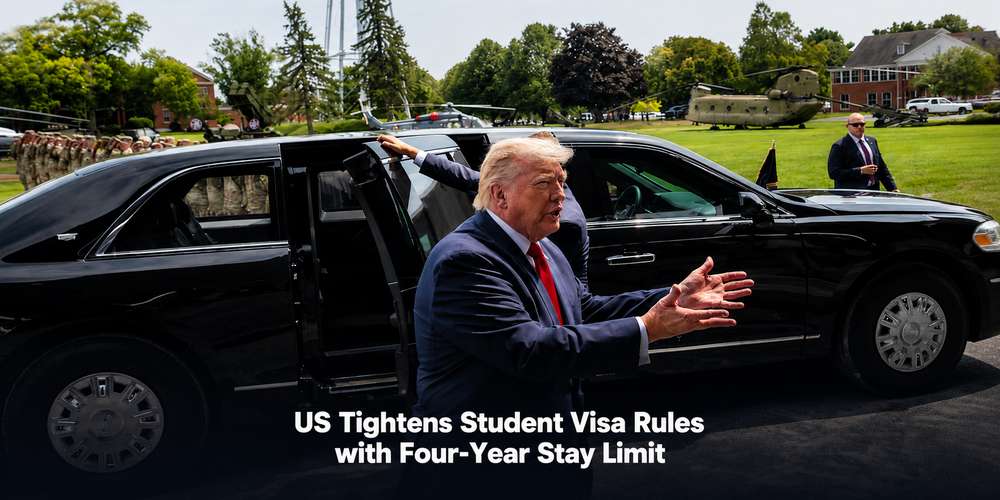
US Limits International Student Stay to Four Years Under New Visa Rule
New US visa rules will limit most international students and introduce new academic programme restrictions.
The United States is set to introduce significant changes to its international student visa framework after the Department of Homeland Security (DHS) finalised a new rule limiting most international students to a maximum stay of four years unless they obtain government approval for an extension.
The revised regulation, which comes into effect in September 2026, marks a major departure from the long-standing "duration of status" system that allowed students to remain in the US until they completed their academic programme.
The policy is expected to affect thousands of international students pursuing undergraduate, postgraduate, doctoral, and professional degree programmes across American universities.
What Is Changing?
Under the new rule, eligible international students will initially receive permission to remain in the United States for up to four years. Students whose programmes extend beyond this period must apply for an extension through the federal government.
The regulation also introduces additional controls over academic progression, including restrictions on changing majors or switching academic programmes without meeting updated visa requirements.
Previously, international students admitted under F-1 visas could generally remain in the country for the full duration of their approved academic programme, regardless of whether it exceeded four years.
Key Changes at a Glance
Current System | New Rule (From September 2026) |
Stay permitted until programme completion | Maximum initial stay limited to four years |
Flexible programme duration | Government approval required for extensions |
Greater flexibility to change academic programmes | New restrictions on changing majors or programmes |
Duration based on academic progress | Fixed visa validity with renewal process |
Government Says Rule Strengthens Oversight
According to the Department of Homeland Security, the revised policy is intended to strengthen oversight of international student visas and close what it describes as loopholes that allowed some students to extend their stay indefinitely.
DHS Secretary Markwayne Mullin stated that establishing fixed visa durations would improve the government's ability to screen, monitor, and manage international student admissions while ensuring students remain focused on completing their education before returning to their home countries.
Universities Raise Concerns
Higher education organisations have criticised the policy, arguing that it creates additional administrative work for universities, students, and federal agencies. The Presidents' Alliance on Higher Education and Immigration said international students are already among the most closely monitored non-immigrant groups in the United States and questioned the need for additional restrictions.
Education leaders also warned that programmes such as doctoral degrees, medical education, engineering, architecture, and research-based qualifications frequently require more than four years to complete, making extensions unavoidable for many students.
Part of Broader Immigration Changes
The revised student visa policy follows a series of immigration measures affecting international students in recent years. These include increased visa screening, mandatory disclosure of social media accounts during visa applications, and expanded travel restrictions affecting applicants from several countries.
The latest changes arrive amid a decline in international student enrolment, prompting concerns among universities that increased regulatory uncertainty could discourage students from choosing the United States for higher education.
Since international students often pay full tuition fees and contribute significantly to research and innovation, institutions warn that the policy may have wider implications for the country's higher education sector and economy.
Why This Matters
The United States remains one of the world's most popular destinations for international education. Introducing a fixed four-year limit on student visas represents one of the most significant changes to US immigration policy for higher education in recent years. While the government views the move as a way to strengthen oversight, universities fear it could create uncertainty for students enrolled in longer academic programmes and influence future international enrolment trends.
Editor's Note
Student mobility has become increasingly competitive, with countries worldwide revising immigration policies to attract global talent. The United States' decision to impose fixed visa durations reflects a stronger emphasis on immigration control, but it also raises important questions about balancing national security with academic openness. As students weigh study destinations more carefully than ever, policy stability and flexibility are likely to play an increasingly important role in global higher education.
Frequently Asked Questions (FAQs)
1. What is changing in the US student visa policy?
International students will generally be allowed to stay in the US for a maximum of four years unless they receive government approval to extend their visa.
2. When will the new rule take effect?
The revised rule is scheduled to come into effect in September 2026.
3. Who will be affected by the new policy?
Most international students studying in the United States under eligible student visas, including those enrolled in programmes lasting longer than four years.
4. Will students in longer degree programmes need a new visa?
Students whose academic programmes extend beyond four years will need to apply for government approval to continue their studies.
5. Can international students still change their major?
Yes, but the new rule introduces additional restrictions and requirements for changing majors or academic programmes.
6. Why has the US government introduced this rule?
The Department of Homeland Security says the change is intended to improve visa oversight, strengthen monitoring, and prevent misuse of student visas.
7. Why are universities concerned about the new policy?
Higher education institutions believe the rule will increase administrative burdens and create uncertainty for students enrolled in longer academic programmes.
8. Could the new rule affect international student enrolment?
Education leaders believe the policy could discourage some students from choosing the United States and increase competition from other international study destinations.

Skoobuzz

 Skoobuzz
 Skoobuzz
 Skoobuzz
 Skoobuzz


0 Comments (Please Login To Continue)