








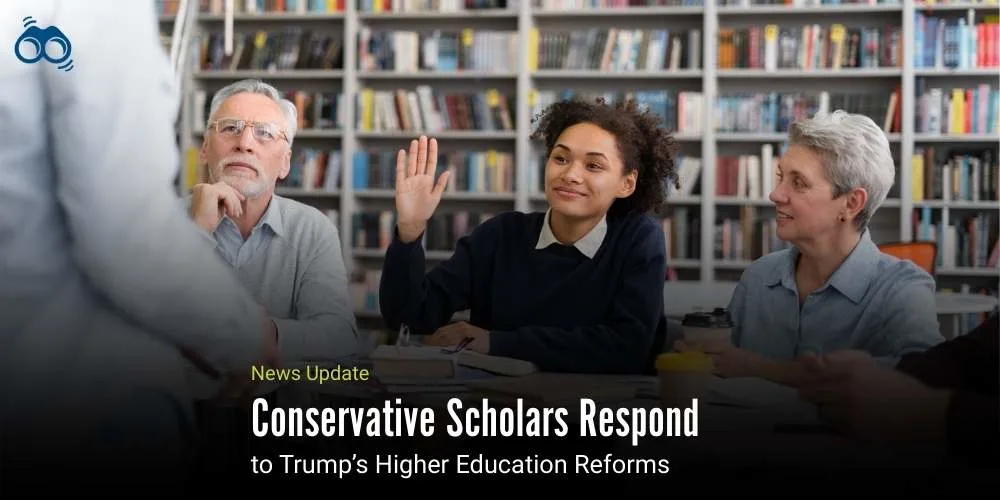
Admissions Equality and Campus Speech at Heart of Trump Higher Ed Plan
Trump Compact for Universities Promises Federal Funding with Strict Conditions
In October 2025, the Trump administration announced the Trump higher education compact, more formally called the Compact for Academic Excellence in Higher Education proposal. Commentators clarified that this agreement was initially forwarded to nine selective institutions, with eight priorities detailing campus speech, costs, culture, and conduct, in return for the promise of federal funds for universities that play ball, with preferential consideration to those who signed on.
Key Commitments:
Commentators noted that the Trump compact for universities required that signatories commit to various measures, including but not limited to, barring all consideration of race, sex, and nationality in admissions and hiring; freezing undergraduate tuition for five years; and making tuition-free for students in hard science programs enrolled in rich institutions.
Other provisions were an international student cap on US universities, disclosure of foreign funding, screening international students for hostile intent, and "marketplace of ideas" by abolishing or modifying campus units that punish conservative thought. But according to the compact, one had to define male and female in biological terms, organize facilities and sports accordingly, and combat grade inflation. Analysts explained that this sums up to a Trump compact admissions policy banning race gender 2025, raising many equal opportunities questions in US university admissions.
Reactions and Debate:
The compact received flak and praise. Its priorities were welcomed by supporters, while critics warned of federal overreach. Commentators said that its most important effect was creating controversy on the longstanding relationship between universities and the federal government. However, they indicated the US higher education compact 2025 with problems but left many practical questions about how to measure priorities or what financial preferences federal officials were legally empowered to offer.
Context of Reform:
Observers would say that US higher education reform 2025 had to be because universities had, in recent years, trampled free inquiry, followed ideological projects on race and gender, and continued race-based admissions despite civil rights laws. Along with that, these institutions had built overreaching cost structures, maligned conservative thought, and sullied their reputation. The Trump administration had already had investigations, lawsuits, and executive actions, described as patchy and sometimes legally dubious.
Legal and Practical Concerns:
Experts maintained that one of the major inadequacies of the compact was that a number of provisions in it had no statutory support. They observed that there was no clear legal authority for the executive branch to condition such expenditures like Pell Grants or NIH research funding on such stipulations. This raised the question of whether US colleges would lose federal funding under the Trump compact and how enforcement would work.
Proposals for a Way Forward:
Conservative higher education thinkers were asked to provide solutions. Their proposals tended to be admissions reforms, ways to preserve campus speech freedom compact, enhancing federal antidiscrimination laws, bettering institutional neutrality, fighting grade inflation, or using immigration law to enforce the international student cap under Trump higher ed plan. Some others suggested easier areas to reduce college costs and hold them responsible.
Broader Implications:
Commentators would present that the impact of international student cap under Trump higher ed plan and other measures can alter the face of the sector. They would say that higher-education policy shift America, 2025 is not about presenting a single agenda but asks what lawmakers should do to reset the relationship between universities and taxpayers.
The details of Trump higher education compact 2025 revealed ambitions and limitations. The terms summation for the compact for academic excellence suggests bold promises but legal and operational gaps exist. Analysts emphasized that any lasting reform must be rule-of-law consistent, practically workable, and ideally have university backing. Criticism and controversy surrounding Trump compact universities might continue, but what's noteworthy is the opening of debate on serious reconsideration of United States university funding reform 2025 and higher education governance in the future.
Editor’s Note:
The Trump higher education compact, announced in October 2025, has reignited debate on how American universities work with the federal government. Sent to nine selective institutions, it set out eight priorities on campus speech, costs, culture, and conduct, offering preferential access to federal funds for those that signed. The compact asked universities to ban consideration of race, sex, and nationality in admissions and hiring, freeze tuition for five years, and make hard sciences tuition‑free at wealthy institutions. It also proposed an international student cap, disclosure of foreign funding, screening of international students, reforms to protect conservative thought, defining male and female in biological terms, and tackling grade inflation. Analysts said these measures raised questions about equality in admissions and legal authority. Reactions were mixed: supporters welcomed the priorities, while critics warned of federal overreach. Experts noted that many provisions lacked statutory support, creating uncertainty about enforcement and funding. Conservative thinkers suggested remedies such as admissions reform, stronger anti‑discrimination laws, safeguarding campus speech, and using immigration law to enforce student caps.
Skoobuzz mentions that the compact has created not only controversy but also opportunity. It has forced a reassessment of US university funding reform 2025, highlighting governance, accountability, and the future direction of higher education.
FAQs
Q1. Does Donald Trump have a higher education degree?
Yes. Donald Trump graduated in 1968 with a Bachelor of Science in economics from the Wharton School of the University of Pennsylvania. He has also received several honorary doctorates, though some were later rescinded.
Q2. Which colleges were asked to sign the Trump higher education compact?
The compact was sent to nine selective institutions in October 2025. These included the University of Arizona, Brown University, Dartmouth College, MIT, University of Pennsylvania, University of Southern California, University of Virginia, Vanderbilt University, and the University of Texas at Austin.
Q3. Which president has the highest level of education?
Woodrow Wilson is the only US president to have earned a PhD (Political Science, Johns Hopkins University). He is widely regarded as the most formally educated president. Other presidents, such as Bill Clinton and Richard Nixon, also held advanced degrees, but Wilson remains unique in holding a doctorate.
Q4. Will US universities lose funding if they reject the compact?
Universities that refuse to sign the Trump higher education compact 2025 risk losing preferential access to federal grants and research funding. However, experts noted that many provisions lack statutory authority, meaning the legal basis for cutting funds is uncertain. Several universities, including MIT, Penn, and Dartmouth, have already rejected the compact.
Q5. Which president did not have a degree?
Several US presidents never earned a college degree. Andrew Johnson had no formal education, and Harry S. Truman was the last president without a college degree. In total, 12 presidents did not graduate from college, though most modern presidents have at least a bachelor’s degree.

Skoobuzz

 Skoobuzz
 Skoobuzz
 Skoobuzz
 Skoobuzz
 Skoobuzz


0 Comments (Please Login To Continue)