








Top UK and Australian Universities Launch Joint Centre for Doctoral Training in Security and Resilience
Cranfield University Among Founding Members of Advanced Skills Alliance Under UK‑Australia Geelong Treaty
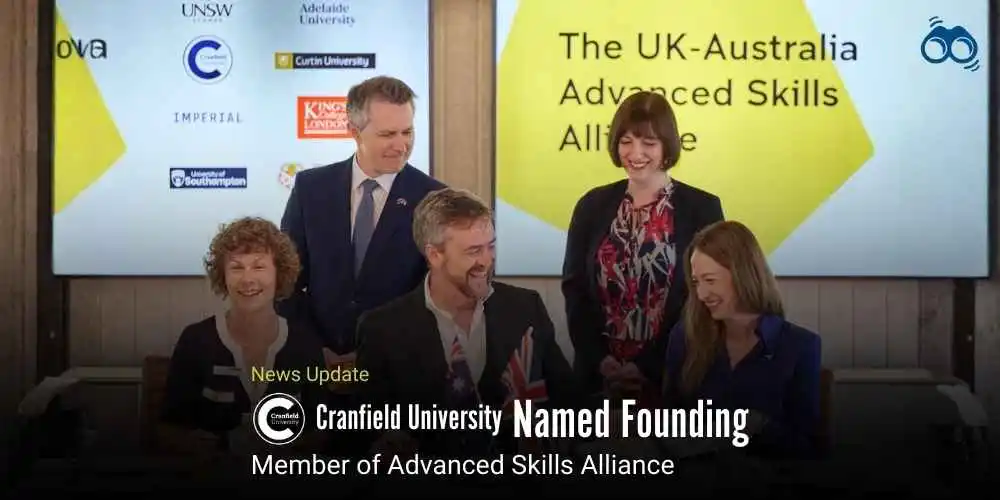
Cranfield University was named as one of the founding partners of the new Advanced Skills Alliance, which brings together top universities in the UK and Australia. The new partnership was established to accelerate skills and innovation in security, defence, and resilience as part of the AUKUS university innovation pact between the UK and Australia.
It was clarified that Education Secretary Bridget Phillipson and Jason Clare, Australian Education Minister, had travelled to UNSW Sydney to sign this historic UK‑Australia Geelong Treaty on education. According to officials, “The Advanced Skills Alliance is informed by the Geelong Treaty and will help to deliver an innovation programme as part of AUKUS, as both governments have plans to ensure a highly skilled workforce to meet future defence and security objectives.” As per the Education Secretary, the key aspects that were considered the backbone of the AUKUS alliance were education and innovation. The Education Secretary further highlighted that through collaboration, the UK and the Australian government were investing in the security, technology, and people of the future.
Partnership in Providing Essential Skills
One of the main projects initiated by the UK‑Australian universities innovation partnership is the establishment of a UK‑Australia Centre for Doctoral Training on security and defence doctoral training UK and Australia. The doctoral candidates will pursue research in nuclear engineering, systems design, and cybersecurity and have the opportunity to spend a maximum period of 12 months in the partnering country. It is anticipated to forge long‑term links between the education, defence, and security communities in the two countries.
The Alliance will also work together on education and workforce training. The plans involve short courses, micro‑credentials, and curriculum development to satisfy the requirements of the Nuclear Powered Submarine Partnership and the AUKUS Agreement. It was observed that this is part of the general movement of education and innovation collaboration within the AUKUS arrangement, which covers higher education, curriculum micro‑credentials, and the development of the workforce.
Cranfield’s Role in International Collaborations
Cranfield University is already providing specialist‑level training in Australia. There was a remark that specialists at Cranfield had co‑delivered an Air Safety Investigation Course with partner MEMKO. This was delivered to the military and civil investigators. This was supported by Professor Dame Karen Holford, Chief Executive and Vice‑Chancellor at Cranfield. There was an explanation of the importance of enhanced international collaboration in providing skills, growth, and innovation in the face of global threats. Additionally, the scholar noted that Cranfield was pleased to contribute reliable expertise, specialised facilities, and industry insight within the collaborative group.
Industry Involvement
One of the characteristics of the “new” agreement is the extent to which the industry is involved. Memorandums of understanding have been produced by the partner universities in collaboration with the two governments, together with organisations including the Australian Submarine Agency, Austal, Babcock International, BAE Systems, and Rolls‑Royce. This is a reflection of the recognition of the value of collaboration between the higher education sector and the defence industries in producing innovation.
The Alliance Members are a collection of top institutions both in the United Kingdom and Australia, and are brought together through the AUKUS university innovation pact. From the United Kingdom, the institutions are represented by Cranfield University, known for its defence and security knowledge, and then King’s College London, Imperial College London, University of Southampton, and University of Strathclyde. In Australia, the institutions are represented by UNSW Sydney, Curtin University, and Adelaide University.
These universities together make up the Advanced Skills Alliance and use their skills in research and education for the support of security, defence, and resilience. This partnership among the universities in the UK and Australian universities in innovation can be used to develop PhD research and partnerships with industries for the benefit of both countries in building the required skills for the future.
Together, these institutions comprise the best Australian and UK universities, signing the AUKUS innovation pact to support security, defence research and skills development in 2025. The Alliance will obtain funding support from both the Australian and UK governments, as well as industry players, to enable them to achieve their set goals, thus illustrating the role of the Advanced Skills Alliance AUKUS universities.
Editor’s Note:
The establishment of the Advanced Skills Alliance in terms of the university innovation pact UK-Australia signifies historic collaboration to reinforce links between top universities in both nations. Through this collaboration, the UK and Australia are laying a solid foundation to enable future security, defence, and resilient protection. Looking ahead, much good work will come out of this partnership. The advanced knowledge that students will acquire through the jointly run UK‑Australia Centre for Doctoral Training will include, but not be limited to, nuclear engineering, systems design, and cybersecurity. Doctoral students taking advantage of a stay of up to twelve months in the partner country will acquire not only knowledge but also engender a lifelong partnership between the educational, defence, and security sectors of both countries. The Alliance will also benefit the wider workforce. Short courses, micro‑credentials, and a new curriculum will be introduced to meet the needs of the AUKUS Agreement and the UK‑Australia Geelong Treaty education partnership. This means that apprentices, professionals, and industry experts alike will have access to training related to the requirements of the future. Another advantage that the collaboration offers the students is the strong industry engagement. Organisations such as BAE Systems, Rolls‑Royce, and the Australian Submarine Agency are already involved in the collaboration. Such engagement will help the students transition easily to the job market, to help in the promotion of national security and technological development. Universities will have opportunities for facility and expertise sharing as well as research collaborations through this alliance. Universities like Cranfield University, AUKUS research partnership, King’s College London, Imperial College London, UNSW Sydney, Curtin University, and Adelaide University will pool resources together to offer innovation and skill development opportunities to people. It will result in the development of a highly skilled workforce equipped to meet international challenges.
Skoobuzz underlines that the AUKUS universities of the Advanced Skills Alliance will offer future gains for further improvements in the realm of education, collaboration, and development of secure and resilient environments by both nations. It is a partnership created for the advancement of people, technology, and future cooperation to ensure that the UK and Australia lead the way in defence and innovation.
FAQs
1. What are the Big 7 universities in Australia?
The term usually refers to the leading institutions that attract international students and rank highly in global tables. These include the University of Melbourne, University of Sydney, Monash University, Australian National University (ANU), UNSW Sydney, University of Queensland, and University of Western Australia (UWA). Together, they are part of the prestigious Group of Eight and are recognised for their strong research and teaching.
2. Which university is best for AI in Australia?
The University of Sydney is ranked as the top institution in Australia for Artificial Intelligence research, standing first in Oceania and among the top 100 globally. Other strong performers include the University of Technology Sydney, Monash University, and the University of Adelaide.
3. What are the major innovations in Australia?
Australia has contributed several world‑changing inventions. Notable examples include the black box flight recorder, plastic banknotes, Google Maps technology, the dual‑flush toilet, and advances in renewable energy and medical research. These innovations highlight Australia’s role as a hub for practical problem‑solving and global impact.
4. What is the fastest-growing university in Australia?
Flinders University has been described as Australia’s fastest-growing research institution, rising 44 places in the 2025 QS World University Rankings. Its research growth has increased by over 140% in five years, while maintaining strong teaching quality.
5. Which university in Australia has the most Indian students?
The University of Melbourne is often cited as the institution with the largest number of Indian students, thanks to its breadth of courses in engineering, business, data, biomedical sciences, and the arts. Other universities with significant Indian student populations include Monash University, UNSW Sydney, and the University of Sydney.

Skoobuzz
 Skoobuzz

 Skoobuzz



0 Comments (Please Login To Continue)