








Universities Warn of Financial Shock as Indian Enrolments Decline
Graduate Route Uncertainty Weakens UK’s Appeal to Indian Graduates
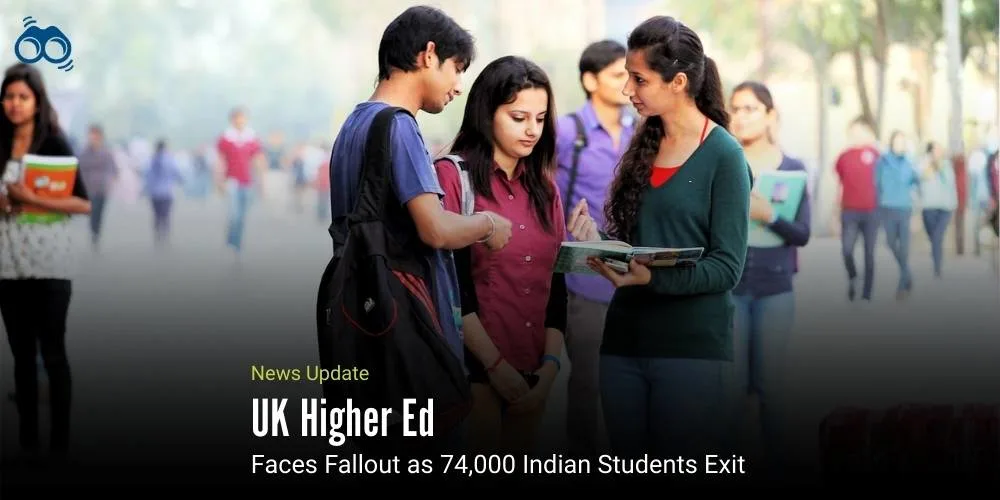
The tightening of the UK’s visa regulations is causing extensive consequences, as new data from the Office for National Statistics indicates that 74,000 Indian students left the UK in the year ending June 2025. This has led to rising concern that restrictive new rules and uncertainty surrounding the post-study visa could damage the UK's largest international student source. Analysts stated that many universities, particularly those outside the Russell Group, rely hugely on income from international fees, and that the UK student visa rules 2025 may, at a huge cost, alter global student mobility.
Visa Curbs and Dependant Ban
Experts noted that recent immigration changes have influenced the decision by Indian students to leave. The UK dependent visa ban for students, which was enforced in January 2024, disallowed most postgraduate students from bringing their families along. This led to an 86 per cent fall in dependent visa applications and a drop of 11 per cent in new Indian student visa applications. Dr Christopher Abraham from SP Jain School of Global Management explained that the reason families would want to be together has been weakened long‑term by the stricter UK higher‑education visa rules. Reports confirmed around 45,000 Indian study‑visa holders were among those who exited, demonstrating how family barriers and policy uncertainty are reshaping enrolment behaviour.
Universities Fear Financial Shock
Insiders warned of an impending financial disaster if Indian students are further punished by UK entry restrictions. While universities offer strong academic programmes, budgets are frequently counterpoised by dependent students' fees. Constant falls in Indian students might cause imbalances, leading to retrenchments or even the closure of some courses. The UK universities rely on international fees, and the loss of one of the largest cohorts can be damaging, analysts state.
Students Shift Preferences Abroad
Commentators observed that Indian student migration trends to the UK are fast-changing. The unpredictability of UK immigration policy is steering Indian student applicants toward clear post-study pathways in other nations. Longer work rights and routes to residency have favoured Australia. The easy availability of visas, the setting up of industry-linked campuses, and proximity to India have increased interest in Dubai. The US, Germany, Ireland, and parts of the EU have started being regarded as more stable in terms of their immigration frameworks compared to the UK Home Office student visa regulations, thus drawing in more students.
Graduate Route Uncertainty
Speculation over changes to the UK Post-Study Work visa, including shortening the Graduate Route and raising Skilled Worker salary thresholds, has kicked up a certain level of worry. Families noted that the attractiveness of post-study work is a game-changer. Dr Abraham stated that the uncertainty around the two-year stay-back option is making plans difficult and is therefore pushing students towards countries that have predictable rule systems. This indicates that the changes in the UK post-study work rules are affecting the Indian graduates and their long-term decisions.
Throwing a lot of shade at the government, certain industry experts think the ripple effects of the UK study visa restrictions 2024-2025 might have been underestimated. Through the deterrent effect of Indian students-who contribute so much to tuition revenue, diversity, and the workforce UK risks eating deep into its own university sector and weakening its talent pipeline. The consequences of UK visa restrictions on global student mobility had now become conspicuous, with thousands of Indian students returning from the UK in 2025.
What Needs to Change
Dr Abraham and others suggested that more serious measures will be required to restore trust. They suggested recommitting to a stable two-year Graduate Route (three years for PhD graduates), avoiding frequent policy changes, rethinking the dependent ban for taught Master’s programmes and ensuring that the Skilled Worker salary thresholds are realistic. They also suggested working on strong promotion and communication around high-skill visa pathways such as Global Talent and HPI routes. According to analysts, such steps would furnish reassurances to students and universities, helping stabilise inflows after an incredibly turbulent time.
Editor’s Note:
It is a grave moment for UK higher education. Recent data shows that many Indian students are exiting, with the stricter visa regulations, the dependence ban being the foremost consequence, being factored in with powerful consideration in decision-making. Therefore, the UK seems to be losing its most significant international student pipeline, adding pressure on its already cash-strapped universities. The signals are clear. When families do not come, demand goes down. Whenever the Graduate Route seems to be on shaky ground, confidence sinks. Together, these developments are nudging students toward destinations where rules appear more certain and post-study pathways are clear. Australia and Dubai are the gainers here; parts of the EU, the US, Germany, and Ireland have assumed safer dispositions. This is a direct challenge to the UK’s competitiveness. The truth is, there is a financial risk. Any further drop in Indian enrolments could render mid-order universities without the capability to continue, laying off staff and closing down useful courses. This would erode the diversity and merit of Australian higher education. These are no longer abstract considerations; these touch students in classrooms, research, and local economies. But the way forward is very much feasible. The stability is paramount. A firm two-year Graduate Route (three years for PhD), realistic thresholds for the Skilled Worker route, and smart communication could rebuild confidence. An honest look at the dependent ban for taught Master’s students would support family planning. More clarity and simpler navigation through the Global Talent and High Potential sectors requires greater guidance.
Skoobuzz mentions that to maintain the UK's appeal as the top destination for ambitious, skilled Indian graduates who offer long-term value, policy must foster predictability for students and stability for universities. This, in turn, will rebuild trust.
FAQs
Q1. What are the rules for student immigration in the UK?
The UK student immigration rules require applicants to hold a valid Confirmation of Acceptance for Studies (CAS) from a licensed university, prove financial ability to pay tuition and living costs, and meet English language requirements. Since 2024, most postgraduate students are no longer allowed to bring dependents, and visa refusal rates are closely monitored under the Home Office’s compliance system.
Q2. Can Indian students get permanent residency (PR) in the UK?
Indian students can apply for permanent residency, but only after completing a longer pathway. Typically, students first use the Graduate Route to work for up to two years (three years for PhD graduates). They may then switch to a Skilled Worker visa if they secure a qualifying job. After five years of continuous lawful residence, they can apply for Indefinite Leave to Remain (ILR), which is the UK’s form of permanent residency.
Q3. How many years can we stay in the UK with a Student visa?
A UK Student visa normally allows students to stay for the full duration of their course. For undergraduate degrees, this is usually three years, while postgraduate taught courses are typically one year. Doctoral students may be granted up to four years. After studies, graduates can apply for the Graduate Route, which permits a further two years of stay (three years for PhD holders).
Q4. How many Indian students left the UK in 2025?
According to the Office for National Statistics, around 74,000 Indian students left the UK in the year ending June 2025. Reports confirmed that about 45,000 of these were study visa holders. Analysts explained that stricter rules, including the dependent ban and uncertainty around post‑study work visas, were key reasons behind this trend.

Skoobuzz

 Skoobuzz
 Skoobuzz
 Skoobuzz
 Skoobuzz
 Skoobuzz


0 Comments (Please Login To Continue)