








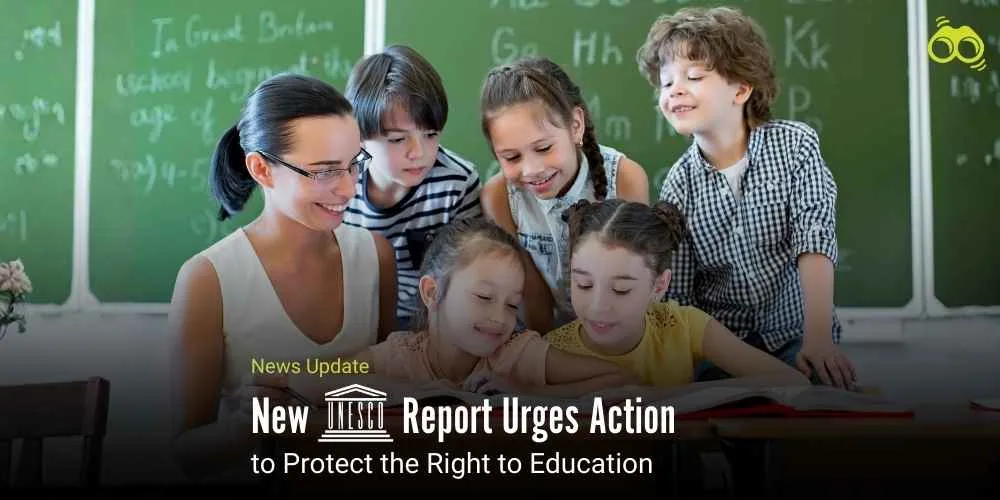
Right to Education at a ‘Decisive Moment’, UNESCO Says in New Global Assessment
UNESCO Marks Human Rights Day with Major Review of Global Education Rights
To commemorate Human Rights Day, UNESCO presented a global report on the right to education on the 65th anniversary of the Convention against Discrimination in Education. The global report on the right to education specifically highlights the progress made in the last 25 years, which was presented at an international symposium on the right to education on 9 December. UNESCO specifically mentioned that currently we are facing challenges such as digitalisation, climate change and inequality.
UNESCO has also shown that the right to education is among the most widely recognised rights, but it is also belongs of the most recently and least defended rights. It should be noted that most rights related to the right to education were formulated in the 1960s; therefore, there is a gap within education and global challenges which should be met. The review on UNESCO Education Rights in 2025 emphasized on the possibility to bridge these gaps based on a commitment with better and more specific legal frameworks, and permanent financing based on a commitment with better and more specific legal frameworks.
Advances During the Previous 25 Years
Despite these challenges, there have been major breakthroughs since 2000, as documented in UNESCO's global report on the right to education. Access to primary schools has become universal, with more countries offering free education. The statistics illustrated in UNESCO's report show an increase from 56% support for free primary and secondary education for more than nine years among 2023 nations as compared to 2000. Some regions, especially Sub-Saharan Africa, have made great progress, as UNESCO reports. The enrolment rate at lower secondary levels rose from 25% in 2000 to 46% in 2020, and at the primary level from 79% in 2000 to 97% in 2024. The progress made here illustrates that the status of global recognition with regard to the right to education continues to develop within low-income nations.
Moreover, it was also included that there was more than a doubling of participation in higher education, from 100 million in 2000 to 264 million in 2023. As per UNESCO, progress in other related areas, like reduced adolescent pregnancy rates, child labour, and child marriage, has also enabled more children to complete their education. As per UNESCO, these developments form the major findings of the 2025 UNESCO report on the right to education.
UNESCO pointed out that despite progress made, there remain large inequities. As of 2023, there were 272 million children out of school. Less-developed countries are still lagging, as evidenced by the UNESCO report on equity in education. UNESCO reports that just 3 per cent of school-aged youth are enrolled in school within the wealthiest nations, compared with 36 per cent who are not attending school within the poorest nations. A large percentage of these out-of-school children are from sub-Saharan Africa and Central and Southern Asia.
UNESCO also projected that there were 739 million people who still do not have basic reading and writing skills, despite an increase in literacy rates compared to 2015. Vulnerable groups, including rural children, girls, immigrant children, and children with disabilities, are most impacted as a result of these challenges. UNESCO also noted that budget constraints are obstructing progress and preventing the fulfilment of SD Goal 4. Digitalisation presents opportunities and threats as it continues. While there will be greater access enabled by new technologies, if there isn’t digital literacy or infrastructure, it will lead to an intensified gap. Again, it reinforces the theme as it relates to challenges as put forth in UNESCO’s latest report on the right to education.
Role of UNESCO in Promoting Education as a Human Right
UNESCO stated that for more than 60 years, it has been promoting and defending the right to education worldwide. In 1960, the Convention included the commitment to free and compulsory primary education and the consecutive secondary education. Furthermore, it should be salient that the 2019 Global Convention on Recognition of Higher Education Qualifications has established a global framework for the automatic recognition of higher education qualifications.
The organisation also mentioned its Initiative on the Evolving Right to Education, launched in 2021. The initiative seeks to ensure that the challenges of digital education, climate change, and inequality do not hinder the right to education. The current report is a significant step in this direction.
Common Global Pledges towards the Future
UNESCO pointed out that it benefits from its international symposium because governments, society, youth, and international and research communities get an opportunity to review progress and seek solutions. It fosters global cooperation and emphasises cooperation and collective responsibility for better educational opportunities for all. According to UNESCO, these consultations and dialogues improve partnerships that will be vital for informing future policy and actions on a global education agenda beyond 2030.
As a contribution to this end, UNESCO encouraged stakeholders to read the report, access the summary on the UNESCO report on education rights, and make use of the data and graphs provided. Users are also capable of downloading documents and signing up for upcoming UNESCO reports on education, as well as purchasing publications. UNESCO made it clear that it is only with a collective commitment that the right to education would be ensured.
Editor’s Note:
UNESCO's newest global report on the right to education, released on Human Rights Day, is both a harbinger of progress and a warning. It also marks the 65-year milestone of the 1960 Convention against Discrimination in Education, a treaty reminding us that while education has been recognised as one of the basic human rights, it remains one of the most poorly defended. Much of the legal framework exists from the 1960s and creates a gap from today's challenge-digitalisation, climate change, and inequality, the protection it should provide. It reveals that the past 25 years have seen some real gains: almost all children now start primary school, more countries offer schooling for free, and Sub-Saharan Africa - once significantly lagging - has greatly surged forward in enrolment. Tertiary education has also expanded quickly, standing at over twice as many students as in 2000. Social changes - fewer child labourers and child brides - have helped more students complete their studies. Despite educational progress, sharp inequalities were also noticed as 272 million children, specifically from the African and Asian regions, are not attending school, and 739 million adults and youth remain illiterate. Moreover, vulnerable groups of girls, rural children, and immigrants are also facing barriers. However, UNESCO’s commitment to ensuring that the right to education remains relevant to contemporary realities is reflected by its 2021 initiative on the right to education. This new report calls on the government and partners to renew their commitment with stronger laws, accountability and financing.
Skoobuzz underlines that through this symposium, the message is loud and clear: left without renewed global effort, millions would continue to remain excluded from learning. Protection of the right to education is more than about schools; it's about equity, opportunity, and the future of societies across the world.
FAQs
1. What is the right to education UNESCO?
UNESCO explains the right to education as a basic human right. It means that everyone, no matter their background, should have free and fair access to learning. This includes primary, secondary, and higher education, as well as equal chances for vulnerable groups such as girls, rural children, and students with disabilities.
2. What does the UNESCO report say about education rights?
The 2025 UNESCO report says that education has improved in the last 25 years, with more children going to school and more countries offering free education. However, it also warns that millions of children and adults are still left out, and new challenges like digitalisation, climate change, and inequality are making education harder to protect.
3. How far has the right to education progressed worldwide?
Since 2000, significant progress has been made. Primary school access is now almost universal, and higher education enrolment has more than doubled. In places like sub-Saharan Africa, enrolment rates have risen sharply. Yet, in 2023, 272 million children were still not in school, showing that progress is uneven.
4. Why does UNESCO want renewed commitment to education rights?
UNESCO wants a stronger commitment because many of the laws protecting education are old and do not match today’s challenges. The organisation says countries need clearer legal frameworks, more accountability, and steady funding to make sure education rights are defended, especially in poorer regions.
5. When was the UNESCO Right to Education Report published?
The report was published on 9 December 2025, during the international symposium on the right to education, which also marked Human Rights Day and the 65th anniversary of the 1960 Convention against Discrimination in Education.

Skoobuzz

 Skoobuzz
 Skoobuzz


0 Comments (Please Login To Continue)