








University of Limerick Professor Wins UN PRME Teaching Award for Innovative Climate Education Programme
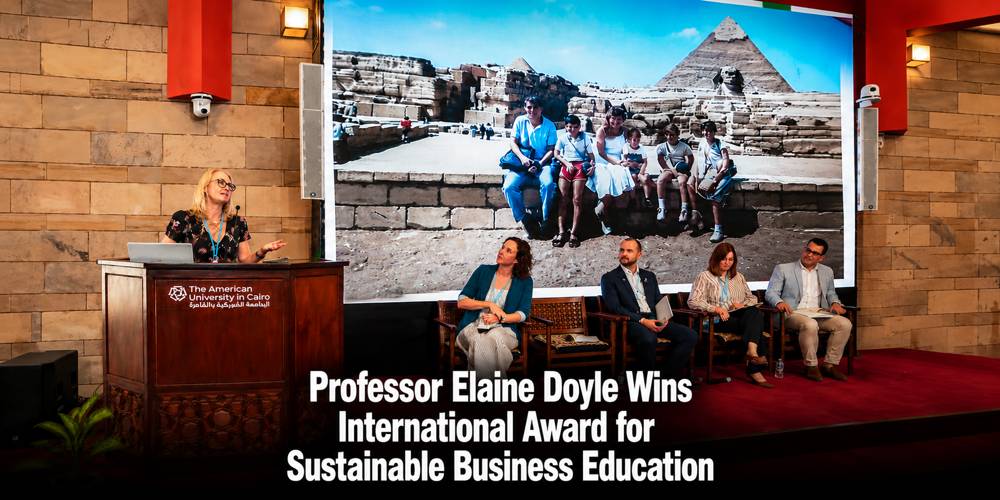
Professor Elaine Doyle received an award for an innovative climate education programme at the University of Limerick.
Professor Elaine Doyle, Professor of Taxation at the Kemmy Business School (KBS), University of Limerick, has received international recognition after winning the Pedagogy Award at the 2026 Principles for Responsible Management Education (PRME) Awards in Cairo, Egypt.
Presented under the United Nations-supported PRME initiative, the award celebrates outstanding contributions to responsible management education and recognises institutions that successfully integrate sustainability into business and management teaching.
Professor Doyle accepted the honour on behalf of the team behind CATALYST (Climate Awareness Through Active Learning for Young People and Students), developed alongside Dr Mary Curtin and Erin King.
Climate Education at the Heart of Business Learning
The award-winning CATALYST programme was introduced to the entire first-year business cohort at Kemmy Business School, reaching nearly 600 students.
Rather than teaching sustainability as a standalone topic, the initiative incorporated climate awareness directly into an accounting module, encouraging students to explore environmental challenges while developing collaborative learning skills.
Beyond climate literacy, the programme also created opportunities for first-year students to connect with classmates, helping them build relationships during their first weeks at university.
International Recognition for Experiential Learning
The PRME Awards recognised CATALYST for both its educational quality and its measurable impact on student learning. Accepting the award during the UN PRME Global Forum in Cairo, Professor Doyle described the recognition as a proud achievement for the entire team.
She explained that the workshops encouraged students not only to better understand climate change but also to engage with one another through shared learning experiences, reinforcing the value of collaboration alongside academic development.
A Childhood Journey Comes Full Circle
Receiving the award in Cairo carried special personal significance for Professor Doyle. As a child, she lived abroad while her father worked with the United Nations, and one memorable family trip to Egypt introduced her to the country's rich history and culture.
Her mother, a teacher, embraced a homeschooling approach centred on experiential learning. Before visiting historical sites, the family researched destinations, mapped locations, and documented their expectations. After returning, they reflected on their experiences through writing and discussion. Professor Doyle credits those early educational experiences with shaping her own philosophy as an educator.
Speaking during the PRME Awards, she reflected on how visiting the tomb of Tutankhamun as a child inspired her understanding that meaningful education is built through exploration, curiosity, and active participation rather than memorisation alone.
Global Recognition for Responsible Management Education
The 2026 PRME Awards recognised four winners selected from 43 submissions representing 22 countries, celebrating excellence across pedagogy, curriculum innovation, research, and academic development.
According to Dr David Steingard, Head of PRME, this year's award recipients demonstrate how thoughtfully designed education can prepare students to address complex global challenges while contributing to the United Nations Sustainable Development Goals (SDGs).
Why This Matters
As universities increasingly integrate sustainability into teaching, initiatives such as CATALYST demonstrate how climate education can be embedded across traditional business disciplines rather than taught in isolation. The programme also highlights the growing importance of experiential learning, where students develop practical skills, critical thinking, and collaboration through active participation. Such approaches are becoming central to preparing graduates for rapidly evolving global and workplace challenges.
Editor's Note
Recognition at the PRME Awards reflects a broader shift in higher education toward learning experiences that connect academic knowledge with real-world challenges. Professor Elaine Doyle's work illustrates how innovative teaching can foster both subject expertise and social responsibility, ensuring students graduate not only with technical knowledge but also with the skills and perspectives needed to contribute meaningfully to a more sustainable future.
FAQs
1. Who is Professor Elaine Doyle?
Professor Elaine Doyle is Professor of Taxation at the Kemmy Business School, University of Limerick, Ireland.
2. What award did Professor Doyle receive?
She received the 2026 PRME Pedagogy Award for designing and delivering an innovative climate education programme.
3. What is the CATALYST initiative?
CATALYST (Climate Awareness Through Active Learning for Young People and Students) is a learning programme that integrates climate education into business studies through experiential learning.
4. What are the PRME Awards?
The Principles for Responsible Management Education (PRME) Awards recognise excellence in embedding sustainability and responsible management practices into higher education.
5. Where were the awards presented?
The awards were presented during the UN PRME Global Forum in Cairo, Egypt.
6. Why is CATALYST considered innovative?
The programme combines climate education with business learning while encouraging collaboration, experiential learning, and student engagement during the transition to university.
7. How many institutions participated in the 2026 PRME Awards?
The awards received 43 submissions from 22 countries, with four overall winners recognised across different categories.
8. Why is experiential learning important in higher education?
Experiential learning encourages students to apply knowledge through real-world activities, strengthening critical thinking, collaboration, problem-solving, and long-term understanding beyond traditional classroom instruction.

Skoobuzz

 Skoobuzz
 Skoobuzz

 Skoobuzz
 Skoobuzz


0 Comments (Please Login To Continue)