








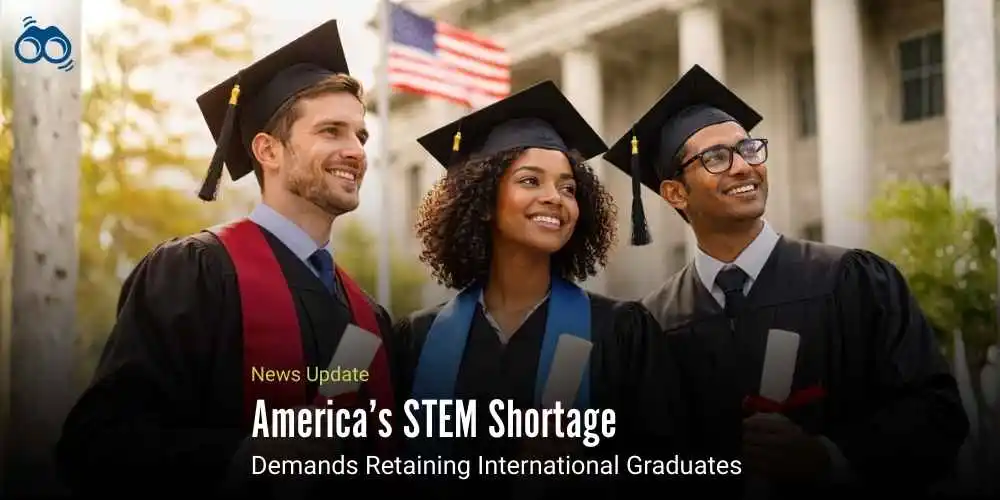
Temporary Visa Holders Account for 58% of Computer Science Doctorates in 2024
NSF Data Show International Students Earn Majority of Advanced STEM Degrees in the United States
America has, over decades, been perceived as a world leader in science, engineering, and technology, supported by some of the world's best universities and research institutes. However, the most recent data reveal that the overall growth of the STEM workforce hasn't translated into an increasing supply of U.S. citizens and permanent residents who enter these professions. According to the National Science Board's Science and Engineering Indicators, the number of workers in STEM occupations increased from 7.3 million in 2011 to 10.2 million in 2021, showing a remarkable rise in the creation of employment opportunities in the advanced industries.
However, the percentage of U.S. citizens going for graduate-level STEM was either stagnant or even fell during this period. Between 2012 and 2021, temporary visa holders earned between 25-40 per cent of all master's degrees in science and engineering and 33-35 per cent of doctorates. Advanced degrees predominantly belonged to international students in strategically important areas such as computer science and engineering. This change reveals a gaping imbalance: whilst the U.S. has witnessed growth in its STEM workforce by headcount, the domestic pipeline of scientists, engineers, and computer scientists is still not sufficiently robust to meet the needs of various sectors such as semiconductors, artificial intelligence, and advanced manufacturing. Consequently, the United States is becoming increasingly reliant on international graduates filling U.S. talent gaps, raising urgent questions regarding retention policies as well as long-term competitiveness.
The most recent NSF data on STEM degrees corroborated this dependence. Temporary visa holders earned most of the graduate degrees in STEM disciplines in the U.S. Analysts suggested that to retain international STEM graduates in the U.S. and bolster the workforce, policymakers need to establish an accelerated green card process for STEM graduates, particularly graduates in computer science and engineering.
The figures are eye-catching just the same. Temporary visa holders accounted for as much as 40 per cent of science and engineering master’s degrees and just over a third of doctorates between 2012 and 2021. In 2024, 58 per cent of all doctorates in computer and information sciences went to students with temporary visas, compared with 37 per cent awarded to U.S. citizens or permanent residents. In engineering, 51 per cent of doctorates went to temporary visa holders, compared with 44 per cent awarded to domestic students. The trend reinforces the fact that historically, international students at U.S. universities have been awarded a critical mass share of STEM degrees as to citizens or permanent residents.
Similar trends can be observed in AI-relevant disciplines. In the last five years, a report from the Council of Economic Advisers shows that non-U.S. citizens earned between 40 and 60 per cent of all AI-relevant master's degrees. Since 2003, more than half of all relevant doctorates have gone to non-U.S. citizens, with 59 per cent of AI-related doctorates given to them in 2022. This points to the contribution of international STEM talent to innovation and foreign-trained researchers in helping to build the U.S. innovation ecosystem.
Experts contend that policies keeping international STEM graduates in the U.S. after graduation would work directly toward a much-needed enhancement of the workforce during a time of incredible demand. Such an expedited green card pathway would enable the retention of these already trained people who have begun to make important contributions to domestic research laboratories, university programs, and industrial innovation activities. At the same time, retention measures would encourage more students to feel comfortable staying in the United States post-degree.
In common parlance, this is how the retention strategy of America's STEM talent is perceived: it is essential for global competitiveness. By tackling U.S. workforce shortages within the STEM area of specialisation, however, America can be sure that the international STEM graduates filling gaps in U.S. talent continue, in part, to spur the economy forward and sustain the lead of the U.S. in global technological competition.
Editor’s Note:
The gap in America's STEM workforce has not developed overnight. It is the result of gradual, slow development in the past decade as fewer U.S. citizens and permanent residents choose to pursue advanced degrees in science, technology, engineering, and mathematics. Those jobs grew significantly-from 7.3 million in 2011 up to 10.2 million in 2021-but the domestic pipeline of graduates has been slow to respond. It has created gaps in various industries: semiconductors, AI, and advanced manufacturing, to name a few. Stepping into this space are international students. Most of the master's and doctoral degrees in critical areas such as computer science and engineering now go to holders of temporary visas. In 2024, it seems almost six out of ten doctorates in computer and information sciences were awarded to international students. This is a sign of the power of American universities in attracting global talent and a weakness in holding on to sufficient domestic graduates. There has been a widespread debate over possibilities. One clear step would be to make an expedited green card pathway for international STEM graduates. Keeping highly skilled persons who are already trained, already working with research labs and innovation, and who would be readily available to add value to the workforce is a core benefit of such a policy for the United States. A long-term response must nevertheless include investment in domestic education as well as incentives for U.S. students to enter STEM. It opens a door for students from other countries. Given that the U.S. really wants skilled STEM graduates, international students who go to study there will have sizeable career paths ahead and, hopefully in time, even clearer pathways to stay and work in the country after graduation if things improve with its retention policies. In layman's terms, the gap in local talent has created an opportunity for learners from across the globe, thus marking the U.S. as one of the best places to study further as well as to build a future in science and technology.
As per Skoobuzz, America faces a dual challenge: it must simultaneously intensify efforts to cultivate a domestic STEM workforce while also welcoming and retaining international graduates to bridge a critical skills gap. Both actions are essential for the U.S. to maintain its global leadership in innovation and competitiveness.
FAQs
1.What percentage of people graduate from STEM degrees in the US?
Around 18–20 per cent of all U.S. bachelor’s degrees are in STEM subjects. At the graduate level, international students on temporary visas earn a large share: between 25–40 per cent of master’s degrees and 33–35 per cent of doctorates in science and engineering.
2.Will international students get a green card in the USA after graduation?
At present, international students do not automatically get a green card after graduation. They usually move from a student visa to work visas such as OPT or H‑1B. Policymakers have discussed an expedited green card process for STEM graduates, but this is not yet standard law.
3.Which country has the most STEM graduates?
India produces the largest number of STEM graduates in the world, followed by China. The United States has fewer in comparison, which is why it relies heavily on international students to fill gaps in its STEM workforce.
4.What is the hardest STEM career to get into?
Fields such as medicine, aerospace engineering, and advanced computer science (including artificial intelligence) are often considered the hardest STEM careers to enter. They require long years of study, high competition, and strong technical skills.
5. Do international students get jobs in the USA after graduation?
Yes, many international students do find jobs in the USA after graduation, especially in STEM fields. They often work under Optional Practical Training (OPT) or H‑1B visas. Employers in technology, engineering, and research sectors actively recruit international graduates because of the demand for skilled talent.

Skoobuzz
 Skoobuzz
 Skoobuzz
 Skoobuzz
 Skoobuzz
 Skoobuzz


0 Comments (Please Login To Continue)