








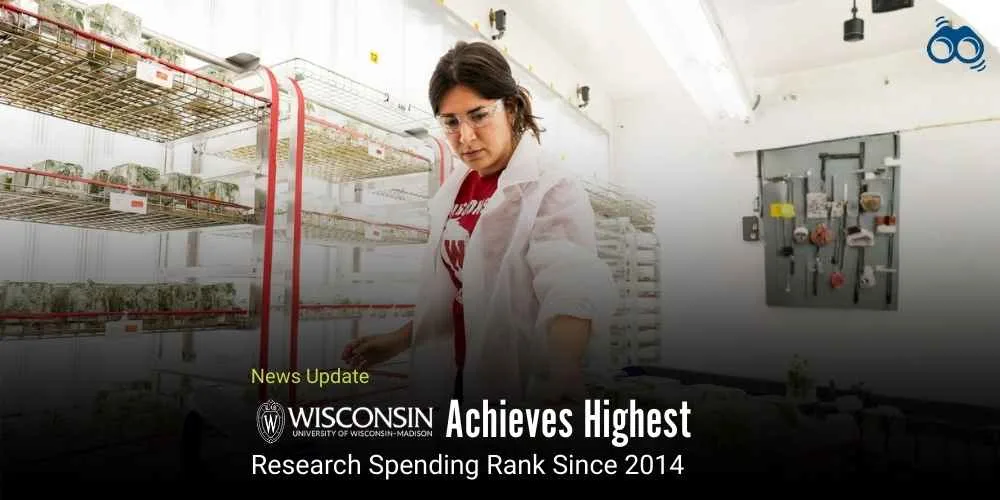
NSF HERD Survey Places UW–Madison Among Top U.S. Research Universities
University of Wisconsin–Madison Achieves Highest Research Ranking Since 2014
The University of Wisconsin–Madison has just been ranked fifth in the nation in expenditures on university research, its highest ranking since 2014. This latest update on the national research rankings for UW-Madison was based on the results of the National Science Foundation HERD survey, which measures research activity on America's universities. The survey indicated that the ranking was for research expenditures for the 2024 fiscal year, July 2023 to June 2024. It said that the survey judged how much money universities spent on funding research work and awarded UW–Madison a top national research university ranking in the USA, and reinforced its role in Wisconsin research university national ranking data.
University officials maintained the result was a milestone in its own right. "This is the highest HERD ranking the University has obtained in more than a decade," declared the Chancellor, with his addition: "Rankings do not really reflect anything about the value of research, but this outcome was made possible by our faculty, researchers, postdocs, and graduate students." He underscored that their work is at the very heart of creativity, innovation, and public benefit, yet again affirming UW-Madison's leadership in innovation and discovery. It is further noted that the ranking served to underscore the durability of the partnership between universities and the federal government-a partnership deemed critical in addressing national problems, fostering economic growth, and training students to enter the workforce. Hence, any impact research growth at UW-Madison has had in the domains of innovation and workforce development is regarded as consequential at both a state and national level.
Notwithstanding these advances, UW–Madison has made steady advancement in the recent past. In FY 2023, it ranked sixth and was eighth in 2022. There were, in total, 925 institutions surveyed, and using the current top-five ranking is a major milestone in the annals of UW-Madison research investments. HERD survey data indicated that UW-Madison research expenses had reached an all-time high in FY2024 at $1.93 billion, representing an increase of 11.6% over the last year. Such increases in university research funding were seen as an indication of a growing and resilient research enterprise in the state of Wisconsin, with Madison's research ranking USA.
Federal funding was essential for this growth. The next largest increase in federal research awards was at UW-Madison, with an increase of $114 million in one year, or 13.9 per cent, for ten universities, following the University of California, San Francisco. An increase from federal research grants was attributed largely to spending by the Department of Defence and the US Department of Agriculture, which elevated high performance in Higher Education Research and Development statistics. Close to one-half of the university's research funding has come from federal agencies, such as the National Science Foundation, National Institutes of Health, and Department of Energy. UW-Madison research funding sources will explain to research leaders, together with federal and industry support, institutional support, and philanthropic support.
The Vice Chancellor for Research reportedly stated that partnerships have always remained critical in UW-Madison's success, as articulated in the National Science Foundation's HERD survey ranking UW-Madison. Federal and university funds were said to be the foundation of research activity, while further support from state and local government, industry, non-profits, and private donors was deemed critical to the university's research enterprise. A few cases highlighted the strength of UW research partnerships with industry and government: The Grainger Institute for Engineering was shown as a key nexus where university researchers collaborated with federal agencies and the private sector on advanced materials, quantum sensing, artificial intelligence, and semiconductor research. This collaboration came out as a clear case in favour of UW-Madison research centres and their breakthroughs.
In agriculture, the Dairy Innovation Hub has been termed an organisation coordinating efforts among scientists, industry partners, and farmers. Reportedly, the endeavours strengthen productivity and regional resilience, corroborating the fifth position in the country that Midwest research universities enjoy. Funding from the non-profit sector has also been important. The two largest contributions from non-profits identified in support of innovation, technology transfer, and long-term research development were from the Wisconsin Foundation and Alumni Association and Wisconsin Alumni Research Foundation.
Linking several major research accomplishments with survey results included the building of the WHAM fusion energy device, the expansion of the Wisconsin Environmental Mesonet, and advances in crop biotechnology at the Wisconsin Crop Innovation Centre. Medical research had its mention as well, particularly NIH-funded research on 3D printed brain tissue and advances in traumatic brain injury prevention through the PANTHER programme.
It clarified that although the federal research funding conditions changed in 2025, the research expenditure measurements being used in the current HERD survey did not capture any data after June 2024. Any negative effect that would arise because of later policy changes would be captured in the next survey cycle. Research leaders concluded that this announcement served as a reminder on campus about the advantages of high research funding presented to universities, direct support for research-related costs, and infrastructure funding. They welcomed the strong result and stressed the fact that, in order to secure the future strength of the research enterprise at the University of Wisconsin-Madison, ongoing investment is needed.
Editor’s Note:
This really does represent a big win for the University of Wisconsin-Madison. Rating as number five in the United States for research spending, hitting a record of 1.93 billion euros ($1.93 billion) in FY2024, is proof of clear growth and steady progress over many years. From eighth position in 2022, it climbed to sixth in 2023, and then fifth in 2024: a demonstration of strong engagement with its research portfolio. And it is not only about funding. The university's relationships with federal agencies, state and local governments, industry, non-profits, and private donors clearly have been central to this success. These relationships allow research to flow into critical areas, such as semiconductors, AI, advanced materials, ag innovation, and medical breakthroughs. Thus, the ranking speaks to both capacity and impact. However, some aspects will require careful attention: First, the HERD Survey covers spending levels as of June 2024, so alterations to federal funding conditions as of 2025 will not yet become visible. Second, sustained growth is contingent upon stable federal support, with strong industry partnerships internally prioritised. Additionally, the university ought to continue demonstrating where funds yield public return via innovation, skills, and local economic resilience. On an even broader scale, the lesson to be learned is that greater research expenditure is targeted toward building infrastructure to attract talent and sustain long-term discoveries. On the other hand, these expenditures must then be converted into an outcome: new patents, start-ups, community outcomes, and the development of a kind of workforce. Thus, transparent reporting on all result demonstrations, be it on a programme or a partnership basis, will be vital to maintain trust and attract future investments.
Skoobuzz underlines that this ranking verifies UW-Madison's position as a leading research university. If the university continues to invest wisely, strengthen partnerships, and demonstrate tangible benefits to society and the economy, it will transform financial strength into lasting prestige.
FAQs
1.Is UW–Madison a top research school?
Yes. The University of Wisconsin–Madison is considered one of the top research universities in the United States. In 2024, it was ranked fifth nationally for research spending, its highest position in more than a decade.
2.What is UW–Madison ranked for research funding?
According to the National Science Foundation’s HERD survey, UW–Madison ranked fifth in the country for research funding in FY2024, with expenditures reaching $1.93 billion.
3.Is UW–Madison a Tier 2 school?
No. UW–Madison is not a Tier 2 school. It is widely recognised as a Tier 1 research university, meaning it is among the highest‑level institutions in terms of research activity, funding, and academic reputation.
4.What is UW–Madison ranked nationally?
UW–Madison consistently ranks among the top public universities in the United States. It is often placed within the top 20–25 nationally in overall university rankings, and much higher in specific areas such as research and engineering.
5.Is UW–Madison considered part of the Ivy League?
No. UW–Madison is not part of the Ivy League, which is a group of eight private universities in the northeastern United States. However, UW–Madison is regarded as a “Public Ivy”, meaning it offers an education comparable to the Ivy League at a public university.

Skoobuzz

 Skoobuzz

 Skoobuzz
 Skoobuzz
 Skoobuzz


0 Comments (Please Login To Continue)