








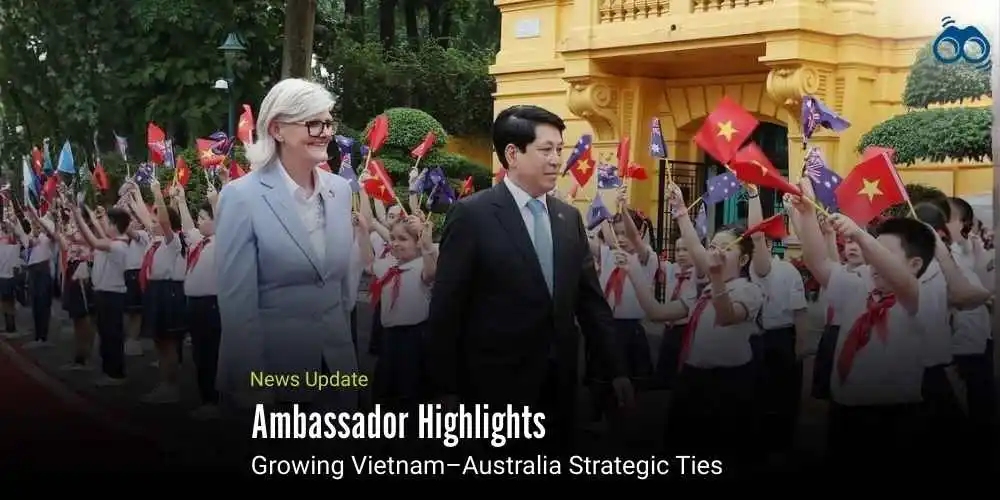
Vietnam–Australia Action Programme 2024–2027 Maps Long-Term Cooperation
Vietnam Joins Australian Naval Exercise as Partnership Deepens
It has been contended that the Vietnam-Australia Comprehensive Strategic Partnership is gaining strong momentum underpinned by mutual trust and collective commitment to peace, stability and prosperity in the Indo-Pacific region. This will involve developments in relations between Vietnam and Australia at a practical level in 2025, as an address shared with the Vietnam News Agency revealed Ambassador Gillian Bird from Australia to Vietnam. She asserted that the partnership has been evolving steadily from the official upgrade in March 2024, reflecting a Vietnam-Australia mutual strategic trust relationship, built on consistent dialogue and co-operation.
According to the envoy, high-level exchanges are still enriching Vietnam-Australia diplomatic relations and Hanoi–Canberra bilateral strategic co-operation. Indeed, the meetings of the two prime ministers on the sidelines of great regional forums, and reciprocal visits by senior leaders and ministers were, in the context, described as clear evidence of why Vietnam and Australia strengthened strategic trust and co-operation in 2025. Such encounters, she opined, further reinforce shared priorities on regional stability and co-operation in the Indo-Pacific and the wider Asia-Pacific strategic partnership involving Vietnam and Australia.
Progress was also reported across the six pillars defining the Vietnam-Australia Comprehensive Strategic Partnership, which both sides have expounded upon as a long-term framework for co-operation. These include political engagement, defence and security, economic co-operation, education and people-to-people links, climate and energy, as well as science, technology and regional co-operation. In terms of the number of commitments made available under this partnership, the ambassador stated that most were either completely realised or progressing on schedule, which, in fact, demonstrated the effectiveness of bilateral co-operation mechanisms between Vietnam and Australia.
Vietnam's participation in a major naval exercise hosted by Australia has been mentioned as a milestone in the economic and security ties between Australia and Vietnam, highlighting the area of defence and security co-operation. This event is seen by many as contributing to confidence and co-operation in the Asia-Pacific region concerning maritime affairs. Economic and trade relations are, in fact, another essential angle in this partnership promotion. Trade between the two countries was increasing through policy dialogue on economic connectivity initiatives, enhancing supply chains and creating new investment opportunities under the Vietnam-Australia partnership. Such efforts are similar to the broader Vietnam-Australia economic connectivity and policy dialogue objectives and offer practical Vietnam-Australia trade agreement insights for businesses wishing to cooperate in the long run.
Under the auspices of education co-operation between Vietnam and Australia, people-to-people ties continued to remain strong. It is said that scholarship programmes, vocational training and university partnerships are the driving fields for Vietnam-Australia people-to-people and education exchange. The Vietnam-Australia strategic partnership has recently been portrayed as showing increasing impacts in the fields of trade and education. Human resource development, as well as innovation capacity growth, is increasingly influenced by the exchange programmes between Vietnam and Australia regarding education. This scheme is also referred to as a vital step taken by Vietnam and Australia in embedding the strategic partnership further from 2024 to 2027.
Climatically, environmentally and in energy terms, Vietnam has proved its position as a key partner in Southeast Asia co-operation. Australia is now recognising Vietnam as a major player towards achieving energy connectivity in the region, as well as being critical for the clean energy transition. This area of the Vietnam-Australia partnership fits into Southeast Asia co-operation under a wider bilateral arrangement with specific programmes for supporting power sector reform, renewable integration, and energy security. Therefore, they are meant to promote long-term sustainability in the region.
The dimensions of co-operation were also crucial, including humanitarian assistance and climate resilience. One example was supporting the communities in distress because of flood impacts in central Vietnam with immediate assistance, accompanied by long-term resilience-building. That is, agriculture, disaster response, and climate adaptation would be areas of ongoing co-operation to enhance and optimise the benefits gained from strategic Vietnam–Australia co-operation for both countries. The ambassador articulated that, in summary, the Vietnam–Australia Action Programme 2024–2027 gives a clear path for moving forward in engagement. Observers note that this illustration explains how close the Vietnam–Australia relationship is in the building of a Comprehensive Strategic Partnership fully anchored in mutual trust, shared values and practical outcomes. Given this deepened level of integration and co-operation, one would expect the Vietnam and Australia regional co-operation framework to yield benefits that could be long-lasting and impactful in economic growth, education and security through stability to audiences across the Indo-Pacific region.
Editor’s Note:
The recent visit under the Comprehensive Strategic Partners scheme of Vietnam and Australia shows clearly how the two countries can build trust through steady dialogue and tangible action in cooperation. The new official upgrade in late 2024 set in motion a new momentum within the partnership, within which both sides worked interactively on politics, defence, trade, education, climate, and technology. Consolidation of the relationship is done through high-level gatherings of the leaders and ministers, whereas activities such as Vietnam's participation in an Australian naval exercise signal growing defence and security relations between both countries. This is especially important for the Indo-Pacific, where stability and confidence matter for the seas. Thus, broader than ever-nurturing economic linkages emerge: Policy discussions on supply chains and investment turn out business opportunities, while educational exchanges through scholarships and university partnerships will build up skills future generations will need. These links are all common-global co-operation—somewhat beyond governments and directly benefiting communities. Then, climate and energy would be the last major area. Vietnam is currently recognised by Australia as one of the leading advocates of the clean energy transition through joint projects on renewable integration and reforms of the power sector. Such humanitarian assistance as floods in central Vietnam would notch up another.
Skoobuzz underlines that the Action Programme 2024–2027 maps out clearly what will be covered. It is about partnerships, not just in diplomacy, but on the ground, economic growth, education, security and sustainability. This news reflects how both countries build long-term co-operation that benefits all across the Indo-Pacific region.
FAQs
1. What is the comprehensive strategic partnership between Vietnam and Australia?
The Vietnam–Australia Comprehensive Strategic Partnership, upgraded in March 2024, is the highest level of diplomatic ties between the two countries. It covers six main areas: political engagement, defence and security, economic cooperation, education and people-to-people links, climate and energy, and science and technology. It aims to deepen trust, strengthen trade, and promote peace and stability in the Indo-Pacific.
2. Who are the comprehensive strategic partners of Vietnam?
As of 2025, Vietnam has comprehensive strategic partnerships with 14 countries. These are: China, Russia, India, South Korea, the United States, Japan, Australia, France, Malaysia, New Zealand, Indonesia, Singapore, Thailand, and the United Kingdom. This is Vietnam’s highest diplomatic tier, showing close cooperation across politics, economics, defence and culture.
3. What is the ASEAN–Australia Comprehensive Strategic Partnership 2025–2029?
The ASEAN–Australia Comprehensive Strategic Partnership 2025–2029 is a joint plan of action agreed in 2024. It builds on decades of cooperation and sets out commitments for peace, prosperity and stability in the region. The plan includes annual summits, economic collaboration, climate action, education exchanges, and regional security cooperation.
4. What is the Australia–Vietnam Development Partnership Plan?
The Australia–Vietnam Development Partnership Plan 2025–2030 is a framework for development cooperation. It focuses on economic engagement, science and innovation, climate and energy, education and people-to-people links, and defence and justice cooperation. It translates shared priorities into practical projects, such as renewable energy, digital transformation and vocational training.
5. What is meant by a comprehensive strategic partnership?
A comprehensive strategic partnership is the highest form of diplomatic relationship between countries. It goes beyond basic cooperation and covers a wide range of areas: politics, economics, defence, science, technology, climate and culture. Unlike a formal military alliance, it is not legally binding but shows deep trust and long-term commitment to work together.

Skoobuzz

 Skoobuzz

 Skoobuzz



0 Comments (Please Login To Continue)