








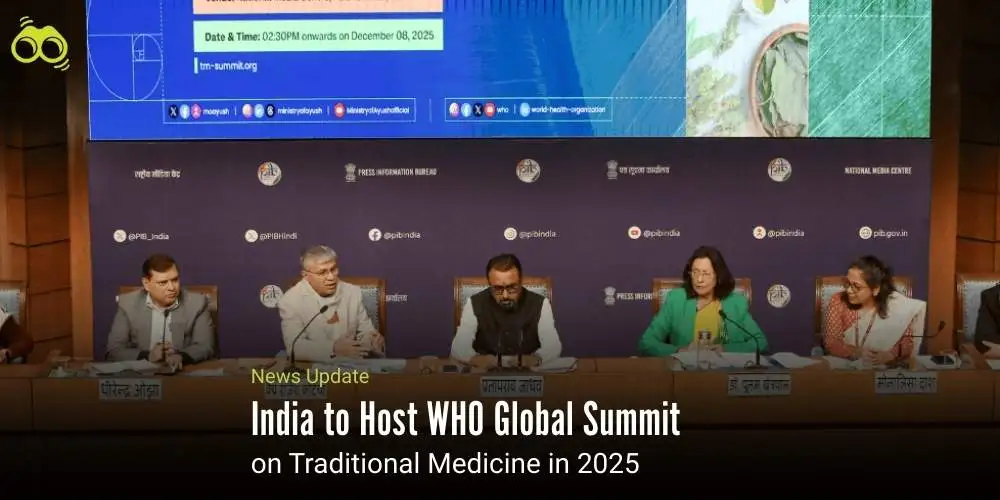
WHO Traditional Medicine Global Library to Launch at New Delhi Summit
WHO Announces 2nd Global Summit on Traditional Medicine with Theme ‘Restoring Balance for People and Planet’
Traditional medicine has been recognised as one of the oldest health practices taken in a very holistic manner in the world. This tradition is associated with culture, communities, and nature. However, with emerging needs of global health systems for resilience, equity, and sustainability, the importance of traditional, complementary, and integrative medicine is growing.
Against this backdrop, the WHO Global Summit on Traditional Medicine India 2025 will take place in New Delhi, India, from 17 to 19 December. The summit brings together policymakers, researchers and regulators, as well as traditional medicine practitioners, coming from over 100 countries to New Delhi. The theme which has been formed for the summit is "Restoring Balance for People and Planet: The Science and Practice of Well-being."
Global Agenda and India’s Role
The agenda of the global summit for integrative medicine would be to enhance research, safety, and the integration of traditional, complementary, as well as integrative medicine. According to WHO representatives, the summit would facilitate collaboration in terms of science, biodiversity, as well as access.
The knowledge and expertise that India has traditionally had in AYUSH traditional systems of medicine, such as Ayurveda, Yoga, Unani, Siddha, Homoeopathy, and Sowa Rigpa, have been cited as crucial to these talks. The role of traditional systems of AYUSH in WHO's “Traditional Medicine Global Summit India” would be showcased in policy, regulation, and integration with conventional healthcare.
Launch of the WHO Global Traditional Medicine Library
A highlight of the summit will be the launching of the WHO Traditional Medicine Global Library (TMGL). This online library will contain over 1.5 million records of traditional and complementary medicine and integration. In response to a query regarding this event, the WHO explained that the launching of the WHO Traditional Medicine Global Library (TMGL) at the 2025 Summit in India will assure worldwide access to evidence maps, research, policies and regulatory information.
The WHO Global Library of Traditional Medicine can be downloaded for access and use of gap analysis tools for research, formulation of policies, and establishment of standards of quality by delegates.
Evidence-Based Practices and Research
It shall cover the traditional, complementary, and alternative medicine research sessions during the WHO Summit 2025 regarding the clinical validation, innovation, and digital conservation of traditional medical knowledge. In addition, the strategy of the World Health Organisation regarding traditional medicine for 2025-2034 shall also be dwelt upon.
The number of AYUSH hospitals, dispensaries, and colleges in India, highlighted as proof of the existence of a strong institutional framework, stood at 3,844 hospitals, 36,848 dispensaries, 886 undergraduate colleges, 251 postgraduate colleges, and over 755,000 registered practising AYUSH practitioners.
Policy and Regulation
The issues to be raised in the discourse on traditional medicinal policy and regulation include pharmacovigilance, standards, and best practices. The World Health Organisation representatives indicated that the summit would facilitate the evidence integration of complementary and integrative medicines into health systems. The Indian Ministry of AYUSH WHO summit partnership was seen to be one of the factors that greatly influenced the agenda, in line with India’s national agendas on scientific validation, safety, and sustainable use of medicinal resources.
Onlookers stated that the effect of the traditional systems of medicine on the global health systems is slowly becoming more visible, particularly in areas where cost-effectiveness and familiarity play an important role in the selection of healthcare systems. The global health summit on the “Traditional Systems of Medicine” would thus focus on the scientific endorsement of Ayurveda, Yoga, Unani, Siddha, and Homoeopathy. The World Health Organisation Traditional Medicine Summit India is anticipated to enhance India's dominance within the health sector internationally. It will also function as the conference on traditional medicine in India in December 2025. It will mark the Asia host city of the WHO summit on traditional medicine.
Access and Participation
Delegates can use the registration for the WHO Traditional Medicine Summit 2025, the summit program schedule, speakers, and accommodation for the summit in New Delhi. Delegates will also have the opportunity to benefit from the summit research and innovation sessions that comprise the plenary, ministerial, and technical sessions.
The perspective on the 2nd WHO Global Summit on Traditional Medicine reveals the increasing contribution of India to shaping international health policies. In organising the summit and participating in the digitisation of traditional health knowledge, it is clear that India is significantly contributing to integrating traditional modes of healing with modern health practices. The Delhi Global Health Summit on Traditional Medicine would be a significant milestone in promoting evidence-based traditional medicine practices globally.
Editor’s Note:
The announcement of the WHO Global Summit on Traditional Medicine India 2025 is much more than just another international event. It marks the beginning of a new era when the world will start looking at traditional, complementary, and integrative medicine differently. Traditions like Ayurveda, Yoga, Unani, Siddha, Homoeopathy, and Sowa Rigpa have been an integral part of society and culture for centuries. They are now being acknowledged for their worth in modern health care as well. The significance of this summit is that it brings India to the forefront of international health discussions. With a robust health infrastructure in place in the form of thousands of AYUSH health institutions and practitioners, India is in a unique position to demonstrate to the world how alternative health systems can be integrated with mainstream health systems. The launch of WHO’s Traditional Medicine Global Library, or TMGL, at this summit is also noteworthy. WHO has made it clear that traditional health practices would not remain in the realm of testimonials and opinions, but rather, would remain grounded in science and be available on a global platform. Restoring Balance for People and Planet,” as the theme highlights, comes not a moment too soon. The health sector across the globe is grappling with rising costs, inequities, and sustainability. For example, traditional medicine is an important intervention that is readily available, easily comprehensible, and preventive. Notably, it has all these qualities at a significantly lower cost compared to current state-of-the-art health facilities.
Skoobuzz mentions that the acceptance of traditional medicine, supported by the WHO and the Indian government, signals a shift towards people-centred healthcare. This innovation blends the strengths of traditional and modern approaches, applying scientific methods to learn from past successes and failures.
FAQs
1. Who is organising the Traditional Medicine Global Summit 2025?
The World Health Organisation (WHO) is organising the Traditional Medicine Global Summit 2025, which will be hosted in New Delhi, India, from 17–19 December.
2. Who organised the first Global Summit on Traditional Medicine?
The first WHO Global Summit on Traditional Medicine was organised by the World Health Organisation in collaboration with the Government of India. It was held in Gandhinagar, Gujarat, in August 2023, alongside the G20 Health Ministers’ Meeting.
3. In which country is the WHO Global Centre for Traditional Medicine located?
The WHO Global Centre for Traditional Medicine is located in India, reflecting the country’s longstanding expertise and leadership in traditional medicine systems.
4. Which is the first Global Centre for Traditional Medicine in the world?
The WHO Global Centre for Traditional Medicine in Jamnagar, Gujarat, India, is the first global centre of its kind. It was established to advance research, evidence, and international collaboration on traditional medicine.
5. Where is the Global Traditional Medicine Centre in India?
The Global Traditional Medicine Centre is situated in Jamnagar, Gujarat, India. It works closely with the Ministry of AYUSH and WHO to strengthen scientific validation, policy frameworks, and global cooperation in traditional medicine.

Skoobuzz
References
 Skoobuzz
 Skoobuzz
 Skoobuzz


0 Comments (Please Login To Continue)