








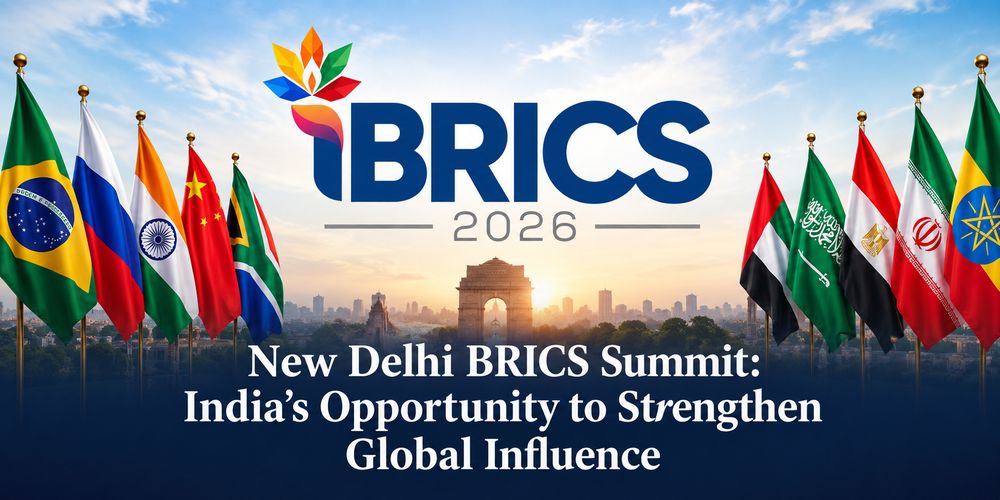
BRICS Summit Gives India Strategic Leverage Amid Global Uncertainty
With Xi Jinping and Vladimir Putin in Delhi, the BRICS Summit offers India greater diplomatic and economic leverage.
The upcoming BRICS Summit in New Delhi is set to bring together leaders from major emerging and developing economies at a time when the global political and economic order is undergoing significant change. The expected participation of Chinese President Xi Jinping and Russian President Vladimir Putin gives the 18th BRICS summit considerable diplomatic weight and places India at the centre of an evolving geopolitical landscape. With two major wars continuing to influence international relations, trade routes facing disruption and countries increasingly reassessing their strategic dependencies, the summit comes at a particularly consequential moment.
For India, however, the gathering represents much more than a high-profile diplomatic event. It offers New Delhi an opportunity to demonstrate its growing international influence, strengthen relationships across different geopolitical blocs and create additional economic and diplomatic options. As countries seek to protect themselves from unpredictable policy shifts and global disruptions, India's ability to maintain relationships with competing power centres has become an increasingly important element of its foreign-policy strategy. BRICS therefore gives India another platform through which it can pursue strategic autonomy while protecting its long-term economic interests.
India’s Strategic Advantage at BRICS
The summit’s agenda is expected to cover several issues that are increasingly central to economic security, including secure trade, reliable energy supplies, digital innovation, logistics, supply chains, agriculture and labour-market cooperation. BRICS leaders are also expected to reiterate the importance of strengthening the multilateral trading system, expanding market access and encouraging greater economic diversification among member countries. Although these objectives are consistent with longstanding international economic principles, their significance has increased as governments confront rising protectionism, trade restrictions and uncertainty surrounding global supply chains.
For India, greater diversification of economic relationships can help reduce exposure to sudden disruptions in individual markets. The country is already seeking to expand its manufacturing base, strengthen supply-chain resilience and attract investment across strategic sectors. A wider network of BRICS partners can complement these efforts by opening additional markets and creating opportunities for cooperation in energy, technology, infrastructure and trade. At the diplomatic level, the summit also gives India additional leverage in its relationship with the United States. New Delhi continues to attach considerable importance to its partnership with Washington, but maintaining meaningful relationships with Russia, China and other emerging economies gives India greater room to manoeuvre when international circumstances change. The objective is not to replace one partnership with another, but to ensure that India has sufficient strategic flexibility to make decisions based on its own interests.
Xi Jinping and Vladimir Putin Bring Added Weight
The presence of Xi Jinping and Vladimir Putin is expected to make the New Delhi summit one of the most closely watched BRICS gatherings in recent years. Xi's participation is particularly significant because it follows a prolonged gap in his visits to India and comes at a time when China's relationship with the United States remains marked by strategic competition, economic tensions and uncertainty. His presence in New Delhi could consequently provide an important setting for engagement not only between India and China but also among several major powers attempting to navigate an increasingly fragmented global system.
The interaction between Narendra Modi, Xi Jinping and Putin will inevitably attract international attention. Previous high-profile meetings involving the three leaders have prompted considerable discussion about the direction of global geopolitics and India's ability to maintain dialogue with countries that have complicated relationships with Washington. A similar display of engagement at the New Delhi summit could underline India's distinctive position: it can work with the United States on strategic and technological priorities while simultaneously engaging Russia, China and the wider Global South. For Washington, such interactions also highlight the potential consequences of policies that could inadvertently push India towards closer coordination with other major powers.
A Broader Economic and Technology Agenda
BRICS cooperation has expanded significantly beyond its traditional focus on trade and finance. The broader agenda now encompasses artificial intelligence, digital public infrastructure, geospatial technologies, science and technology, research, education, agriculture, energy and space. These areas are particularly relevant to India as it seeks to establish itself as a major technology and innovation centre while expanding the international reach of its digital infrastructure and start-up ecosystem.
Artificial intelligence and digital public infrastructure, however, also present some of the most difficult areas for international cooperation. Countries differ significantly in their regulatory approaches, technology capabilities, data policies and strategic priorities, while concerns about transparency and security can make technology partnerships particularly sensitive. Even so, the shared economic importance of these technologies could create opportunities for practical cooperation. India can use the BRICS platform to showcase its experience in digital public infrastructure, technology-enabled governance, entrepreneurship and innovation, while exploring partnerships that could expand access to emerging markets.
The central challenge will be translating broad political declarations into practical outcomes. BRICS brings together countries with different economic structures, political systems and foreign-policy priorities, meaning consensus can often be easier to achieve than implementation. India's leadership will therefore be judged not only by the issues it places on the agenda but also by whether those priorities produce measurable cooperation after the summit concludes.
BRICS and India’s Economic Resilience
India's BRICS leadership is built around four broad themes: resilience, innovation, cooperation and sustainability. The resilience agenda focuses on sectors such as healthcare, agriculture, food and energy security and disaster-risk reduction. These priorities have become increasingly important as economies experience the combined effects of geopolitical instability, climate-related disruptions, changing trade patterns and pressure on critical resources. Strengthening cooperation in these areas could help BRICS countries reduce vulnerabilities that extend beyond traditional economic policy.
The innovation pillar places emphasis on start-ups, micro, small and medium enterprises, research and development, science and technology and digital infrastructure. This aligns closely with India's own development priorities, particularly its efforts to strengthen entrepreneurship, technology adoption and domestic innovation. Meanwhile, the cooperation agenda focuses on strengthening multilateralism and advancing reforms of global institutions, while the sustainability pillar addresses clean energy, climate action and sustainable consumption. Taken together, these priorities show how India is attempting to connect its diplomatic leadership with broader economic and development objectives rather than treating BRICS purely as a geopolitical grouping.
Why BRICS Matters to India’s Global Position
One of BRICS' most important advantages for India is the diversity of the countries involved and the geographic reach of the wider grouping. Its members and partner countries span Asia, Africa, the Middle East and Latin America, creating a network that represents a substantial share of the developing world's economic and political interests. Cooperation across trade, finance, healthcare, education, technology, agriculture, energy and space gives India multiple avenues through which it can deepen its engagement with emerging markets.
The scale of the BRICS mechanism also provides an extensive institutional framework for cooperation, involving ministerial and agency-level tracks, working groups and business and people-to-people mechanisms. For India, this creates opportunities to move beyond traditional diplomatic engagement and establish more sustained economic and institutional partnerships. It also strengthens New Delhi's position within the Global South, where India has increasingly sought to present itself as a bridge between developing economies and the major centres of global power. The ability to communicate with Western countries while maintaining active engagement with Russia, China and developing economies gives India a distinctive diplomatic advantage.
BRICS Is Not a Replacement for the US Partnership
India's growing engagement with BRICS should not be interpreted as a move away from the United States. Washington remains an important economic, technological and strategic partner for New Delhi, and India's cooperation with the US spans areas including defence, technology, investment and regional security. At the same time, India's foreign policy has historically placed considerable emphasis on strategic autonomy, allowing it to maintain relationships with countries whose interests may not always align with those of its Western partners.
This approach becomes particularly valuable when international policy is unpredictable. By maintaining relationships across several power centres, India can reduce the risks associated with excessive dependence on any one country or bloc. BRICS therefore functions less as an alternative alliance and more as an additional source of diplomatic and economic leverage. The ability to engage simultaneously with Washington, Moscow, Beijing and other major economies gives India greater flexibility when responding to global crises, trade pressures or shifts in international policy.
What the New Delhi Summit Could Signal
The BRICS Summit comes at a time when the international system is becoming increasingly fragmented and competitive. Trade disputes, wars, supply-chain disruptions, energy concerns and technological competition are forcing governments to rethink how they manage economic and strategic risks. India's decision to use its BRICS leadership to focus on resilience, innovation, cooperation and sustainability reflects an understanding that economic security can no longer be separated from geopolitics.
Hosting the summit also allows India to showcase its diplomatic acceptability and the scale of its economy to a diverse group of international partners. Yet the more important opportunity lies beyond the symbolism of leaders gathering in New Delhi. If India can use the summit to advance practical cooperation in trade, technology, energy, supply chains and sustainable development, BRICS could become a more meaningful component of its broader economic strategy. Ultimately, the success of the summit will depend less on high-profile meetings and more on whether those meetings lead to mechanisms that strengthen India's resilience while preserving its freedom to navigate an uncertain global order.
Editor’s Note
The 2026 BRICS Summit arrives at a particularly important moment for India because the global environment is becoming less predictable and traditional assumptions about international partnerships are being tested. The real value of BRICS for New Delhi lies not in presenting the grouping as an alternative to the West, but in using it to expand India's strategic choices. In a world where trade policy, energy security, technology and diplomacy are increasingly interconnected, having multiple relationships can itself become a source of economic and political resilience.
India's engagement with BRICS should therefore be viewed through the broader lens of strategic autonomy. Strong ties with the United States remain important, but relationships with Russia, China, the Gulf, Africa, Southeast Asia and Latin America allow New Delhi to avoid being overly dependent on any single geopolitical centre. The presence of Xi Jinping and Vladimir Putin will understandably dominate headlines, but the summit's economic agenda may ultimately prove more consequential. Questions surrounding supply chains, energy security, digital infrastructure, artificial intelligence and market access directly affect India's ability to sustain growth during periods of global disruption.
The opportunity for India is now to convert diplomatic visibility into tangible outcomes. BRICS can give New Delhi additional bargaining power and strengthen its position within the Global South, but declarations alone will not deliver economic resilience. The effectiveness of the summit will ultimately depend on implementation—whether agreements translate into investment, trade, technology partnerships, stronger supply chains and institutional cooperation. In that sense, the New Delhi summit is both a showcase of India's rising diplomatic influence and a test of its ability to turn strategic autonomy into practical economic advantage.
Frequently Asked Questions
1. What is the BRICS Summit 2026?
The BRICS Summit 2026 is the 18th summit of the BRICS grouping and is being hosted by India in New Delhi. The summit brings together leaders and representatives from major emerging and developing economies to discuss issues spanning trade, finance, technology, energy, development, sustainability and international cooperation. Its timing makes it particularly significant as countries reassess their economic and diplomatic strategies amid growing geopolitical uncertainty.
2. Why is the BRICS Summit important for India?
The summit allows India to strengthen relationships with emerging economies, diversify economic partnerships and reinforce its strategic autonomy. It also allows New Delhi to demonstrate that it can maintain dialogue with multiple global power centres while advancing its own economic and diplomatic priorities. This flexibility can become particularly valuable during periods of international instability.
3. Will Xi Jinping attend the BRICS Summit in India?
Chinese President Xi Jinping is among the prominent leaders expected to attend the BRICS Summit in New Delhi. His participation is significant against the backdrop of India's complex relationship with China and the continuing strategic competition between China and the United States. His presence could also create an important opportunity for high-level diplomatic engagement.
4. Why is Vladimir Putin’s presence significant?
Russian President Vladimir Putin's participation highlights India's continuing engagement with Russia and adds considerable strategic weight to the summit. India has maintained its relationship with Moscow while simultaneously strengthening ties with Western countries. Putin's presence therefore reinforces India's ability to pursue a multi-aligned foreign-policy approach.
5. Is BRICS a rival to the United States?
BRICS should not necessarily be viewed as a replacement for India's relationship with the United States. India continues to maintain significant strategic, economic and technological ties with Washington. Instead, BRICS provides New Delhi with another platform for engagement and gives it greater flexibility by strengthening relationships with emerging economies and other major global powers.
6. What are the key areas of BRICS cooperation?
BRICS cooperation extends across trade, finance, energy, healthcare, agriculture, education, science and technology, artificial intelligence, digital infrastructure, space, sustainability and supply-chain resilience. The broadening of this agenda reflects the growing recognition that economic development, technological capacity and geopolitical security are increasingly interconnected.
7. How can BRICS benefit India economically?
BRICS can help India diversify its trading relationships, expand access to emerging markets and strengthen cooperation in areas such as technology, energy, infrastructure and supply chains. Greater engagement with member and partner countries can also create opportunities for Indian businesses, start-ups and investors while reducing excessive dependence on individual markets.
8. What is India’s approach to BRICS?
India's approach is centred on resilience, innovation, cooperation and sustainability. These priorities seek to connect BRICS engagement with India's wider economic and development goals, including stronger supply chains, technological innovation, energy security, sustainable growth and greater cooperation among developing economies.

Skoobuzz

 Skoobuzz

 Skoobuzz



0 Comments (Please Login To Continue)