








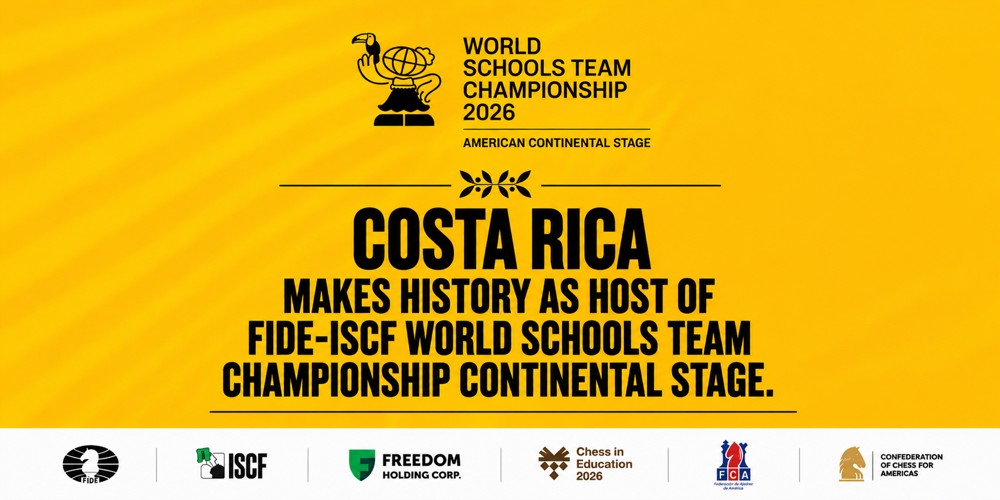
Costa Rica to Host American Continental Stage of the FIDE-ISCF World Schools Team Championship 2026
Costa Rica will host the Americas' top school chess teams and education leaders from August 11 to 16, 2026.
For the first time in history, Costa Rica will host the American Continental Stage of the FIDE-ISCF World Schools Team Championship (WSTC) 2026, positioning Central America on the global school chess map. Scheduled from August 11 to 16, 2026, the championship will bring together the strongest school chess teams from across the Americas at the DoubleTree by Hilton Cariari in San José.
Organised by the International Chess Federation (FIDE), the International Schools Chess Federation (ISCF), the Costa Rican Chess Federation, and the Confederation of Chess for the Americas (CCA), the event forms part of the Year of Chess in Education 2026, an international initiative promoting chess as a powerful educational tool in schools worldwide.
A Historic Milestone for Central America
The championship marks a significant moment for Costa Rica and the wider Central American region. Never before has the American Continental Stage of the World Schools Team Championship been hosted in the region, making San José a new hub for youth talent, educational collaboration, and international sporting excellence.
School teams representing countries across the Americas—from Mexico and the United States to Peru, Jamaica, Barbados, Panama, and the Dominican Republic—will compete for a coveted place in the World Schools Team Championship Grand Final against champions from other continental stages.
More Than a Chess Tournament
While the championship celebrates elite school chess competition, it also serves as a platform for advancing educational innovation. Held under the banner of the Year of Chess in Education 2026, the event reflects the growing adoption of chess in classrooms around the world to strengthen critical thinking, creativity, problem-solving, resilience, and decision-making among students.
Throughout the week, educators, policymakers, school leaders, chess federations, and families will exchange ideas and best practices aimed at expanding Chess in Education programmes across the Americas.
Smart Moves Americas to Drive Educational Dialogue
A major highlight of the championship week is Smart Moves Americas: Governments That Think Ahead, a ministerial conference organised by the ISCF and the Confederation of Chess for the Americas.
Taking place on August 12 at the Cariari Country Club, the conference will bring together ministers, education officials, curriculum experts, teacher-training specialists, and international education partners to discuss successful strategies for integrating chess into national education systems.
The conference agenda includes:
- Ministerial discussions on national education policies and leadership.
- Signing of regional cooperation memorandums.
- Launch of the Beacons League School Certification Programme for Costa Rican schools implementing Chess in Education.
- Recognition of schools demonstrating excellence in chess-based learning.
- Expert sessions on teacher development, curriculum integration, funding, and sustainable programme implementation.
- Workshops exploring innovative classroom practices that use chess to support interdisciplinary learning.
Delegations from countries including Costa Rica, Barbados, El Salvador, Panama, the United States, and the Dominican Republic are expected to participate, creating one of the largest regional policy forums dedicated to Chess in Education.
Learning Beyond the Chessboard
The championship will also feature a diverse educational programme designed for students, teachers, coaches, parents, and federation officials.
Key activities include:
Programme | Focus |
Smart Moves: Girls Who Lead | Empowering girls and young women through chess masterclasses and competitions |
Chess in Subject | Integrating chess into classroom teaching across multiple disciplines |
ISCF Master Class Series | Developing young chess talent through expert guidance |
Simul with a Twist | Interactive simultaneous exhibition involving audience participation |
Kahoot Chess Quiz | Engaging educational quiz combining learning and competition |
Sustainability & Community Initiatives | Environmental awareness and collaborative international activities |
These initiatives are designed to ensure participants leave with valuable knowledge, new professional connections, and practical ideas that extend well beyond the championship itself.
International Leaders to Attend
The event will welcome distinguished guests from across the Americas, including education ministers, chess federation leaders, curriculum specialists, and renowned educators.
Among the confirmed participants are:
- José Antonio Carrillo Pujol, President of FIDE Americas (CCA)
- Hon. Chad J. Blackman, Minister of Educational Transformation, Barbados
- Dalila Beatriz Beltrán de Menjívar, National Director of School Coexistence, El Salvador
- Andrea Marshall-Harris, International Director, Barbados Chess Federation
- Robert McLellan, National Scholastic Chess Foundation (USA)
- WFM Amelia Hernández (USA/Venezuela)
Their participation reinforces the championship's dual mission of promoting competitive excellence while strengthening educational partnerships across the region.
Why This Matters
The FIDE-ISCF World Schools Team Championship demonstrates how chess can serve as more than a competitive sport. Increasingly recognised as a valuable educational resource, chess helps students develop analytical thinking, strategic planning, concentration, and collaboration—skills that are transferable to classrooms and future careers.
By combining high-level competition with educational dialogue, policy discussions, and teacher development, Costa Rica's hosting of the championship reflects a broader movement toward integrating innovative learning approaches into school systems worldwide.
Editor's Note
The growing connection between chess and education is reshaping how schools approach learning beyond traditional academics. Events like the FIDE-ISCF World Schools Team Championship showcase that chess is not only a competitive pursuit but also a practical classroom tool that nurtures critical thinking, resilience, and informed decision-making. Costa Rica's role as host reflects the increasing recognition that education thrives when academic learning is complemented by experiences that build confidence, collaboration, and lifelong problem-solving skills.
FAQs
1. What is the FIDE-ISCF World Schools Team Championship?
It is an international school chess competition organised by FIDE and the International Schools Chess Federation, bringing together top school teams from across the world.
2. When and where will the American Continental Stage take place?
The event will be held in San José, Costa Rica, from August 11 to 16, 2026, at the DoubleTree by Hilton Cariari.
3. Why is this event historic?
It is the first time Costa Rica and Central America will host the American Continental Stage of the World Schools Team Championship.
4. What is the Year of Chess in Education 2026?
It is a global initiative led by FIDE and ISCF that promotes the integration of chess into school education to enhance learning and student development.
5. What is Smart Moves Americas?
Smart Moves Americas is a ministerial conference that brings together government leaders, educators, and policymakers to share best practices for implementing Chess in Education programmes.
6. Which countries are expected to participate?
School teams and education representatives from countries including Mexico, the United States, Peru, Barbados, Jamaica, Panama, El Salvador, the Dominican Republic, and others across the Americas are expected to attend.
7. What educational programmes will accompany the championship?
Participants will engage in masterclasses, teacher workshops, girls' leadership programmes, classroom integration sessions, sustainability initiatives, and interactive learning activities.
8. Why is chess increasingly being adopted in schools?
Research and educational practice suggest that chess can strengthen critical thinking, creativity, concentration, strategic planning, and problem-solving skills, making it a valuable complement to classroom learning.

Skoobuzz

 Skoobuzz

 Skoobuzz



0 Comments (Please Login To Continue)