








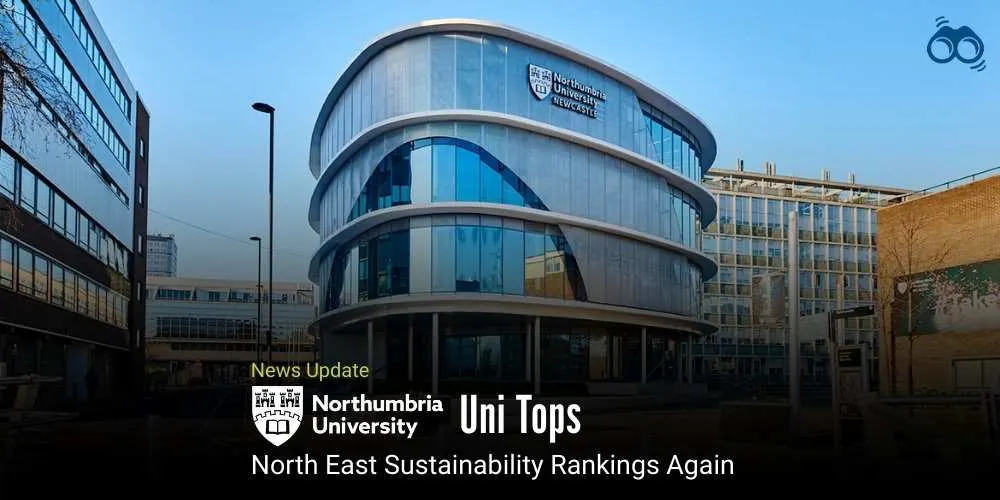
Northumbria University Secures 16th Place Nationally for Sustainability Performance
Northumbria Ranked ‘1st Class’ in People & Planet University League
Northumbria University is an award‑winning institution based in Newcastle upon Tyne in northeast England. Known for its strong research profile, innovative teaching, and global reach, the University attracts students from across the world and plays a key role in regional growth and international collaboration. As part of its academic and international excellence, the University has been ranked ‘1st class’ in the People & Planet University League ranking, reflecting its excellent sustainability performance. The People & Planet University League is published each year by People & Planet, the largest university campaigning group in the UK. It is the only league table that rigorously judges universities against high sustainability and ethical standards.
Universities are assessed in areas such as environmental policy, carbon reduction, campus waste and recycling, ethical investment, and more. The People & Planet University League is considered the broadest measure of sustainable higher education in the UK, making it easier to compare university performance on environmental sustainability. The table, drawn up annually by the UK’s largest student campaigning network, is widely regarded as the most comprehensive benchmark of environmental sustainability in UK universities. Northumbria was ranked 16th nationally for sustainability performance and confirmed for the fifth consecutive year as the most sustainable university in the North East. This achievement has been noted as strengthening the University’s reputation, particularly with its emphasis on embedding sustainability into everyday operations.
In terms of categories assessed, the University was reported to have scored maximum marks in environmental policy achievements and in university environmental audits and management systems. Commentators observed that Northumbria has shown significant progress in carbon management and recycling improvements, including enhanced waste reduction programmes and improved recycling infrastructure across campus. Dr Paul Steadman, Sustainability Manager at the University, said: “We are very pleased to retain our position in the league table for sustainability and to be recognised as the most sustainable university within the region. The University is seeing real progress as a result of our carbon reduction and biodiversity plan, including the installation of air source heat pumps, solar panels, and a plan to enhance campus biodiversity and sustainability.”
Observers also highlighted Northumbria’s achievement of Cycle Friendly Employer status and its first successful Bike Week, which showed that the University’s sustainability commitments extend beyond infrastructure to community engagement. Projects such as Leave Newcastle Happy and the British Heart Foundation’s Pack for Good diverted large amounts of unwanted student belongings to charity, reducing landfill waste and promoting sustainable higher education practices in the UK. Internationally, Northumbria was ranked joint 53rd in the Times Higher Education Impact Rankings for sustainability, which measure institutions against the United Nations’ Sustainable Development Goals. Analysts noted that Northumbria secured a leading position in sustainability rankings both locally and globally.
The University also received praise in the Green Gown Awards for the UK and Ireland, where it was highly commended in the Research with Impact category. It was recognised for an innovative project that transforms banana farming waste in Pakistan into eco‑friendly textiles and clean energy. Overall, the People & Planet University League sustainability ranking demonstrates how consistent performance has established Northumbria’s leadership in the sector. Being named the most sustainable university in the North East for five years running shows the institution’s commitment to staying ahead in sustainability rankings and shaping the future of UK university sustainability performance.
Editor’s Note:
The award won by Northumbria University in the People & Planet University League is far from an isolated success. It represents the steady build‑up of its reputation as a sustainable institution. The University has reached these milestones by combining strong environmental policies with effective audits and management practices. Scoring maximum marks in these areas reflects not only careful planning but also consistency and delivery. Over the past year, Northumbria has made clear progress in carbon management and recycling. New air source heat pumps and rooftop solar panels have been installed, while the Biodiversity Action Plan has transformed the campus into a greener, more eco‑friendly environment. Community engagement has been equally important. Achieving Cycle Friendly Employer status and hosting the first Bike Week encouraged staff and students to adopt sustainable transport. At the same time, initiatives such as Leave Newcastle Happy and the British Heart Foundation’s Pack for Good diverted large quantities of student donations away from landfill, showing that sustainability is part of everyday life as well as infrastructure. Internationally, Northumbria’s joint 53rd place in the Times Higher Education Impact Rankings for sustainability demonstrates how its actions align with the UN’s Sustainable Development Goals. Recognition in the Green Gown Awards further highlights its innovation, with research turning banana farming waste in Pakistan into textiles and clean energy. Together, these achievements explain how Northumbria has secured top marks in sustainability both regionally and nationally. Being recognised as the most sustainable university in the North East for five consecutive years shows consistency in its approach and a determination to improve year after year.
As per Skoobuzz, this record makes clear that sustainability is not an add‑on but a core value of the institution. It is this commitment that has placed Northumbria among the UK’s leading universities for sustainability.
FAQs
1.What is Northumbria University best known for?
Northumbria University is best known for its strong research profile, innovative teaching, and global reach. It has been named UK University of the Year 2022 by Times Higher Education and Modern University of the Year 2025 by The Times and The Sunday Times. The University is also recognised for graduate employability, industry partnerships with organisations such as Nike, IBM and the NHS, and being one of the UK’s leading institutions for graduate start‑ups.
2.Which university is the most sustainable?
In the UK, several universities consistently perform strongly in sustainability rankings. Northumbria University is ranked the most sustainable university in the North East of England for five consecutive years in the People & Planet University League. Nationally, institutions such as University College London, Imperial College London, and the University of Edinburgh are also recognised for their sustainability leadership.
3.What is the ranking of Northumbria University?
Northumbria University is ranked 55th in the UK and 644th globally in the 2025 EduRank listings. It also climbed to 34th place in the Complete University Guide 2025. In sustainability, Northumbria was placed 16th nationally in the People & Planet University League and joint 53rd globally in the Times Higher Education Impact Rankings 2025, which measures progress against the UN Sustainable Development Goals.
4.Which is the most sustainable university as per the QS ranking?
According to the QS World University Rankings: Sustainability 2025, the University of Toronto in Canada retained its position as the world’s most sustainable university. Other leading institutions include ETH Zürich (Switzerland), Lund University (Sweden), and University College London (UK), which ranked among the global top ten.
5.Which country is best for sustainability studies?
Countries widely regarded as the best destinations for sustainability studies include:
Germany – known for engineering excellence and renewable energy leadership.
Sweden – a pioneer in environmental science and sustainable living.
United Kingdom – home to globally ranked sustainable universities such as UCL, Edinburgh, and Northumbria.
Canada – with institutions like the University of Toronto and the University of British Columbia leading in sustainability.
Switzerland – ETH Zürich is a global leader in sustainability research and education.

Skoobuzz

 Skoobuzz
 Skoobuzz
 Skoobuzz
 Skoobuzz



0 Comments (Please Login To Continue)