








Punjab Launches AI as Core School Subject for Classes 1–12 Under Sarbat.AI
Punjab's Sarbat.AI mission will gradually bring AI education to over 31 lakh students across government schools.
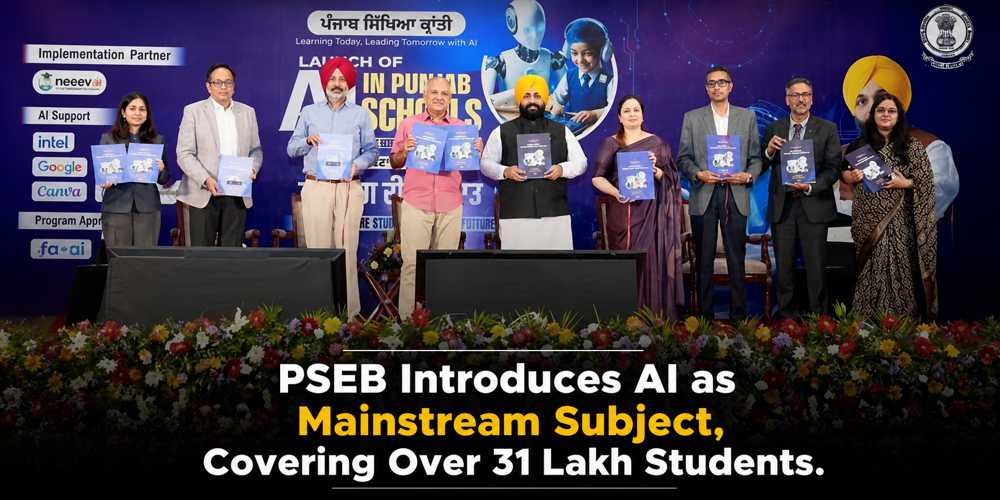
Punjab has become the first state in India to introduce Artificial Intelligence (AI) as a mainstream subject across Classes 1 to 12, marking a significant shift in how school education is preparing students for the future. The initiative, launched by the Punjab School Education Board (PSEB) under the Sarbat.AI project, aims to embed AI learning into classrooms through a phased implementation that combines technical knowledge with ethical and responsible use of emerging technologies.
The move positions Punjab among a growing number of education systems worldwide that are integrating AI into school curricula to equip students with future-ready skills from an early age.
Phased Rollout Begins with Secondary School Students
The programme will be introduced in two phases. During Phase I, AI will be integrated into the Computer Science curriculum for Classes VIII to XII across government and affiliated private schools. Students will learn through:
- Live online classes
- Recorded lectures
- Project-based learning
- Continuous assessments
- A dedicated Learning Management System (LMS)
Phase II will extend AI education to Classes I to VII, ensuring age-appropriate learning experiences from the foundational years of schooling.
Curriculum Designed Around Global Best Practices
According to Punjab School Education Minister Harjot Singh Bains, the curriculum has been developed after studying education models from:
- Singapore
- Finland
- United Arab Emirates
- United States
It is also aligned with UNESCO's Ethical AI Framework, ensuring students develop not only technical proficiency but also an understanding of responsible, safe and ethical AI practices.
Speaking at the launch, Bains said the initiative marks the beginning of Punjab's transition from leading the Green Revolution to becoming a leader in the Artificial Intelligence Revolution.
Building Future-Ready Learners
The Sarbat.AI programme builds upon PSEB's earlier AI pilot project conducted in collaboration with FA-AI, which concluded with a statewide AI Hackathon showcasing student-led innovations. The larger statewide initiative will be supported technologically by Neeev AI and strengthened through collaborations with Google, Intel, Canva and FA-AI, focusing on:
- AI literacy
- Teacher training
- Innovation
- Workforce readiness
Scale of the Initiative
The programme is expected to become one of India's largest state-led AI education initiatives.
Initiative | Details |
Schools Covered | 25,172 |
Students Benefiting | Nearly 31.5 lakh |
Computer Science Teachers (Phase I) | 12,424 |
Teachers to Receive AI Training | Over 2 lakh |
Officials said AI learning outcomes will also become part of the compulsory Computer Science curriculum reflected in students' board certificates.
A Step Towards Equitable AI Education
The initiative seeks to make AI education accessible regardless of whether students study in urban or rural schools. Officials believe introducing AI from school level can help nurture innovation, entrepreneurship and digital problem-solving while reducing disparities in access to emerging technologies.
Former Delhi Education Minister Manish Sisodia, who attended the launch, described the programme as a landmark step that positions Punjab as a national benchmark for AI education and encourages students to become creators rather than merely consumers of technology.
Why This Matters
Artificial Intelligence is rapidly reshaping industries, workplaces and everyday life. While higher education institutions have increasingly incorporated AI into their programmes, introducing these concepts at the school level represents a broader shift in educational priorities.
Punjab's initiative reflects an emerging belief that future preparedness extends beyond digital literacy to include computational thinking, ethical decision-making and responsible innovation. Its long-term impact will depend not only on curriculum design but also on teacher preparedness, equitable infrastructure and meaningful classroom implementation.
Editor's Note
Artificial Intelligence is no longer a distant technology reserved for specialists—it is becoming part of how societies learn, work and solve problems. Punjab's decision is noteworthy not simply because it is the first of its kind in India, but because it reframes AI as a foundational literacy rather than an optional skill.
Yet, pioneering a curriculum is only the beginning. The true measure of success will lie in whether classrooms encourage curiosity over memorisation, ethics alongside efficiency, and creativity over dependency. As AI becomes increasingly woven into education, schools carry a responsibility not just to teach students how to use intelligent systems, but to help them question, shape and responsibly coexist with them. The future will belong not to those who merely understand technology, but to those who understand its human consequences.
Frequently Asked Questions (FAQs)
1. Why has Punjab introduced Artificial Intelligence as a mainstream school subject?
Punjab aims to equip students with future-ready skills by making AI education an integral part of school learning. The initiative focuses on developing technical knowledge, ethical awareness, creativity, problem-solving, and innovation from an early age.
2. Is Punjab the first state in India to introduce AI as a mainstream subject?
Yes. Punjab has become the first Indian state to introduce Artificial Intelligence as a mainstream subject for students from Class 1 to Class 12 through the Punjab School Education Board (PSEB).
3. What is the Sarbat.AI initiative?
Sarbat.AI is Punjab's statewide AI education mission designed to integrate Artificial Intelligence into school education in a phased manner. It aims to make AI learning accessible to students across both urban and rural schools.
4. Which classes will begin learning AI first?
The first phase will cover Classes VIII to XII, where AI will be integrated into the existing Computer Science curriculum. The programme will later expand to Classes I to VII.
5. How will students learn Artificial Intelligence?
Students will learn through a blend of live online classes, recorded lectures, project-based learning, continuous assessments, and a dedicated Learning Management System (LMS).
6. How many schools and students will benefit from the programme?
The initiative is expected to reach 25,172 schools and nearly 31.5 lakh students across Punjab, making it one of India's largest AI education programmes.
7. Will teachers receive AI training?
Yes. Around 12,424 Computer Science teachers will lead Phase I, while over two lakh teachers from different subjects will be progressively trained to integrate AI into classroom teaching.
8. Is the AI curriculum aligned with international standards?
Yes. The curriculum has been developed after studying education models from Singapore, Finland, the UAE, and the United States, and is aligned with UNESCO's Ethical AI Framework.
9. Which organisations are supporting the initiative?
The programme is being implemented technologically by Neeev AI and supported through collaborations with Google, Intel, Canva, and FA-AI to strengthen AI literacy, teacher capacity, and innovation.

Skoobuzz
 Skoobuzz
 Skoobuzz
 Skoobuzz
 Skoobuzz



0 Comments (Please Login To Continue)