








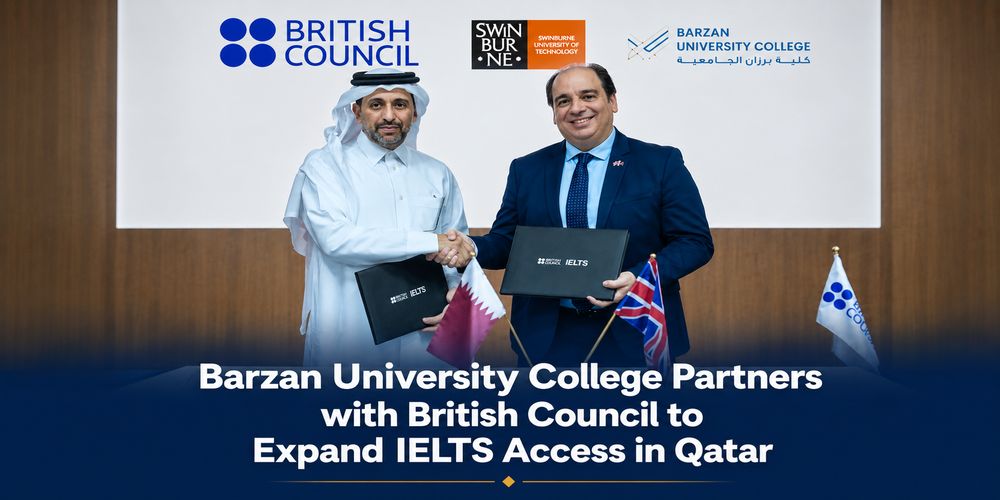
Barzan University College, British Council Partner to Strengthen English Education in Qatar
They will expand access to English education and internationally recognised IELTS services in Qatar.
Barzan University College (BUC) has entered into a strategic partnership with the British Council to strengthen English language education and expand access to internationally recognised IELTS services in Qatar.
The collaboration brings together two institutions with a shared focus on academic excellence, international engagement and high-quality language assessment. Through the partnership, Barzan University College and the British Council aim to support learners in developing English language skills that can help them pursue higher education, advance their careers and participate more confidently in an increasingly interconnected global environment.
The agreement also adds to Barzan University College’s growing network of international academic partnerships and reflects the institution’s broader efforts to connect learners in Qatar with globally recognised educational opportunities.
Strengthening Access to English Language Education
English proficiency has become an increasingly important component of academic and professional mobility. For students seeking admission to English-medium universities, professionals pursuing international career opportunities, and learners looking to engage with global academic and professional networks, recognised English language qualifications can play an important role.
The partnership between Barzan University College and the British Council is intended to strengthen access to trusted English language assessment while supporting a broader culture of English language learning.
By combining Barzan University College’s academic environment with the British Council’s expertise in English language education and assessment, the collaboration seeks to create additional opportunities for learners at different stages of their academic and professional journeys.
Expanding Access to IELTS Services in Qatar
A key element of the partnership is the expansion of access to internationally recognised IELTS services in Qatar. IELTS is widely used as an English language proficiency assessment for purposes including higher education, employment and international mobility. Greater access to recognised assessment services can therefore help learners navigate academic and professional pathways that require evidence of English language proficiency.
For students, this can mean greater preparedness for applications to universities and programmes where English proficiency is an admission requirement. For working professionals, recognised language qualifications can support career development and opportunities that extend beyond national borders.
The partnership, therefore, goes beyond language testing alone. It reflects a wider effort to connect language learning and assessment with the real-world opportunities that proficiency can unlock.
Supporting Qatar’s International Education Ambitions
The collaboration comes at a time when Qatar continues to strengthen its position as a knowledge-driven economy and an increasingly connected education hub. International partnerships have become an important part of higher education institutions’ efforts to broaden academic exposure, strengthen quality and prepare learners for a global workforce. In this context, collaborations with internationally recognised organisations can provide students and the wider community with access to expertise, services and opportunities that complement local education.
For Barzan University College, the agreement with the British Council represents another step in its international engagement strategy and supports its efforts to contribute to the development of a highly skilled workforce in line with the ambitions of Qatar National Vision 2030.
Barzan University College’s Growing Global Outlook
The partnership also builds on Barzan University College’s existing international academic engagement. Dr Lotfi Belkhir, Dean and Chief Academic Officer at Barzan University College, highlighted the importance of English language proficiency in today’s global education landscape and said the collaboration reflects the institution’s commitment to maintaining high academic standards while giving learners access to internationally recognised English language assessment.
He noted that the partnership complements Barzan University College’s academic collaboration with Swinburne University of Technology in Australia, further strengthening the institution’s international outlook.
The college’s approach reflects a broader shift in higher education, where partnerships are increasingly being used not only to enhance academic programmes but also to connect students with international standards, qualifications and professional opportunities.
British Council Highlights Importance of Global Skills
The British Council also emphasised the role of English language proficiency in helping learners prepare for higher education and professional opportunities. Dr Waseem Kotoub, Country Director and Gulf Cluster Lead for Business Development at the British Council, said the organisation was pleased to partner with Barzan University College to strengthen access to internationally recognised English language assessment in Qatar.
According to the British Council, the collaboration reflects a shared commitment to equipping learners with the skills and qualifications required to succeed in higher education, their careers and an increasingly global environment. The organisation also expects the partnership to help expand access to trusted IELTS services while supporting excellence in English language education across Qatar.
What the Partnership Could Mean for Learners
For learners in Qatar, the partnership could have implications beyond simply improving access to an English language test. It brings together language education, assessment and international academic engagement within a single collaborative framework. This can help reinforce the connection between language proficiency and the opportunities that students and professionals are working towards.
The collaboration may particularly benefit learners who aspire to:
- Pursue higher education in English-speaking or English-medium institutions
- Meet English language requirements for university applications
- Obtain internationally recognised English language qualifications
- Strengthen their employability in international workplaces
- Prepare for academic and professional opportunities outside Qatar
- Develop stronger communication skills for a global environment
A Partnership Built Around Future Readiness
The significance of the agreement lies partly in the changing role of English in education and employment. Language proficiency is no longer simply an academic skill. For many learners, it can determine whether they can access particular universities, professional opportunities, international networks and global learning environments. That makes partnerships focused on language education and recognised assessment increasingly relevant to the future of higher education.
For Barzan University College, working with the British Council represents an opportunity to further embed international standards into its educational ecosystem. For learners, it could provide another pathway towards qualifications and skills that have relevance well beyond the classroom.
As Qatar continues to invest in education, human capital and knowledge-based development, collaborations of this nature could play a role in preparing learners to participate more fully in the global academic and professional landscape.
Editor’s Note
Education is often discussed in terms of degrees, rankings, institutions and employment outcomes. Yet beneath all of these measures lies something more fundamental: the ability to communicate, participate and belong in the world beyond one’s immediate environment. English proficiency is increasingly part of that equation.
For some students, learning English may simply mean acquiring another language. For others, it can represent access — access to a university they once thought was beyond reach, a scholarship application, an international classroom, a global workplace or even the confidence to speak and be heard in unfamiliar environments. That is what makes partnerships such as this worth looking beyond the announcement itself.
The real measure of an education partnership is not the agreement signed between two institutions, but what eventually becomes possible for the learner standing at the other end of it. Will more students feel equipped to apply internationally? Will recognised qualifications become easier to access? Will language education become less about passing a test and more about developing the confidence to navigate a global world? Those are the questions that will ultimately determine the value of this collaboration.
As Qatar continues to position education and human capital at the heart of its future, strengthening English language education is not simply an investment in communication. It is an investment in mobility, confidence, participation and possibility.
Frequently Asked Questions
1. What is the new partnership between Barzan University College and the British Council?
Barzan University College has signed a strategic partnership agreement with the British Council to strengthen English language education and expand access to internationally recognised IELTS services in Qatar.
2. Why is English language proficiency important for students?
English proficiency can be important for students seeking admission to English-medium universities and programmes. It can also support access to international academic resources, professional opportunities and global learning environments.
3. Will the partnership expand access to IELTS services in Qatar?
Yes. Expanding access to trusted, internationally recognised IELTS services in Qatar is one of the key objectives of the partnership.
4. What is the IELTS test used for?
IELTS is an internationally recognised English language proficiency assessment commonly used for purposes including higher education, employment and international mobility.
5. How does the partnership support Qatar’s education goals?
The collaboration supports Qatar’s broader focus on developing a highly skilled, internationally connected and knowledge-driven economy. It also aligns with the objectives associated with Qatar National Vision 2030.
6. Does the partnership build on Barzan University College’s existing international collaborations?
Yes. According to the college, the partnership with the British Council complements its academic collaboration with Swinburne University of Technology in Australia and forms part of its broader international engagement strategy.
7. Who could benefit from the collaboration?
Students, prospective university applicants, professionals and other learners seeking to strengthen their English language skills or obtain internationally recognised English language assessment services could benefit from the collaboration.
8. What does the partnership mean for higher education in Qatar?
The agreement highlights the growing importance of international partnerships in strengthening educational quality, language proficiency and global readiness. It also reflects the increasing connection between English language skills, higher education and international career opportunities.

Skoobuzz
 Skoobuzz
 Skoobuzz
 Skoobuzz
 Skoobuzz
 Skoobuzz


0 Comments (Please Login To Continue)