








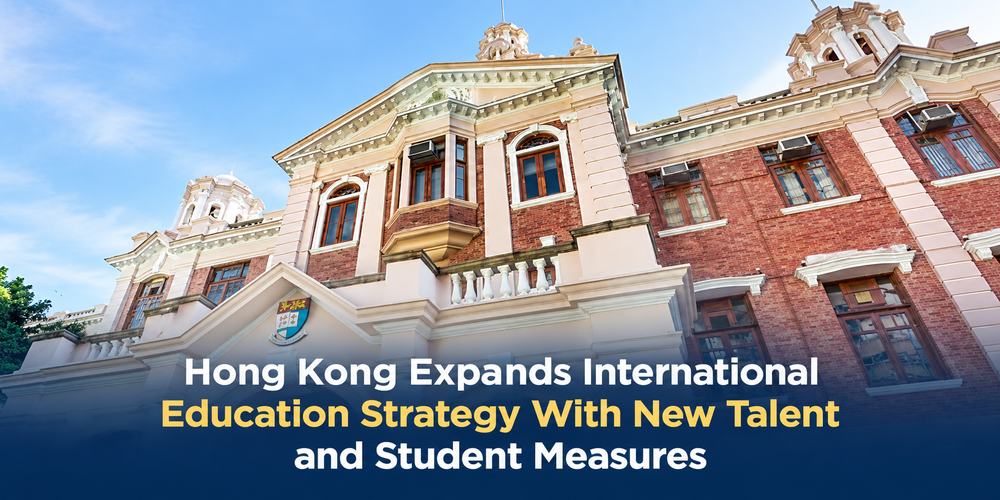
Hong Kong Expands Plans to Build International Education and Talent Hub
New measures include the “Study in Hong Kong” brand, overseas student recruitment and expanded accommodation
Hong Kong has outlined a series of measures to strengthen its position as an international education and talent hub, with the 2026 Policy Address placing greater emphasis on attracting overseas students, developing talent for technology and industry, expanding student accommodation and adjusting immigration arrangements.
The government said it plans to promote the integrated development of education, technology and talent, while strengthening coordination among universities, research institutions, innovation platforms and businesses. It also plans to introduce the “Study in Hong Kong” brand as part of a broader strategy to attract international students and overseas professionals.
The policy address notes that Hong Kong placed fourth in the World Talent Ranking in the previous year and third globally in education competitiveness, while five Hong Kong universities were among the world's top 100. These figures are cited by the government as part of the context for its plans to further develop education and talent initiatives.
Hong Kong to Strengthen International Education Promotion
A central part of the strategy is the expansion of Hong Kong's international education profile. The Education Bureau has established a Task Force on Study in Hong Kong and organised the first “Study in Hong Kong Week”, alongside the 2026 Asia-Pacific Association for International Education Conference and Exhibition.
The government also highlighted the first International Symposium of the Alliance of Universities of Applied Sciences, which brought education leaders together to discuss developments and challenges in post-secondary education. These initiatives are intended to strengthen Hong Kong's international education network while increasing its visibility among prospective students and institutions overseas.
Under the new plans, Hong Kong will expand the “Hong Kong: Your World-class Campus” international promotion campaign and organise exhibitions in selected overseas markets, including countries and regions along the Belt and Road.
Universities funded by the University Grants Committee (UGC) are also planning more than 160 recruitment activities in mainland China and overseas during the 2026/27 academic year. The activities are intended to attract students from different international markets and increase awareness of Hong Kong's higher education opportunities.
Pilot Arrangement for GBA University Graduates to Be Extended
The government also plans to extend by two years a pilot arrangement covering graduates of Hong Kong universities' campuses in the Guangdong-Hong Kong-Macao Greater Bay Area (GBA) under the Immigration Arrangements for Non-local Graduates.
The extension is intended to provide additional opportunities for eligible graduates to remain in Hong Kong or move to the city for employment after completing their studies at participating GBA campuses. The measure forms part of the government's wider approach of linking higher education with talent development and employment pathways.
Student Accommodation Capacity to Be Expanded
The policy address also focuses on one of the practical requirements associated with attracting more international students: student accommodation. The government's Hostels in the City Scheme, launched in July 2025 by the Development Bureau and Education Bureau, encourages the conversion or redevelopment of existing commercial properties into privately operated student hostels.
According to the 2026 Policy Address, 41 applications have been confirmed under the scheme, representing about 10,800 bed spaces. The Development Bureau also plans to put its first student hostel site up for sale during the current financial year.
The Education Bureau will additionally support the Hong Kong Direct Subsidy Scheme Schools Council in developing a Code of Practice for Operating Student Hostels. The proposed standards will cover areas including accommodation, hygiene, safety and warden arrangements, particularly for facilities accommodating non-local students and minors. The measures are intended to address both the availability and operating standards of accommodation as Hong Kong seeks to attract students from outside the city.
More Direct Subsidy and International Schools Planned
Hong Kong is also continuing its Direct Subsidy Scheme (DSS) Expansion to encourage participating schools to admit more non-local students. The government says 48 DSS schools have so far been approved to participate in the programme, with these schools beginning to admit new overseas students progressively from September 2026.
In addition, the government plans to allocate sites in the Northern Metropolis or other areas next year for the development of international schools. The stated objective is to respond to demand while supporting wider talent-development efforts.
Together, the measures cover different stages of international education, from school-level provision and accommodation to university recruitment and post-study employment opportunities.
Talent Visa Rules to Focus More on Technology
The 2026 Policy Address also proposes changes to Hong Kong's talent immigration arrangements. The government is considering adding more occupations related to artificial intelligence applications to its Talent List. The existing list covers 60 professions experiencing local talent shortages, including areas such as finance, healthcare and innovation and technology.
Another proposed change concerns technology entrepreneurs entering Hong Kong through the Top Talent Pass Scheme (TTPS). The government plans to relax certain extension-of-stay requirements for eligible technology start-up founders supported by designated public-sector organisations.
The proposal responds to the financial uncertainty that technology start-ups can face during their early stages. Under the proposed arrangement, qualifying founders would be exempt from requirements such as providing company income evidence when applying for an extension of stay under the TTPS.
New Visa Category Proposed for Short-Term Training
Hong Kong also plans to introduce a new visa category allowing non-local participants to attend short-term training programmes recognised by government bureaux and departments. The measure is intended to support talent exchange and professional training while contributing to Hong Kong's development as a regional training hub.
The government also proposes expanding the Immigration Facilitation Scheme for Invited Persons, extending its coverage beyond ASEAN member states to countries and regions in Central Asia and the Middle East. The proposal would also allow all government bureaux and departments to issue invitations under the scheme.
Education, Technology and Talent to Be Developed Together
The talent measures form part of a wider policy approach that connects higher education with technology, innovation and economic development.
The government says it intends to improve mechanisms for identifying, selecting and developing young innovation talent, while strengthening the role of universities, research institutions, innovation platforms and enterprises in attracting and nurturing skilled professionals.
The 2026 Policy Address also links talent development with technological innovation and industry development, indicating that the government's education strategy is being positioned alongside broader plans for Hong Kong's innovation and technology sectors.
What the New Measures Mean for International Students
For prospective international students, the proposed changes cover several stages of the study-abroad journey. Recruitment campaigns and the “Study in Hong Kong” brand are intended to increase international awareness of Hong Kong's universities, while expanded student accommodation could address an important logistical requirement for incoming students.
The extension of the GBA graduate arrangement could also create an additional pathway for eligible graduates, while the proposed changes to international schools and student hostels broaden the policy beyond university education.
At the same time, the proposed talent visa changes indicate a stronger connection between education, employment and professional development. International graduates and professionals in areas linked to technology, including AI applications, may be affected if the proposed immigration changes are implemented.
Hong Kong's Wider Internationalisation Strategy
The education and talent measures sit within a broader section of the 2026 Policy Address focused on Hong Kong's international role. The government has also outlined plans involving international legal and dispute-resolution services, intellectual property trading and cultural exchange.
Within education specifically, the policy direction combines international student recruitment, infrastructure, school development, graduate mobility and talent immigration. The government says these initiatives are intended to support the development of an international education hub and a hub for high-calibre talent.
Editor’s Note
Hong Kong's 2026 Policy Address presents international education and talent development as closely connected areas, rather than treating student recruitment as an isolated higher education objective. The proposed “Study in Hong Kong” brand, overseas recruitment activities and expansion of student accommodation address the infrastructure and visibility needed to attract more international learners. At the same time, extending the GBA graduate arrangement and considering changes to talent visas creates a stronger link between education, employment and longer-term professional mobility.
For international students, the significance of these measures will depend on how the proposed initiatives are implemented and how individual eligibility requirements develop. The policy nevertheless outlines a broad framework covering recruitment, accommodation, school and university capacity, graduate pathways and professional mobility. By combining these elements, Hong Kong is seeking to position education as part of a wider strategy involving technology, innovation and talent development.
Frequently Asked Questions
1. What is Hong Kong's “Study in Hong Kong” initiative?
The “Study in Hong Kong” brand is part of the government's strategy to promote Hong Kong's post-secondary education internationally and attract students from overseas.
2. How many overseas recruitment activities are planned?
UGC-funded universities plan to conduct more than 160 recruitment activities in mainland China and overseas during the 2026/27 academic year.
3. Will Hong Kong expand student accommodation?
Yes. Under the Hostels in the City Scheme, 41 applications had been confirmed, representing about 10,800 bed spaces, and the government plans to put its first student hostel site up for sale during the current financial year.
4. Will more international schools be developed?
The government plans to allocate sites in the Northern Metropolis or other areas in 2027 for international school development.
5. What is changing for GBA university graduates?
The government plans to extend by two years the pilot arrangement that includes graduates from Hong Kong universities' GBA campuses under the Immigration Arrangements for Non-local Graduates.
6. Will Hong Kong expand its Talent List?
The government is considering adding more occupations related to AI applications to the Talent List, which currently covers 60 professions experiencing local talent shortages.
7. Is a new training visa being proposed?
Yes. The government plans to introduce a new visa category for non-local participants attending recognised short-term training programmes in Hong Kong.
8. What is the focus of the proposed talent visa changes?
The proposals focus on attracting skills needed for Hong Kong's development, supporting technology start-up founders and facilitating international talent exchange and training.

Skoobuzz
 Skoobuzz
 Skoobuzz
 Skoobuzz
 Skoobuzz
 Skoobuzz


0 Comments (Please Login To Continue)