








Education Malaysia Global Services Wins Student Support Award at PIEoneer Awards 2026
EMGS receives global recognition as Malaysia expands efforts to attract international students.
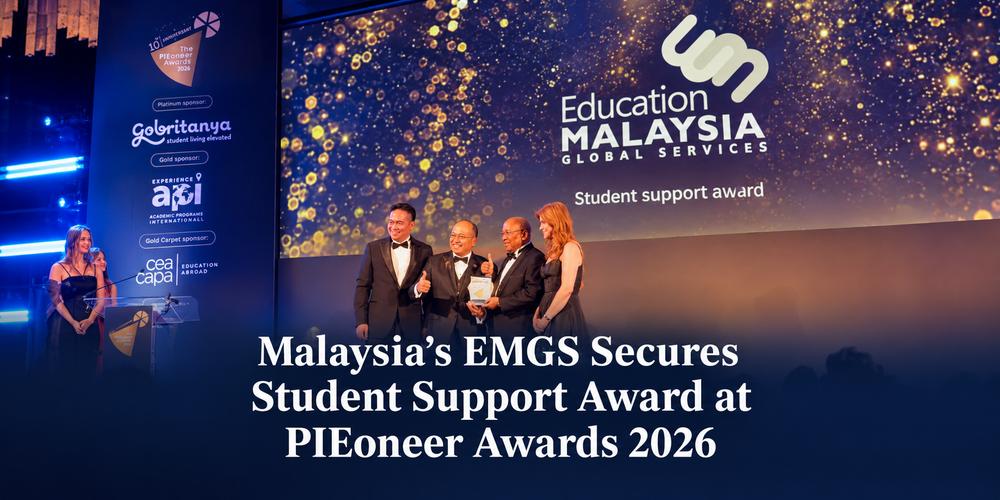
Education Malaysia Global Services (EMGS) has received international recognition for its efforts to support international students after winning the Student Support Award at The PIEoneer Awards 2026 for its International Student Arrival Centre (ISAC). The award was presented on September 4 at London’s historic Guildhall during the 10th anniversary edition of The PIEoneer Awards, widely recognised as a major international education industry event.
The recognition comes at a significant time for Malaysia as the country works to strengthen its position as an international higher education destination and diversify its international student population. Alongside promoting Malaysian universities overseas, EMGS is increasingly focusing on student experience, visa support and arrival services as important components of the country's international education strategy.
The award was received by EMGS chairman Datuk Ahmad Shalimin Ahmad Shaffie and chief executive officer Novie Tajuddin, accompanied by board member Dzariman Ibrahim. EMGS's ISAC was recognised alongside established UK organisations, including UCAS and the UK Council for International Student Affairs (UKCISA), highlighting the international significance of its student-support model.
EMGS Recognised for International Student Support
The Student Support Award recognises the International Student Arrival Centre, which was established by EMGS in 2018. The organisation describes ISAC as the world's first and only dedicated arrival centre for international students positioned before immigration clearance at Malaysian international airports.
The centre forms part of EMGS's wider role in managing the international student journey. Unlike models where university admissions, visa processing and student support are handled through separate institutions, EMGS combines several functions under one organisation. This integrated approach allows international students to receive assistance from the visa-processing stage through their arrival in Malaysia, potentially making the transition into a new country more structured and accessible.
According to Shalimin, this integrated model gives Malaysia an advantage as it seeks to compete with established international education destinations. He highlighted EMGS's role not only in promoting Malaysian higher education but also in processing student visas and monitoring international students after they arrive in the country.
Malaysia Targets New International Student Markets
The PIEoneer recognition comes as Malaysia intensifies efforts to expand and diversify its international student population. The country currently hosts around 167,000 international students, with China, Indonesia, Bangladesh, India and Pakistan among its major source markets. EMGS has set an ambition of increasing the international student population to 500,000 by 2035, making the development of new recruitment markets an important part of its long-term strategy.
The United Kingdom and Ireland are among the markets Malaysia is increasingly targeting. EMGS has been using education fairs, community engagement programmes and targeted outreach campaigns to introduce Malaysian higher education opportunities to students and families who may not have previously considered the country as a study destination.
This strategy reflects growing competition within the international education sector. As students and families become increasingly conscious of tuition fees, living expenses, employability and student support, destinations such as Malaysia can position affordability and a supportive student experience as important alternatives to more expensive traditional destinations.
UK Outreach Highlights Malaysia’s Affordability
As part of its UK campaign, EMGS recently organised an engagement session at London Central Mosque, where prospective students and families discussed higher education opportunities in Malaysia, affordability, visa guidance, student support and facilities designed to accommodate different cultural and religious needs.
Novie said discussions during the event indicated that the rising cost of higher education in the UK was becoming a concern for some families. This creates an opportunity for Malaysia to position itself as a comparatively affordable international study destination while offering students the experience of studying abroad.
The outreach also highlighted the importance of understanding the specific needs of different student communities. For some prospective students, affordability is only one consideration; cultural familiarity, religious facilities, student welfare and the overall ease of adapting to a new environment can also influence destination decisions. By addressing these factors directly, Malaysia is attempting to build a more targeted international recruitment strategy.
Students attending the London engagement session also expressed interest in Malaysia as a destination that could provide both an overseas academic experience and exposure to a different culture. Their responses suggest that Malaysia's appeal may extend beyond cost considerations to include the broader experience associated with international study.
Malaysia Expands Education Promotion in the UK
EMGS's UK outreach has extended beyond formal education events. The organisation also participated in the Malaysia Carnival at Brickendonbury, an annual event organised by the High Commission of Malaysia in London that attracted more than 3,000 visitors.
The carnival provided EMGS with an opportunity to engage directly with members of the community and share information about Malaysian higher education alongside the country's culture, food, performances and tourism. Such community-based outreach can be particularly useful for destinations seeking to build awareness among prospective students and families who may not actively engage with conventional international education fairs.
Malaysian High Commissioner to the UK Datuk Indera Dr Azfar Mohamad Mustafar also highlighted the role of Malaysian students already studying in the UK. He suggested that these students could act as informal ambassadors for Malaysia by introducing British communities to Malaysian culture and helping build awareness of the country as an education destination in Southeast Asia.
Student Welfare at the Centre of Malaysia’s Strategy
The recognition for ISAC highlights a broader shift in the international education sector, where student support is increasingly becoming an important factor in destination competitiveness. Universities and governments are no longer competing solely on rankings, programmes and tuition costs. The quality of the student journey—from application and visa processing to arrival, accommodation and integration—can significantly influence how international students perceive a destination.
Novie said the PIEoneer award demonstrates what Malaysia can achieve when innovation and student care are brought together. He described ISAC as a potential global benchmark for international student support and emphasised that student welfare should remain central to Malaysia's international education strategy.
For Malaysia, this approach could become increasingly important as it seeks to expand beyond its traditional recruitment markets. Attracting more students is only one part of the challenge; ensuring that those students receive effective support throughout their academic journey will be critical to sustaining the country's reputation as a reliable international education destination.
What the PIEoneer Award Means for Malaysia
The Student Support Award provides EMGS with international recognition at a time when Malaysia is seeking to increase its visibility in the global higher education market. The recognition could strengthen the country's positioning among prospective students who place importance on accessibility, affordability and structured support when choosing where to study.
More broadly, the award demonstrates that student services can become an important element of national education strategy. Malaysia's ambition to reach 500,000 international students by 2035 will require sustained recruitment efforts, but long-term growth will also depend on whether the country can deliver a consistent and positive experience for students from diverse backgrounds.
The combination of international recruitment, centralised visa services and arrival support gives EMGS a distinctive model to build upon. If Malaysia can continue improving these services while strengthening the academic quality and global reputation of its universities, the country could further establish itself as a competitive higher education hub in Southeast Asia.
Editor’s Note
EMGS's success at the PIEoneer Awards 2026 is significant because it places student experience at the centre of Malaysia's international education ambitions. In an increasingly competitive global market, affordability may attract students initially, but effective support can play an equally important role in determining whether a destination earns their long-term confidence. The International Student Arrival Centre addresses a practical but often overlooked part of international mobility: the transition from being an accepted student to actually arriving and beginning life in a new country.
Malaysia's strategy is also notable because it combines international recruitment with an integrated administrative model. By bringing promotion, visa processing and aspects of student support under one agency, EMGS is attempting to simplify what can otherwise be a complicated process for international students. This could become a valuable differentiator as students compare destinations not only on university rankings and fees but also on how efficiently and safely they can navigate the journey from application to arrival.
The UK's growing cost pressures provide Malaysia with another opening. However, attracting students from markets such as the UK and Ireland will require more than presenting Malaysia as a cheaper alternative. Students will also look closely at academic quality, graduate outcomes, international recognition, campus facilities and career opportunities. The real test for Malaysia will therefore be whether its affordability and student-support advantages can be combined with a compelling academic proposition.
The PIEoneer award gives EMGS valuable international validation, but the larger challenge is sustaining that momentum. If Malaysia can turn strong student-support infrastructure into a consistently positive international student experience, it will be better positioned to achieve its ambitious 2035 enrolment target and strengthen its reputation as a serious global education destination.
Frequently Asked Questions
1. What award did EMGS win at the PIEoneer Awards 2026?
Education Malaysia Global Services won the Student Support Award at The PIEoneer Awards 2026 for its International Student Arrival Centre. The award recognised EMGS's efforts to improve support for international students arriving in Malaysia.
2. What is the International Student Arrival Centre?
The International Student Arrival Centre, or ISAC, was established by EMGS in 2018 to provide dedicated assistance to international students arriving in Malaysia. It is located before immigration clearance at Malaysian international airports and is designed to support students during the arrival process.
3. Why is the EMGS award important for Malaysia?
The award provides international recognition for Malaysia's approach to international student support at a time when the country is seeking to expand its global higher education presence. It also strengthens the country's positioning around student welfare, accessibility and a more coordinated international student journey.
4. How many international students are currently studying in Malaysia?
Malaysia currently has around 167,000 international students, with China, Indonesia, Bangladesh, India and Pakistan among its major source markets. EMGS has set a longer-term ambition of reaching 500,000 international students by 2035.
5. Why is Malaysia targeting students from the UK and Ireland?
Malaysia is seeking to diversify its international student population beyond traditional recruitment markets. The UK and Ireland offer potential new markets, particularly among families looking for more affordable international higher education options while still providing students with an overseas academic and cultural experience.
6. How is EMGS promoting Malaysia in the UK?
EMGS is using education fairs, community engagement and targeted outreach to promote Malaysian higher education. Its activities have included engagement sessions with prospective students and families as well as participation in community events such as the Malaysia Carnival at Brickendonbury.
7. What makes Malaysia attractive to international students?
Malaysia can offer international students a combination of comparatively affordable education, multicultural experiences, established higher education institutions and support services. The country's location in Southeast Asia can also provide students with exposure to a diverse regional environment.
8. What is EMGS's role in Malaysia's international education system?
EMGS plays an integrated role in promoting Malaysian higher education, processing student visas and supporting and monitoring international students. Its International Student Arrival Centre extends this support to the crucial stage when students arrive in Malaysia and begin their academic journey.

Skoobuzz


 Skoobuzz
 Skoobuzz
 Skoobuzz
 Skoobuzz


0 Comments (Please Login To Continue)