








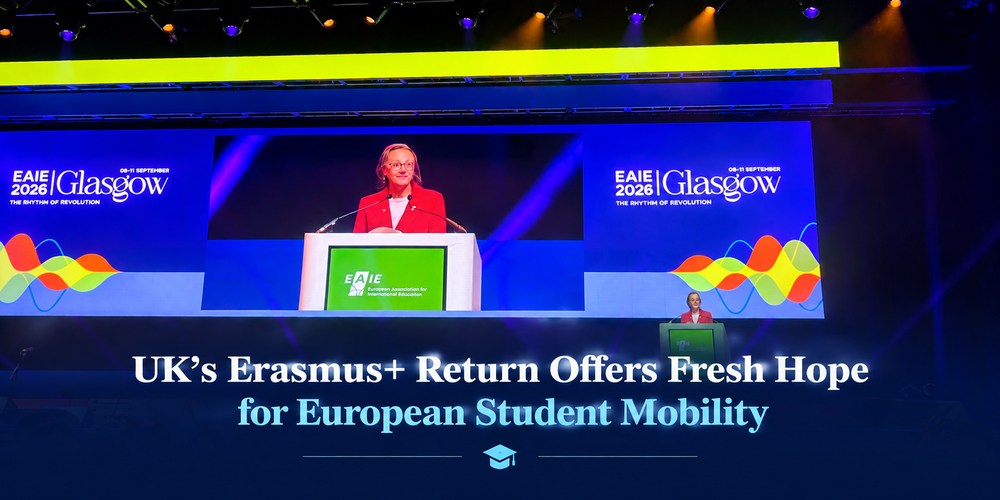
European Association of International Education President Calls on to Embrace Uncertainty and Erasmus+ Reset
Renewed Erasmus+ cooperation highlighted as Europe responds to uncertainty and changing education priorities.
International education leaders have been urged to confront growing geopolitical and policy uncertainty with greater clarity, cooperation and a willingness to adapt as the sector prepares for a major reset in European student mobility. Opening the European Association of International Education (EAIE) conference in Glasgow, EAIE President Sarah Lopez Selga told around 7,000 delegates that international education is operating in an increasingly unpredictable environment, but argued that uncertainty should not become a reason for institutions to retreat from collaboration or compromise on their values.
Lopez Selga said shifting policies, funding pressures and conflicts around the world were creating a sense that the international education landscape was changing faster than institutions could respond. Against this backdrop, she positioned the conference theme, “the rhythm of revolution,” as more than a slogan, calling on universities and international education professionals to rethink how they cooperate, communicate and respond to global challenges. She stressed that the sector's strength lies in its ability to connect people across borders and create meaningful relationships through education.
International education must respond to a changing world
Lopez Selga acknowledged that international education is facing significant uncertainty as institutions navigate changing government policies, financial pressures and geopolitical tensions. However, she argued that the sector has an important advantage because it is simultaneously rooted in local communities and exposed to global developments. The presence of thousands of professionals from different countries at the Glasgow conference, she said, demonstrated the continuing importance of meeting in person and maintaining international relationships even when political and economic conditions become more difficult.
The EAIE president also highlighted dialogue and cooperation as essential tools for navigating an unsettled environment. Rather than avoiding difficult conversations, international education institutions should create opportunities for candid discussions across cultures and identities. She suggested that experiential learning, face-to-face engagement and cross-border collaboration can themselves become forms of meaningful change, particularly at a time when mistrust and division are becoming more prominent in international relations.
According to Lopez Selga, the sector has historically been strongest when it has chosen dialogue over avoidance and cooperation over mistrust. Her message places greater responsibility on universities and international education organisations to actively shape the environment in which global learning takes place rather than simply reacting to external policy changes.
UK return to Erasmus+ creates new opportunity
One of the most significant developments highlighted at the conference was the planned return of the United Kingdom to Erasmus+ from 2027, alongside Switzerland. Lopez Selga described the development as important not simply because it could increase student and staff mobility, but because Erasmus has represented a wider model of European cooperation for generations.
She argued that the UK's return demonstrates that international partnerships once considered difficult or even impossible to restore can be rebuilt when institutions and policymakers continue to work towards them. For international education professionals, the development creates an opportunity to strengthen mobility links and demonstrate the broader value of international exchange at a time when access to overseas education is being reassessed in many countries.
Lopez Selga also cautioned that the sector cannot assume the future of Erasmus+ will automatically be secured. She said stakeholders would still need to make a strong case for the programme to remain a flagship initiative beyond 2028, signalling that universities and international education organisations will have an important role in demonstrating its educational, social and economic value.
Erasmus+ aims to become more inclusive
Roxana Minzatu, Executive Vice President for Social Rights and Skills, Quality Jobs and Preparedness at the European Commission, also addressed delegates on the future of Erasmus+ and the next EU budget. She confirmed that the UK's and Switzerland's participation from 2027 would expand the Erasmus+ family to 35 countries, while stressing that increasing the programme's size should not be the only objective.
Minzatu said the European Commission wants Erasmus+ to become not only larger in terms of funding but also more strategic and inclusive. A central ambition is to make international mobility an opportunity available to a much wider section of society rather than something primarily accessed by students who already have greater financial, academic or social advantages.
She argued that Erasmus should be accessible to all Europeans and that every European should have the opportunity to participate in a mobility programme at least once. Achieving that ambition, however, will require continued support from universities, policymakers and other stakeholders responsible for implementing international education programmes.
Erasmus+ linked to Europe’s skills strategy
The future of Erasmus+ is also being connected to Europe's wider response to skills shortages and changing labour-market demands. Minzatu said the programme could play a stronger role in helping Europe develop and retain its own talent while also supporting efforts to attract skilled people from other parts of the world.
This represents a broader understanding of international education as part of economic and workforce policy rather than solely an academic exchange mechanism. By strengthening international experiences, developing cross-border skills and improving connections between education and employment, Erasmus+ could contribute to Europe's ability to respond to emerging skills gaps while maintaining its global attractiveness.
The emphasis on skills also comes as governments and universities increasingly reassess the relationship between international student mobility, employability and long-term talent development. For institutions, this could mean demonstrating more clearly how international education contributes to students' academic development, professional capabilities and ability to participate in increasingly international labour markets.
A reset for European international education
The discussions in Glasgow highlight a significant moment for European international education. The return of the UK and Switzerland to Erasmus+ offers a practical opportunity to rebuild mobility networks, but the wider message from the EAIE conference is that internationalisation cannot depend solely on programmes or funding. Institutions must also be prepared to engage with uncertainty, maintain partnerships and demonstrate why cross-border education remains valuable.
The challenge will be to turn renewed political momentum into meaningful opportunities for students and staff. If Erasmus+ is to become more inclusive, its benefits will need to reach beyond students who already have the resources and confidence to participate in international mobility. At the same time, universities will need to balance international ambitions with changing economic conditions, skills requirements and public expectations.
For the international education sector, the proposed Erasmus+ reset therefore represents both an opportunity and a responsibility. The expansion of the programme provides a reason for optimism, but its long-term success will depend on whether institutions can translate renewed cooperation into broader participation, stronger partnerships and tangible outcomes for students.
Editor’s Note
The return of the UK and Switzerland to Erasmus+ comes at a particularly important time for international education, as universities and policymakers across Europe confront uncertainty over funding, mobility, skills and geopolitical relationships. The development is significant because it suggests that international cooperation can be rebuilt even after major political changes disrupt established education networks.
However, the real measure of success will not simply be the number of participating countries or the size of the programme's budget. Erasmus+ will have greater long-term impact if it becomes genuinely accessible to students from different socioeconomic backgrounds and if mobility is connected meaningfully to learning, employability and talent development. The Glasgow discussions underline a wider lesson for the sector: uncertainty may be unavoidable, but international education still has the capacity to create connections, strengthen cooperation and provide practical pathways through periods of change.
Frequently Asked Questions
1. What is the significance of the UK returning to Erasmus+?
The UK's planned return to Erasmus+ from 2027 is expected to strengthen European student and staff mobility while rebuilding education links that were disrupted in recent years. It also represents a broader renewal of European cooperation through education.
2. When will the UK rejoin Erasmus+?
The UK is expected to rejoin Erasmus+ from 2027, alongside Switzerland.
3. How many countries will be part of Erasmus+ from 2027?
According to the European Commission, the participation of the UK and Switzerland will bring the Erasmus+ family to 35 countries.
4. What does the EAIE president want international education institutions to do?
Sarah Lopez Selga has urged institutions to respond actively to uncertainty by strengthening dialogue, cooperation and international relationships rather than becoming passive in the face of geopolitical and policy changes.
5. What is the future focus of Erasmus+?
The European Commission is seeking to make Erasmus+ more strategic and inclusive, with stronger links to skills development, talent retention and Europe's response to labour-market shortages.
6. Will Erasmus+ become more accessible?
A key ambition outlined at the conference is to make Erasmus+ a mainstream opportunity rather than one primarily available to a limited group of students. Greater inclusivity is therefore expected to be an important part of its future development.

Skoobuzz

 Skoobuzz


0 Comments (Please Login To Continue)