








Florida State University’s Learning Systems Institute Takes AI in Education to Global Platforms
Present AI-focused education strategies at major international conferences in France and the Netherlands
Florida State University’s Learning Systems Institute (LSI) is expanding its international presence in artificial intelligence and education, with three of its leaders set to present their work at major European conferences this semester.
Rabieh Razzouk, director of LSI; Carrie Meyers, director of education and workforce talent at FSU’s Institute for Strategic Partnerships, Innovation, Research, and Education (FSU InSPIRE); and Jim Reynolds, LSI’s director of STEM outreach, will represent the university at events in Paris, France, and Breda, the Netherlands. Their upcoming presentations highlight FSU’s growing work in AI-supported teaching, workforce development, instructional design and educational innovation.
FSU Experts to Showcase AI Innovations in Europe
The international engagements come as LSI strengthens its role in the rapidly developing field of AI in education. Meyers and Reynolds are leading the development of an AI education pathway through the FSU InSPIRE initiative and have already presented their work to audiences across Florida.
Razzouk, meanwhile, has developed and implemented an AI-assisted instructional support system designed to help Florida teachers. He is also applying AI expertise through the Early Grade Education Activity in Jordan, an initiative focused on strengthening the country’s early-grade education system. Together, these projects demonstrate FSU’s approach to AI as both a teaching tool and a broader capability supporting educators, students and workforce development.
Rabieh Razzouk to Present at UNESCO Digital Learning Week
Razzouk will participate in UNESCO’s Digital Learning Week 2026 in Paris, taking place from September 8 to 11. This year’s event is centred on the theme “Education in the age of AI: Facts, Frictions, Frontiers.” The programme is designed to encourage critical discussion and international collaboration around ethical and human-centred digital transformation in education.
Razzouk will present “Customizing Standards-Aligned Lessons with AI: The CPALMS Experience.” The presentation will examine an AI-assisted instructional support system that enables teachers to adapt existing standards-aligned educational resources to address different student needs more efficiently. The project illustrates how AI can support educators without replacing the professional judgement and expertise required to design effective learning experiences.
LSI Builds on Previous Global AI Engagement
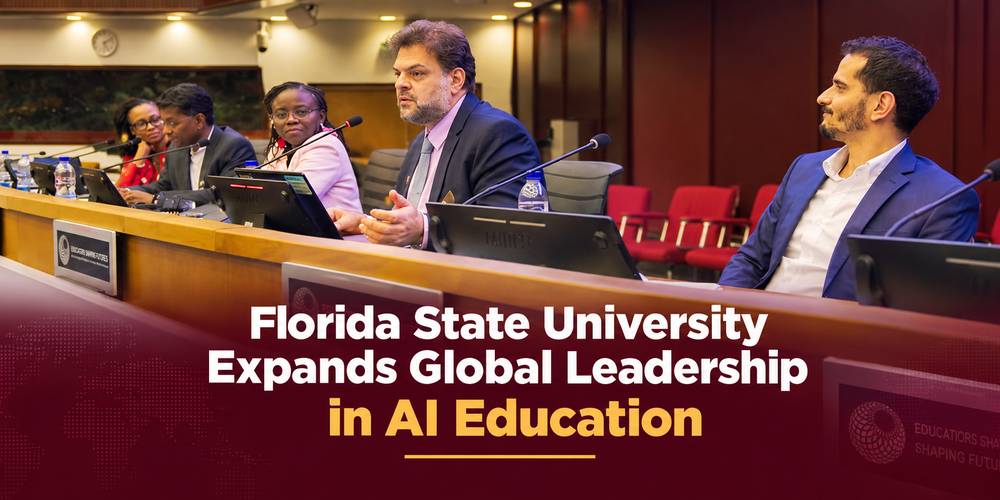
Razzouk’s participation at UNESCO’s event builds on LSI’s previous international work in AI and teacher education. In November 2025, LSI partnered with the World Bank and UNESCO to host Educators Shaping Futures: A Global Knowledge Exchange on Teacher Preparation and Development in Addis Ababa, Ethiopia.
Held from November 2 to 4, the event brought together more than 340 policymakers, teacher educators, researchers and practitioners from 41 countries. Razzouk participated in a panel examining the opportunities and risks associated with AI in teacher education and professional development.
He said LSI has made artificial intelligence a core capability intended to strengthen different areas of its work, including professional learning that helps educators incorporate AI into teaching responsibly and effectively.
FSU InSPIRE Team Heads to Netherlands AI Conference
Meyers and Reynolds will take the university’s AI education work to the Netherlands next month. The pair will present at the inaugural “Teaching and Learning with AI in Europe” conference in Breda on October 19–20.
The event is being co-hosted by Breda University and the University of Central Florida and is intended to encourage cross-border collaboration around AI in higher education. The conference will provide educators and institutions with an opportunity to exchange ideas, discuss emerging practices and explore new approaches to AI-supported teaching and learning. For FSU, the event also offers an opportunity to learn from international institutions and identify approaches that could strengthen its own AI education initiatives.
Using AI to Make Complex Learning More Accessible
Meyers will lead a session titled “From Content to Comics: Using AI-Supported Graphic Novels to Teach Complex Concepts.” Drawing on examples developed by educators participating in FSU InSPIRE, the presentation will explore how AI can support the creation of comics, graphic novels, e-readers and other visual learning resources.
The approach aims to make complex concepts more accessible and engaging while maintaining academic depth and rigor. Rather than presenting AI simply as a content-generation tool, the session positions the technology as a resource that educators and instructional designers can use to develop alternative ways of communicating challenging ideas.
Reynolds to Explore AI-Powered Learning Activities
Reynolds will present “From Prompt to Possibility: Co-Designing Thought-Revealing Activities with AI.” His presentation will focus on prompt engineering and how educators can use AI to co-design authentic learning activities.
The activities are grounded in research surrounding model-eliciting activities, which are designed to reveal how students think and approach complex problems. The session will therefore focus on using AI to enhance instructional design and encourage deeper student thinking rather than relying on the technology simply to automate classroom tasks.
AI Education Becomes Strategic Priority for FSU
The international presentations reflect a broader effort by Florida State University to position AI as an important part of its academic innovation strategy. Paul Marty, associate vice provost for Academic Innovation and professor in FSU’s School of Information in the College of Communication and Information, said the university’s work demonstrates how a major public research institution can adopt disruptive technologies while continuing to prioritise student learning and the public good.
The emphasis is particularly relevant as universities worldwide consider how AI will reshape teaching, assessment, curriculum design and workforce preparation. For FSU, the goal appears to extend beyond adopting new technologies. Its initiatives focus on developing the skills and frameworks educators need to use AI effectively and responsibly.
Why FSU’s Global AI Work Matters
The international visibility of LSI’s work comes at an important moment for higher education. Universities are under growing pressure to prepare students for workplaces where AI will influence everything from research and communication to professional decision-making. At the same time, educators must address concerns surrounding accuracy, ethics, academic integrity and the appropriate role of technology in learning.
FSU’s approach places educators at the centre of that transition. By combining AI research, professional development, instructional design and international collaboration, the university is seeking to develop practical applications rather than treating AI as a purely technological issue.
Its participation in global conferences also creates opportunities for FSU to exchange ideas with institutions facing similar challenges and to contribute its own experience to the international conversation.
Editor’s Note
Florida State University’s growing international profile in AI education reflects a broader shift in how universities are approaching artificial intelligence. The conversation is moving beyond whether educators should use AI toward a more practical question: how can institutions integrate it without compromising educational quality, critical thinking or human judgement?
That distinction is important. AI can make it easier to produce content, adapt resources and develop new learning materials, but technology alone does not guarantee better education. The value depends on how thoughtfully educators incorporate it into curriculum and pedagogy.
LSI’s work is notable because it places professional learning and instructional design alongside technological innovation. Initiatives such as AI-assisted lesson adaptation, visual learning resources and thought-revealing activities focus on how educators can use AI to enhance—not simply automate—the learning process.
Its international engagement also matters. Education systems are confronting many of the same questions about AI, but they are doing so within different cultural, institutional and regulatory environments. Sharing successful approaches across borders can help universities avoid working in isolation and develop more informed strategies.
Ultimately, FSU’s participation in global AI education discussions will be judged not by the number of conferences it attends, but by whether the ideas exchanged translate into meaningful improvements for educators and students. That is where the university’s international AI ambitions could have their greatest impact.
Frequently Asked Questions
1. What is Florida State University’s Learning Systems Institute?
The Learning Systems Institute (LSI) is an FSU institute focused on education, learning systems, professional development, research and innovation.
2. Who from FSU will present on AI in education internationally?
Rabieh Razzouk, Carrie Meyers and Jim Reynolds will represent FSU at international AI and education conferences in France and the Netherlands.
3. Where will Rabieh Razzouk present?
Razzouk will present at UNESCO’s Digital Learning Week 2026 in Paris, France, from September 8–11.
4. What will Razzouk present at UNESCO Digital Learning Week?
His presentation, “Customizing Standards-Aligned Lessons with AI: The CPALMS Experience,” will examine an AI-supported system designed to help teachers adapt educational resources to students’ needs.
5. When will FSU participate in the Netherlands conference?
Carrie Meyers and Jim Reynolds will present at the “Teaching and Learning with AI in Europe” conference in Breda on October 19–20, 2026.
6. What will Carrie Meyers discuss?
Meyers will explore the use of AI-supported comics, graphic novels, e-readers and other visual resources to teach complex concepts.
7. What will Jim Reynolds focus on?
Reynolds will discuss how educators can use prompt engineering and AI to co-design thought-revealing learning activities.
8. Why is FSU focusing on AI in education?
FSU is developing AI-related pathways, instructional tools and professional learning programmes to help educators and students use artificial intelligence effectively and responsibly.

Skoobuzz

 Skoobuzz

 Skoobuzz
 Skoobuzz
 Skoobuzz


0 Comments (Please Login To Continue)