








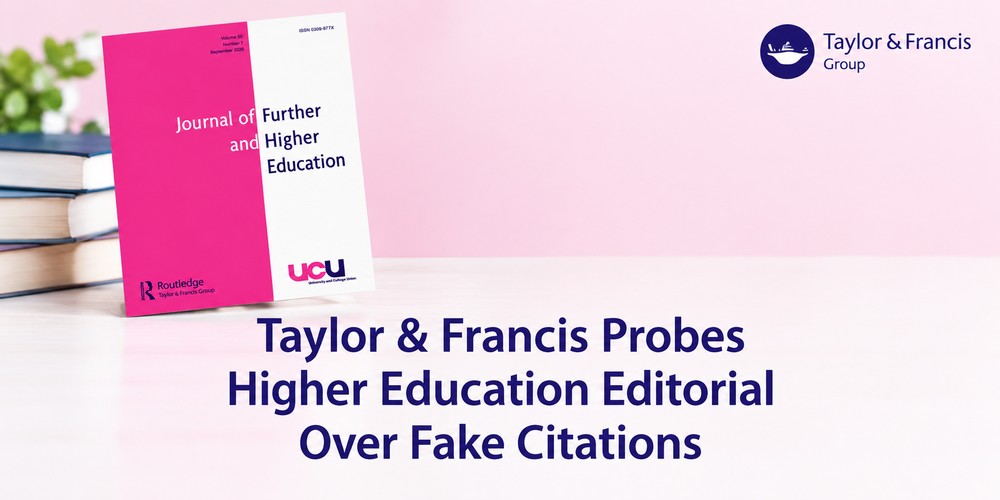
Editors of Higher Education Journal Coauthor Editorial With Fake References
Taylor & Francis Investigates Editorial After Multiple Citation Errors and Fabricated References Are Identified
Taylor & Francis is investigating an editorial published in the Journal of Higher and Further Education (JHFE) after an examination found multiple fabricated references, incorrect author attributions and citation errors in the article.
The editorial, published in May, focused on threats to academic freedom and the challenges facing social justice research in higher education. It was coauthored by JHFE coeditors Anastasia Christou and Steve Lambert, along with deputy editor Rosalind Latiner Raby.
However, an analysis of the article’s 31 references has identified at least nine that either appear to be nonexistent or contain significant errors involving journal titles, authors and article details.
The discovery raises renewed concerns about the use of artificial intelligence in academic publishing. Large language models can generate convincing but nonexistent citations, commonly described as AI “hallucinations,” making verification of references increasingly important in scholarly publishing.
Taylor & Francis Investigates Citation Concerns
A spokesperson for Taylor & Francis confirmed that its publishing ethics and integrity team is investigating the concerns raised about the editorial. The publisher declined to provide further details while the investigation is ongoing. Lambert, an associate professor of educational leadership at the University of Chester in England, said he could not comment until the publisher had completed its investigation.
Christou, a social justice professor at Middlesex University in London, and Raby, a director at California Colleges for International Education, did not respond to requests for comment. The investigation comes as academic publishers face increasing scrutiny over the reliability of research references and the possible role of generative AI in scholarly writing.
Researchers Say Articles Were Wrongly Attributed
Several scholars whose names appear in the editorial’s reference list have said they did not write the papers attributed to them. One reference identifies John Skrentny, a professor at the University of California, San Diego, as the author of a 2025 article on self-censorship in higher education published in the Journal of Higher Education.
Skrentny said he did not write the article and had never published or submitted a paper to that journal. Another fabricated citation attributes a nonexistent paper on academic freedom in Higher Education Policy to Brendan Cantwell, a higher education researcher at Michigan State University.
Cantwell said the cited article was not his work and described it as a presumed fabricated citation. Searches through Google Scholar also failed to locate several of the papers listed in the editorial. Some links returned messages indicating that the articles could not be found, while other links led to publications written by different authors.
Real Research Also Listed Under Incorrect Authors
The citation problems are not limited to apparently fabricated papers. The editorial also references genuine academic work but assigns it to incorrect authors. One example is the 2025 article, “Decolonising Solidarity in Higher Education: Navigating Barriers and Enablers in Advocacy with People from Displaced Backgrounds,” published in the International Journal of Inclusive Education.
The JHFE editorial identifies the authors as Stevenson, J., M. Asamoah, N. Bouakkaz and E. Swanby. However, the actual paper was written by Melanie Baak and colleagues. Baak confirmed that the citation refers to the article her team produced but said the listed author team was incorrect.
The problem becomes more significant because sections of the JHFE editorial appear to paraphrase material from genuine research while attributing that material to fabricated references. For example, content drawn from Baak’s research appears to have been paraphrased in the editorial but attributed to the nonexistent Cantwell paper.
This means the issue involves more than isolated mistakes in a bibliography. Incorrect attribution can affect how researchers receive credit for their work and can make it difficult for readers to trace the evidence supporting an academic argument.
Fake References Raise Questions About AI Use
Fabricated academic references have increasingly become a concern for scholarly publishers. Generative AI systems can produce plausible-looking citations that do not exist, particularly when users ask them to generate literature reviews or supporting references. Such citations can contain realistic author names, journal titles, publication dates and article subjects while remaining entirely fictional.
However, the presence of fabricated references alone does not establish that AI was used to produce the JHFE editorial. Taylor & Francis has not publicly stated that artificial intelligence was responsible for the errors, and the publisher’s investigation is still underway.
The episode nevertheless highlights the importance of human verification in academic publishing, particularly when articles are written or reviewed by individuals with editorial responsibilities.
Part of a Wider Academic Publishing Problem
The JHFE editorial is not an isolated case. Recent investigations have identified fabricated references in papers published by other academic journals. In March, an investigation reported that 12 of 14 references in a paper published by Springer Nature appeared not to exist. A paper published in the Journal of Academic Ethics was also previously found to contain fabricated references.
Another case involved a paper that had reportedly been rejected because of concerns about AI-generated fake references before later appearing in the World of Media with few substantive changes. These cases demonstrate how fabricated citations can move through different stages of the research and publishing process if adequate verification is not carried out.
Why Accurate Citations Matter in Higher Education
Academic citations serve a fundamental purpose: they allow readers to verify claims, locate original research and understand how new arguments are connected to existing scholarship.
When references are fabricated or incorrectly attributed, that chain of verification breaks down. The consequences can be particularly serious when the subject involves academic freedom, social justice or other areas where arguments depend heavily on established research and scholarly debate.
The case also raises questions about editorial accountability. Editors are responsible not only for shaping a journal’s academic direction but also for maintaining standards of research integrity and publication quality.
The Journal of Higher and Further Education describes itself as an international, peer-reviewed, open-access journal covering the broader field of post-16 education and training.
Its editorial concludes by expressing gratitude to researchers whose work appears in the journal and reaffirming a commitment to expanding the space for critical inquiry and inclusive knowledge. The ongoing investigation will determine how the citation problems occurred and whether further action is required.
Editor’s Note
The concerns surrounding the JHFE editorial extend beyond a flawed reference list. In academic publishing, citations are part of the infrastructure of trust: they show where an argument comes from, let readers examine the evidence, and ensure researchers receive appropriate recognition for their work.
That makes fabricated or incorrectly attributed references especially troubling when they appear in an editorial written by senior journal editors. Editorial leadership carries an additional responsibility because the people shaping a publication’s standards are also expected to model those standards.
At the same time, it is important not to conclude the cause before Taylor & Francis completes its investigation. The appearance of fabricated references may raise questions about generative AI, but the available evidence does not establish that AI was responsible for this particular editorial.
The larger lesson is therefore about verification rather than technology alone. As generative AI becomes increasingly embedded in academic writing, publishers, editors, reviewers and researchers will need stronger systems for checking references and tracing claims back to their original sources.
For higher education, where debates increasingly depend on evidence and scholarly credibility, accurate attribution is not a technical detail. It is fundamental to maintaining confidence in the research ecosystem.
Frequently Asked Questions
1. What happened to the Journal of Higher and Further Education editorial?
An editorial published in the journal was found to contain multiple apparently fabricated references, incorrect author names, wrong journal details and other citation errors. Taylor & Francis is investigating the concerns.
2. How many problematic references were identified?
At least nine of the editorial’s 31 references were found to be nonexistent or to contain significant inaccuracies.
3. Were real researchers named as authors of papers they did not write?
Yes. Researchers including John Skrentny and Brendan Cantwell said they did not write the papers attributed to them.
4. Does this prove that AI was used to write the editorial?
No. Fabricated references can be associated with generative AI, but the citation problems do not by themselves establish that AI was used. Taylor & Francis has not publicly confirmed the cause.
5. Why are fabricated academic references a serious issue?
References allow readers to verify research and trace the evidence behind academic claims. Fabricated or inaccurate citations can undermine scholarly credibility, misattribute researchers’ work and make independent verification difficult.
6. What is Taylor & Francis doing about the issue?
Taylor & Francis has said its publishing ethics and integrity team is investigating the concerns. The publisher has not provided further details while the investigation continues.

Skoobuzz

 Skoobuzz
 Skoobuzz
 Skoobuzz

 Skoobuzz


0 Comments (Please Login To Continue)