








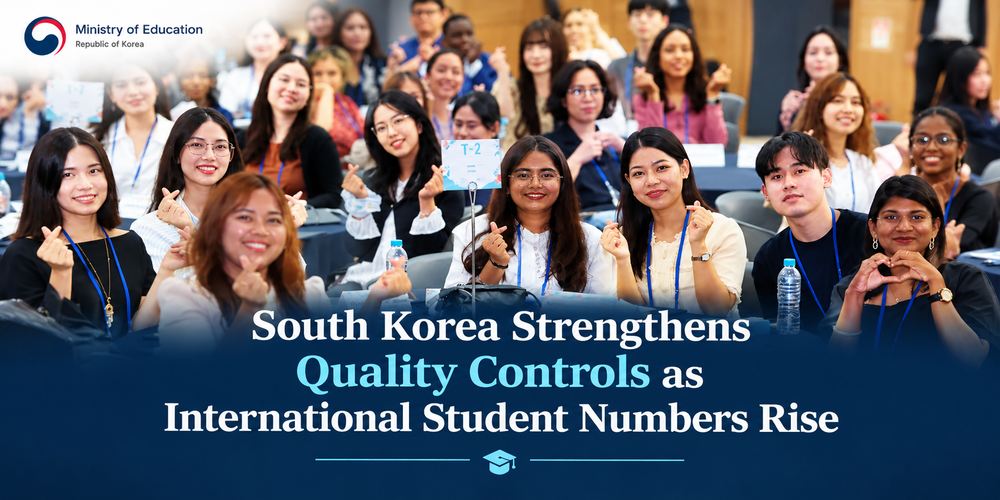
Korea Shifts International Student Strategy From Quantity to Quality
South Korea is tightening university oversight and recruitment practices while prioritising high-quality students
South Korea is moving into a new phase of its international education strategy, shifting away from simply increasing the number of overseas students toward improving the quality of education, strengthening student protections and retaining high-performing graduates.
The Ministry of Education has introduced a new policy framework, “Study Korea: Talent Project,” aimed at strengthening oversight of universities and student recruitment agencies, improving the verification of overseas academic credentials and creating stronger support systems for international students. The move comes after the number of international students in South Korea exceeded 300,000, reaching the government’s original target earlier than expected.
The policy signals a broader change in how South Korea views international education. Rather than treating international enrolment primarily as a measure of global competitiveness, authorities are increasingly linking overseas student recruitment with academic quality, employment opportunities, regional development and the country’s need for skilled talent.
South Korea Tightens Oversight of International Student Recruitment
A key element of the new strategy is stronger supervision of recruitment agencies that help international students select Korean universities. These agencies play an important role in the student decision-making process, particularly for applicants unfamiliar with the Korean higher education system.
According to the Education Ministry, a survey of 8,300 international students found that 17.8% considered recommendations from recruitment agencies a major factor in choosing their university. At the same time, concerns have emerged over misleading promotional claims, exaggerated information and cases involving falsified academic documents.
To address these issues, the government plans to introduce a standardised contract between universities and recruitment agencies during the second half of 2026. The agreement will prohibit false or exaggerated advertising and introduce greater financial protection for students. Universities will be required to directly refund tuition fees when admission is cancelled because of visa-related issues.
The government will also introduce guidelines for verifying foreign degrees during admissions and transfer procedures. Universities will receive consultation and support to strengthen their systems for checking overseas academic credentials, helping reduce the risk of fraudulent documentation entering the higher education system.
IEQAS to Introduce Stricter Quality Standards
South Korea is also preparing a major overhaul of the International Education Quality Assurance System (IEQAS), which evaluates universities on areas including academic programmes and student support services.
The revised system, scheduled to apply from 2029 to 2032, will make several evaluation indicators that are currently voluntary into mandatory requirements. Language standards will also gradually become stricter through 2030, with the government aiming to increase the proportion of international students achieving specified levels on officially recognised language proficiency tests from 40% to 60%.
Academic quality and student support will receive greater attention under the revised framework. Universities that fail to obtain accreditation or are judged to have financial or operational risks for two consecutive years could face restrictions on issuing student visas. Such institutions could also be placed in the lowest IEQAS category, with limits imposed on international freshman enrolment.
The existing IEQAS framework will continue to operate until the end of 2028, giving universities time to prepare for the stricter requirements.
More Inspections and Greater Student Protection
The Education Ministry also plans to expand on-site inspections of universities where concerns have been reported about international student programmes, academic conditions or human rights. Ten universities will be selected for inspection each year, increasing direct government scrutiny of institutions that may not be meeting expected standards.
This approach reflects an important shift in South Korea’s international education policy. As international enrolment grows, simply attracting students is no longer enough. Universities will increasingly be expected to demonstrate that they can provide appropriate academic programmes, adequate student services and a safe environment for overseas learners.
For international students, stronger oversight could offer greater protection against poor-quality programmes, misleading recruitment practices and institutions that lack the resources to properly support overseas learners.
STEM Students Become a Strategic Priority
The new policy also places greater emphasis on attracting international students in science, technology, engineering and mathematics (STEM) fields. The government wants international education to contribute more directly to advanced industries, regional economies and South Korea’s long-term talent requirements.
The proportion of master’s and doctoral students receiving Global Korea Scholarship (GKS) support through STEM programmes increased from 40.9% in 2025 to 43% in 2026. The government has set a target of reaching 45% by 2027.
Additional visa-related incentives for STEM scholarship recipients are also being considered. South Korea plans to strengthen connections between international students and senior students to improve their academic and social experience while studying in the country.
The strategy indicates that scholarships and international student recruitment are increasingly being used as tools for talent development rather than simply increasing foreign enrolment.
Universities Could Receive More Support for High-Value Programmes
Beginning next year, South Korea will introduce a quality assurance framework for academic majors considered particularly suitable for international students. Programmes that demonstrate strong connections with regional industries and positive employment or residency outcomes for international graduates could become eligible for government support.
Such programmes may receive benefits including government subsidies and scholarships, creating an incentive for universities to develop courses that respond to both international student demand and local labour-market needs.
This could be particularly significant for universities outside South Korea’s largest metropolitan areas. By linking international education with regional industries, the government hopes to encourage students to study and potentially build careers in areas facing talent shortages.
New Rules to Clarify University Responsibilities
The policy shift will also involve changes to South Korea’s legal and institutional framework. An amendment to the Higher Education Act is expected to clarify the responsibilities of both the government and universities in supporting international students.
The amendment would also establish a legal foundation for corrective action against illegal or inappropriate practices, giving authorities stronger tools to respond when institutions or recruitment agencies fail to meet required standards.
The proposed changes therefore extend beyond recruitment numbers. They seek to establish a more structured international education ecosystem in which universities are accountable for the quality of programmes, recruitment practices and student support.
What the Policy Means for International Students
For prospective international students, South Korea’s new approach could ultimately mean that the quality and relevance of a chosen programme become more important than simply gaining admission to a Korean university.
Students should examine whether their institution has appropriate quality assurance credentials, whether the programme offers meaningful academic and career opportunities and whether recruitment information comes directly from reliable university or government sources. Applicants should also carefully verify tuition fees, scholarship conditions, visa requirements and potential employment opportunities before making a decision.
The increasing emphasis on STEM, regional industries and graduate employment suggests that students whose academic and career plans align with South Korea’s economic priorities could find stronger opportunities in the years ahead. At the same time, universities that depend heavily on international enrolment will face greater pressure to demonstrate that they can deliver genuine academic value and adequate student support.
South Korea’s International Education Strategy Enters a New Phase
South Korea’s decision to prioritise quality over quantity reflects the changing nature of global competition for international students. With overseas enrolment already surpassing 300,000, the immediate challenge is no longer simply attracting larger numbers. The country now needs to ensure that international students receive a strong educational experience and that talented graduates can contribute meaningfully to its economy and communities.
Education Minister Choi Kyo-jin described the milestone as evidence of South Korea’s growing appeal to global talent, while stressing the importance of attracting and developing capable students. The government’s latest strategy suggests that international education will increasingly be connected to workforce development, innovation and regional growth.
For South Korea, the next stage of internationalisation will therefore be measured not only by how many students arrive, but by who they are, what they study, how they are supported and what opportunities they have after graduation.
Editor’s Note
South Korea’s latest international education strategy represents a notable departure from the traditional race to increase international enrolment. Crossing the 300,000-student mark ahead of schedule demonstrates that the country has succeeded in making its universities more visible to global learners. However, rapid growth can also expose weaknesses in recruitment, academic quality and student support, particularly when universities rely heavily on third-party agencies.
The decision to strengthen IEQAS, scrutinise recruitment practices and verify foreign qualifications addresses some of these structural concerns. More importantly, the policy connects international education with a broader national objective: attracting talent that can support advanced industries and regional economies. The focus on STEM scholarships and programmes linked to employment outcomes shows that South Korea is attempting to move from a volume-driven model toward a more strategic talent pipeline.
For international students, this could be a positive development if stronger oversight translates into better academic experiences and clearer post-study opportunities. But it also means applicants will need to become more selective. The most important question is no longer simply whether a university accepts international students, but whether it offers a credible programme, meaningful support and realistic opportunities aligned with a student's long-term goals.
South Korea is effectively turning international education into a quality-controlled component of its talent strategy. The success of this transition will depend on whether universities, regulators and recruitment agencies can implement these standards consistently while continuing to make the country attractive to students from around the world.
Frequently Asked Questions
1. What is South Korea’s new international student strategy?
South Korea’s “Study Korea: Talent Project” aims to improve the quality of international student recruitment and education while strengthening student protection, university oversight and talent retention.
2. How many international students are currently in South Korea?
The number of international students in South Korea has surpassed 300,000, exceeding the government’s original target earlier than planned.
3. What is changing for international student recruitment agencies?
South Korea plans to introduce standardised contracts between universities and recruitment agencies to prevent misleading advertising and strengthen protections for students, including tuition refunds in certain visa-related admission cancellations.
4. What is IEQAS?
The International Education Quality Assurance System (IEQAS) evaluates Korean universities on areas such as academic quality and international student support. Its standards will become stricter from 2029.
5. Will STEM students receive greater support?
Yes. South Korea plans to increase the share of GKS-supported master’s and doctoral students studying STEM subjects and is considering additional incentives for these students.
6. What should international students consider before applying to South Korea?
Students should research the university’s quality status, programme structure, tuition fees, language requirements, visa conditions, scholarship availability and post-graduation employment opportunities before applying.

Skoobuzz
 Skoobuzz
 Skoobuzz
 Skoobuzz

 Skoobuzz


0 Comments (Please Login To Continue)