








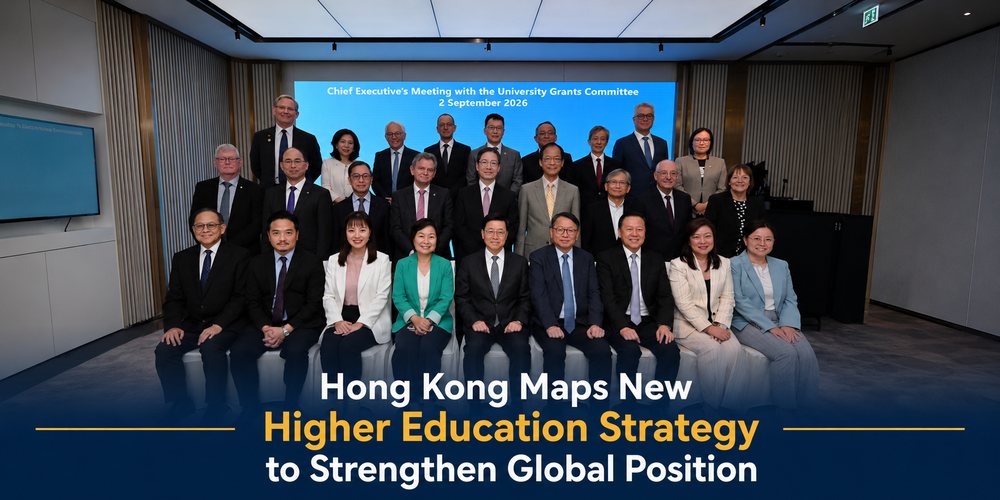
John Lee and UGC Outline Hong Kong’s Higher Education Strategy to Strengthen Global Education Hub
Education plans focused on global partnerships, research, digital transformation and talent development
Hong Kong is preparing to further strengthen its position as an international education hub as Chief Executive John Lee Ka-chiu and the University Grants Committee (UGC) discuss plans to reshape the city’s higher education strategy around research excellence, international collaboration, digital transformation and stronger links between universities and industry.
Lee met members of the UGC on Wednesday to review strategies for advancing Hong Kong’s higher education sector and enhancing its role in the international post-secondary education landscape. The discussions focused on several priorities, including the development of the Northern Metropolis University Town, closer industry-academia-research collaboration, expanded national and international partnerships, and the need for universities to strengthen their leadership in teaching, learning and research in the digital era.
The meeting comes as Hong Kong prepares to announce its First Five-Year Plan for the Northern Metropolis. The government’s vision for the area includes a university town model designed to bring together education, technology, talent, industry and urban development. By creating closer connections between higher education institutions and businesses, the initiative is expected to support research commercialisation, innovation and talent development while contributing to Hong Kong’s wider economic and educational ambitions.
The latest discussions also underline the government and UGC’s intention to promote Hong Kong as a destination for international students, academics and researchers. With five UGC-funded universities ranked among the world’s top 100, including two institutions placed within the global top 20, the city is seeking to build on its existing academic reputation and expand the international reach of its higher education system.
Hong Kong Higher Education Strategy Focuses on Global Competitiveness
The meeting between John Lee and the UGC reflects a broader effort to position Hong Kong higher education for the changing demands of the global knowledge economy. Rather than focusing solely on university rankings or student enrolment, the strategy places increasing emphasis on the ability of higher education institutions to contribute to research, innovation, talent development and economic growth.
Lee highlighted Hong Kong’s existing international standing in higher education during the meeting, pointing to the strong global rankings achieved by several UGC-funded universities. Five UGC-funded universities are currently among the world’s top 100, while two have achieved positions within the global top 20. These results provide Hong Kong with a strong foundation as it seeks to attract more international students and strengthen its reputation as a regional and global education destination.
The government’s strategy is also closely connected to Hong Kong’s broader development priorities. Universities are increasingly expected to serve as centres for research, innovation and talent development rather than operate independently from the wider economy. Stronger relationships between universities, companies and research organisations can create opportunities for students and researchers to work on real-world challenges while helping businesses access specialist knowledge and emerging technologies.
For Hong Kong, this approach could become particularly important as the city seeks to remain competitive in an increasingly international higher education market. Countries and cities across Asia are investing heavily in universities, research infrastructure and international student recruitment. Hong Kong’s strategy therefore seeks to build on its established academic strengths while creating a more integrated education and innovation ecosystem.
Northern Metropolis University Town to Connect Education, Technology and Industry
One of the central elements of the discussion was the proposed Northern Metropolis University Town. The government plans to use a university town concept as part of the development of the Northern Metropolis, integrating higher education with technology, talent, industry and urban development.
The initiative represents a significant shift towards a more connected model of higher education development. Instead of universities functioning primarily as individual campuses, the university town concept is designed to encourage institutions, businesses, researchers and technology organisations to operate within a closely connected ecosystem.
The Northern Metropolis is already a major component of Hong Kong’s long-term development plans, and incorporating higher education into the area could give universities a larger role in the region’s innovation and economic development. The proposed model could facilitate greater interaction between academic researchers and industry, potentially creating new opportunities for applied research, technology development and entrepreneurship.
Industry-academia collaboration is becoming increasingly important globally as universities face growing expectations to translate research into practical outcomes. For Hong Kong, the Northern Metropolis University Town could provide an environment where academic research, technological innovation and commercial activity are more closely aligned.
The government is expected to provide further direction through its First Five-Year Plan for the Northern Metropolis. The plan could offer greater clarity on how the university town will be developed and how higher education institutions will participate in the wider transformation of the area.
Stronger Industry-Academia-Research Collaboration
Another major priority identified during the meeting was strengthening industry-academia-research collaboration. The government sees closer cooperation among universities, businesses and research organisations as an important mechanism for improving Hong Kong’s research capabilities and supporting innovation.
Universities possess significant expertise and research capacity, while businesses can provide access to practical challenges, market knowledge and commercial pathways. Bringing these capabilities together can create a more effective environment for research and development.
The proposed approach also has implications for students. Greater university-industry engagement can expose students to professional environments, emerging technologies and industry-specific challenges while they are still studying. Such opportunities can contribute to the development of graduates with skills that are better aligned with future labour-market requirements.
For Hong Kong’s higher education sector, this is particularly relevant as digital technologies continue to transform industries. Universities will need to ensure that teaching and learning evolve alongside developments in artificial intelligence, digitalisation, advanced technology and other emerging fields.
The government’s emphasis on industry-academia-research cooperation therefore extends beyond economic development. It also forms part of a wider effort to ensure that Hong Kong’s higher education institutions remain relevant to the needs of students, employers and researchers in the digital era.
Digital Transformation Becomes a Higher Education Priority
Digital transformation was another important theme discussed by John Lee and the UGC. As technology changes how people study, work and conduct research, higher education institutions are under increasing pressure to modernise their teaching, learning and research practices.
Lee stressed the importance of enhancing the leadership role of Hong Kong universities in research, teaching and learning in the digital era. This suggests that digital transformation will increasingly influence the city’s higher education policy, from academic programmes and research methods to international collaboration and talent development.
The digital transformation of universities can involve several areas. Institutions may need to strengthen digital learning infrastructure, expand technology-related academic programmes, develop new approaches to research and provide students with opportunities to build future-focused skills.
At the same time, universities are becoming important players in the development and application of emerging technologies. Research institutions can contribute to areas such as artificial intelligence, data science, advanced manufacturing and other technology-intensive disciplines, while collaboration with industry can help ensure that research responds to real-world needs.
For international students considering Hong Kong universities, this emphasis on digital transformation could also make the city increasingly attractive to students interested in technology, research and innovation.
Expanding International Collaboration and Partnerships
International collaboration is another major pillar of Hong Kong’s higher education strategy. The government wants universities to strengthen their partnerships both nationally and globally, helping institutions expand their academic networks and increase Hong Kong’s visibility in the international education sector.
International partnerships can take many forms, including academic collaborations, research projects, student mobility, faculty exchanges, joint programmes and international conferences. Such connections can enhance the global experience of students and researchers while giving Hong Kong institutions access to wider academic and professional networks.
The UGC is also planning to organise high-profile summits and forums designed to facilitate forward-looking exchanges with international stakeholders and academic leaders. These events are expected to provide opportunities to discuss emerging trends in higher education, research and innovation while showcasing Hong Kong’s academic strengths.
The strategy comes at a time when international higher education is becoming increasingly competitive. Universities and education hubs are competing not only for international students but also for researchers, faculty members, investment and research partnerships.
By increasing international engagement, Hong Kong aims to reinforce its position as a location where global academic talent can study, conduct research and collaborate with institutions and industries across Asia and beyond.
UGC Promotes Hong Kong as an International Post-Secondary Education Hub
UGC chairman Tim Lui Tim-leung briefed John Lee on the committee’s latest initiatives to strengthen Hong Kong’s position as an international post-secondary education hub.
The UGC intends to use high-profile summits and forums to create greater engagement with international stakeholders and academic leaders. These initiatives are also intended to align the development of Hong Kong’s higher education sector with national priorities and the city’s strategic objectives.
A key component of this effort is promoting the “Study in Hong Kong” brand. International student recruitment has become an important part of Hong Kong’s strategy to strengthen its role in global education, and the city is seeking to communicate its academic strengths to prospective students around the world.
The positioning of Hong Kong as an international education hub is supported by its universities’ global rankings, established research capabilities and international outlook. The city’s geographical position and connections with the wider Asian region also provide opportunities for institutions to attract students and researchers seeking an international academic environment in Asia.
Promoting the “Study in Hong Kong” brand could therefore play an important role in the government’s broader higher education strategy. By showcasing universities, research opportunities and academic partnerships, Hong Kong can seek to increase its appeal to international students and talent.
Attracting Global Talent While Developing Homegrown Talent
Talent development is another central objective of the strategy. According to Lui, the UGC will continue supporting local institutions in nurturing homegrown talent while also attracting talent from around the world.
The two objectives are closely connected. Developing local talent can strengthen Hong Kong’s workforce and research capabilities, while attracting international academics, researchers and students can add diversity and expertise to the higher education ecosystem.
Universities play a critical role in this process because they provide the advanced education, research opportunities and professional networks required to develop highly skilled graduates. Stronger links between universities and industry can further improve the transition between academic study and employment.
International talent can also contribute to research collaboration and knowledge exchange. Researchers and academics from different countries can bring new perspectives, expertise and international networks to Hong Kong institutions.
For Hong Kong, combining homegrown talent development with international recruitment is therefore likely to remain an important component of its strategy to build a globally competitive knowledge economy.
Hong Kong Seeks Greater Leadership in Research and Innovation
Research excellence is at the heart of Hong Kong’s higher education ambitions. The government wants universities to strengthen their leadership in research while increasing collaboration with industry and international partners.
Hong Kong already has several highly ranked universities, providing a strong base for further research development. However, maintaining and improving international competitiveness requires continued investment in research capabilities, talent and global partnerships.
The proposed Northern Metropolis University Town could potentially contribute to this objective by creating greater physical and institutional connections between universities, technology companies and other organisations. Such an ecosystem could encourage interdisciplinary research and increase opportunities for academic discoveries to move towards practical applications.
The focus on research also supports Hong Kong’s wider ambition to become a leading international education and innovation centre. As economies increasingly depend on knowledge, technology and highly skilled workers, research universities can play a central role in generating new ideas and supporting economic transformation.
Why Hong Kong’s Higher Education Strategy Matters
Hong Kong’s latest higher education strategy reflects the changing role of universities in the global economy. Higher education institutions are no longer viewed only as places for teaching and academic research; they are increasingly expected to contribute directly to innovation, talent development, technological progress and economic competitiveness.
The planned Northern Metropolis University Town is particularly significant because it attempts to integrate these functions into a wider urban development strategy. Bringing together education, technology, industry and talent could create opportunities for deeper collaboration and establish new pathways between research and commercial innovation.
At the same time, the emphasis on international partnerships and the “Study in Hong Kong” brand demonstrates the city’s intention to compete more actively in the global higher education market. With five UGC-funded universities already among the world’s top 100, Hong Kong has a strong academic foundation from which to build.
The success of the strategy will ultimately depend on how effectively these initiatives are implemented. Strong university-industry relationships, international partnerships, research investment and talent policies will all be important in determining whether Hong Kong can further strengthen its position as an international education hub.
Editor’s Note
Hong Kong’s latest higher education strategy highlights the growing importance of universities in shaping the city’s future economic, technological and international ambitions. With several UGC-funded institutions already achieving strong positions in global university rankings, the government is looking to build on this academic foundation by strengthening research excellence, expanding international partnerships and creating closer connections between higher education and industry. The proposed Northern Metropolis University Town is particularly significant in this context, as it represents an effort to bring education, technology, research, talent and industry together within a more integrated development ecosystem.
The coming years will therefore be important for determining how effectively Hong Kong can translate these ambitions into tangible opportunities for institutions, students, researchers and industry. The development of the Northern Metropolis, the expansion of global partnerships and continued investment in research and talent could collectively reshape the city’s higher education landscape and reinforce its position as a competitive international education and research hub in Asia.
Frequently Asked Questions
What is Hong Kong’s new higher education strategy?
Hong Kong’s higher education strategy focuses on strengthening the city as an international education hub through research excellence, digital transformation, international partnerships, industry-academia collaboration and talent development.
What is the Northern Metropolis University Town?
The Northern Metropolis University Town is a proposed university town concept that aims to integrate education, technology, talent, industry and urban development while encouraging stronger collaboration between universities and businesses.
How many Hong Kong universities are ranked among the world’s top 100?
According to Chief Executive John Lee, five University Grants Committee-funded universities are ranked among the world’s top 100, with two placed within the global top 20.
What is the “Study in Hong Kong” initiative?
“Study in Hong Kong” is a branding effort aimed at promoting Hong Kong as an international destination for post-secondary education and attracting students and talent from around the world.
Why is industry-academia collaboration important for Hong Kong?
Stronger industry-academia collaboration can connect university research with real-world industry needs, support innovation, provide students with practical opportunities and contribute to Hong Kong’s wider technology and economic development.
How will digital transformation affect Hong Kong universities?
Digital transformation is expected to influence teaching, learning and research across Hong Kong’s higher education sector, while universities are also expected to strengthen their role in developing talent for emerging technology-driven industries.

Skoobuzz

 Skoobuzz


 Skoobuzz


0 Comments (Please Login To Continue)