








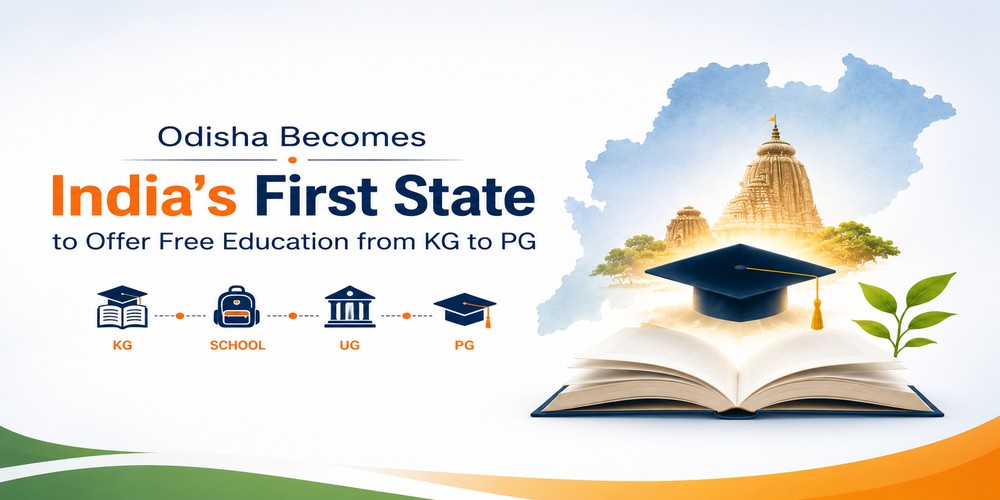
Odisha Launches Landmark KG-to-PG Free Education Scheme for Over 32 Lakh Students
The landmark scheme removes financial barriers to education for millions of students across the state.
In a landmark move that could reshape access to education in India, the Odisha Cabinet has approved free education for students from Kindergarten (KG) to Postgraduate (PG) level across government and government-aided institutions. The decision, announced on Wednesday under the newly approved Gyanodaya–Shiksharu Samruddhi Scheme, makes Odisha the first state in the country to extend free education across every stage of formal schooling and higher education.
The scheme will come into effect from the 2026–27 academic session and aims to remove financial barriers that prevent students from continuing their education.
What Is the Gyanodaya–Shiksharu Samruddhi Scheme?
Approved by the Cabinet chaired by Chief Minister Mohan Charan Majhi, the Gyanodaya–Shiksharu Samruddhi Scheme will waive all tuition and academic fees for students enrolled in regular courses at government and government-aided educational institutions.
While Odisha had already been providing free education from Kindergarten to Class VIII, the new policy significantly expands its scope to include:
- Classes IX to XII
- Undergraduate (UG) programmes
- Postgraduate (PG) programmes
The benefit applies to students studying in:
- Government schools
- Government colleges
- Government universities
- Government-aided educational institutions
According to the state government, the initiative is designed to ensure that financial constraints no longer prevent students from completing their education.
What the Chief Minister Said
Speaking after the Cabinet meeting, Chief Minister Mohan Charan Majhi described the decision as a historic milestone for the state's education system.
He stated that the scheme goes beyond a simple fee waiver and represents the government's commitment to ensuring equal educational opportunities for every child and young person in Odisha, regardless of their economic background.
The government believes the initiative will make quality education more accessible, equitable, and affordable while easing the financial burden on families, particularly those from economically weaker and socially disadvantaged communities.
Who Will Benefit?
The Odisha government estimates that more than 32 lakh students will benefit from the programme every year.
The financial commitment includes:
- ₹895.57 crore allocated for the first year of implementation.
- ₹5,467.55 crore earmarked over the next five years.
The state expects the scheme to:
- Increase student enrolment across schools and colleges.
- Improve attendance.
- Reduce dropout rates.
- Encourage more students to pursue higher education.
- Strengthen educational equity across Odisha.
What Is Not Covered?
The scheme applies only to regular academic programmes offered by government and government-aided institutions.
It does not cover:
- Private unaided institutions
- Self-financing courses
- Professional and technical programmes
- Public-Private Partnership (PPP) institutions
Students enrolled in these institutions or programmes will continue to pay applicable tuition and other academic fees.
Alignment with National Education Goals
The Odisha government has stated that the scheme supports the broader objectives of:
- National Education Policy (NEP) 2020
- Odisha Vision 2036
- Odisha Vision 2047
Officials believe that investing in universal access to education will contribute to building a more inclusive, skilled, and knowledge-driven society while improving long-term educational outcomes across the state.
Apart from approving the Gyanodaya–Shiksharu Samruddhi Scheme, the Cabinet also cleared 12 additional proposals across eight government departments.
Editor's Note
The rising cost of education continues to be one of the biggest reasons students across India discontinue their studies after secondary school. While several states provide free schooling at the elementary level, extending financial support through undergraduate and postgraduate education remains rare.
Odisha's decision marks a significant shift in public education policy by expanding fee-free education from early childhood through higher education in government institutions. Although the scheme excludes private colleges and professional programmes, it has the potential to reduce financial barriers for millions of students and improve access to higher education for families from economically weaker backgrounds.
If successfully implemented, the initiative could serve as a model for other Indian states exploring ways to improve educational equity and reduce dropout rates.
FAQs
1. What is the Gyanodaya–Shiksharu Samruddhi Scheme?
The Gyanodaya–Shiksharu Samruddhi Scheme is Odisha's new education initiative that provides free education from Kindergarten (KG) to Postgraduate (PG) level for students enrolled in regular courses at government and government-aided educational institutions.
2. Who is eligible for free education under the scheme?
Students studying in regular courses at:
- Government schools
- Government colleges
- Government universities
- Government-aided educational institutions
will be eligible for complete fee waivers beginning with the 2026–27 academic session.
3. Does the scheme include private colleges?
No. The scheme does not apply to:
- Private unaided institutions
- Self-financing colleges
- PPP institutions
- Professional and technical courses
Only regular programmes offered by government and government-aided institutions are covered.
4. How many students are expected to benefit?
The Odisha government estimates that over 32 lakh students will benefit from the scheme every year.
5. How much will the programme cost?
The state has allocated:
- ₹895.57 crore for the first year.
- ₹5,467.55 crore over a five-year period.
This makes it one of Odisha's largest investments in the education sector.
6. Why is this decision considered historic?
Odisha has become the first Indian state to provide free education across the entire educational journey—from Kindergarten through postgraduate studies—in government and government-aided institutions, making higher education more accessible for students from financially disadvantaged backgrounds.

Skoobuzz
 Skoobuzz

 Skoobuzz


0 Comments (Please Login To Continue)