








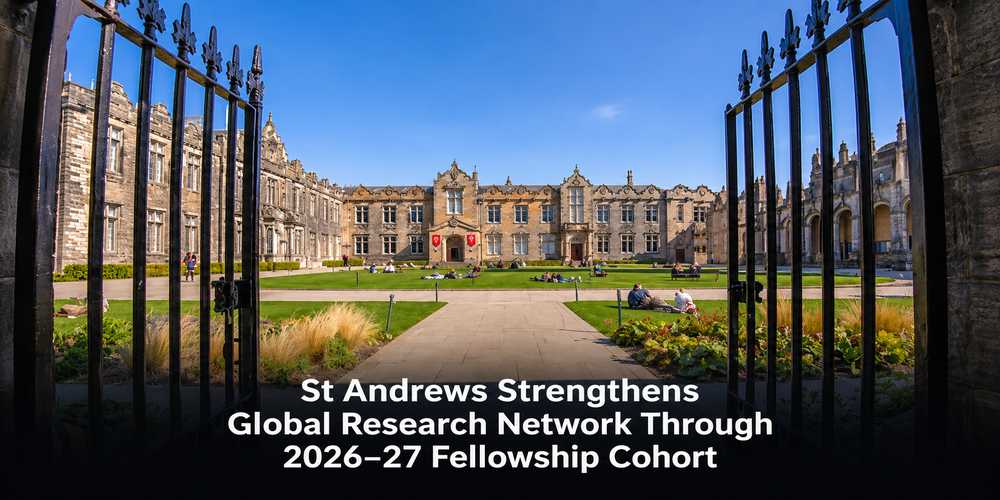
University of St Andrews Welcomes Global Fellows for 2026–27 Academic Year
St Andrews welcomes over 20 international fellows to strengthen global research, teaching, innovation, and collaboration
The University of St Andrews is set to welcome more than 20 internationally recognised researchers, educators, and industry professionals through its Global Fellowship Scheme for the 2026–27 academic year. The latest cohort expands the University's growing international network of academic leaders while fostering new opportunities for research collaboration, innovative teaching, and real-world engagement across multiple disciplines.
This year's intake also marks the introduction of a new fellowship category focused on professional practice, further strengthening connections between academia and industry.
What Is the Global Fellowship Scheme?
The Global Fellowship Scheme is designed to bring leading international experts to St Andrews, enabling them to collaborate with academic departments, contribute to research projects, enrich teaching, and share professional expertise with students and staff. The initiative has become a key part of the University's international strategy, creating lasting partnerships that continue well beyond each fellow's residency.
To reflect the diversity of expertise being welcomed, the programme now includes four fellowship categories:
- Global Fellowship for internationally recognised academics.
- Senior Global Fellowship for distinguished scholars with exceptional global standing.
- Global Fellowship (Education) recognising excellence in teaching and learning.
- Global Fellowship (Practice), a newly introduced stream for accomplished professionals connecting academic knowledge with industry and public practice.
A Truly Global Cohort
The 2026–27 fellowship cohort reflects the international reach of the programme. New fellows will join St Andrews from leading institutions across five continents, including universities and research organisations in:
- India
- Germany
- South Africa
- Canada
- New Zealand
- Brazil
- Singapore
- France
- Norway
- Ireland
- Australia
- United States
This global representation reinforces the University's commitment to international collaboration and knowledge exchange.
Expertise Across Diverse Disciplines
The incoming fellows represent an impressive range of academic and professional specialisations. Areas of expertise include:
- Artificial Intelligence
- Viral Evolution
- Bioengineering
- Climate Resilience
- Medieval History
- Contemporary Art
- Entrepreneurship
- Student Employability
- Mathematics
- Psychology
- Sustainable Development
- Computer Science
- Aboriginal Knowledge Systems
- Future of Work
By bringing together specialists from multiple disciplines, the programme encourages interdisciplinary collaboration while exposing students and researchers to diverse global perspectives.
Strengthening Research and Teaching
Beyond conducting research, fellows will actively contribute to teaching, mentoring, public engagement, and institutional partnerships. Their presence is expected to:
- expand collaborative research projects
- introduce new teaching approaches
- support interdisciplinary learning
- strengthen international academic networks
- create opportunities for future joint initiatives
These collaborations continue to generate long-term benefits for both the University and its international partners.
Introducing the Global Fellowship (Practice)
One of the programme's most significant developments this year is the launch of the Global Fellowship (Practice). Unlike traditional academic fellowships, this new stream welcomes professionals whose careers demonstrate the practical application of research beyond universities. The inaugural appointment recognises the growing importance of connecting academic scholarship with industry, creative practice, public policy, and community impact.
Building an International Community of Scholars
According to Deputy Principal and Vice-Principal (International Strategy and External Relations) Professor Brad McKay, the latest cohort will add fresh perspectives and expertise while expanding a programme that has already supported nearly 120 fellows since its launch.
Beyond individual visits, many fellowship partnerships continue long after the programme concludes, resulting in collaborative research projects, enhanced student learning experiences, and stronger global academic relationships.
Applications for the Next Fellowship Cycle
The University has confirmed that applications for the 2027–28 Global Fellowship Scheme are expected to open in November 2026. The next intake will continue the University's efforts to attract internationally recognised researchers, educators, and practitioners who can contribute to teaching, research, and global collaboration.
Key Highlights
Feature | Details |
Fellowship Categories | Four |
New Addition | Global Fellowship (Practice) |
Fellows Joining | 20+ |
Countries Represented | Institutions across five continents |
Focus Areas | Research, Teaching, Professional Practice |
Next Application Round | November 2026 |
Why This Matters
Universities increasingly compete not only for students but also for global talent capable of driving research, innovation, and educational excellence. Fellowship programmes like St Andrews' Global Fellowship Scheme demonstrate how international collaboration extends beyond student mobility, creating opportunities for scholars, educators, and industry leaders to exchange knowledge across borders. By bringing together expertise from diverse disciplines and regions, such initiatives help universities strengthen research capacity, enrich classroom experiences, and develop partnerships that continue generating impact long after each fellowship concludes.
Editor's Note
Academic excellence has always been built on the exchange of ideas. Today, those ideas travel farther and faster than ever before, making international collaboration one of higher education's greatest strengths.
Programmes like the Global Fellowship Scheme remind us that universities are more than places where knowledge is created—they are meeting points where different cultures, disciplines, and perspectives come together. As institutions continue addressing increasingly global challenges, investing in people and partnerships may prove just as valuable as investing in research itself.
Frequently Asked Questions (FAQs)
1. What is the University of St Andrews Global Fellowship Scheme?
The Global Fellowship Scheme invites internationally recognised researchers, educators, and practitioners to collaborate with the University through research, teaching, and knowledge exchange.
2. How many fellowship categories are available?
The programme now includes four categories: Global Fellowship, Senior Global Fellowship, Global Fellowship (Education), and the newly introduced Global Fellowship (Practice).
3. What is new for the 2026–27 fellowship programme?
The University has introduced the Global Fellowship (Practice), expanding opportunities for accomplished professionals whose work bridges academia and real-world practice.
4. Where do the 2026–27 fellows come from?
The incoming fellows represent leading universities and research institutions across five continents, including India, Germany, Australia, Brazil, Singapore, South Africa, the United States, and several other countries.
5. Which academic disciplines are represented?
The cohort includes expertise in artificial intelligence, medicine, biology, climate science, history, entrepreneurship, mathematics, psychology, art history, computer science, and many other disciplines.
6. How does the fellowship benefit St Andrews?
The programme strengthens international research collaborations, enhances teaching, supports interdisciplinary learning, and builds long-term global partnerships.
7. When will applications open for the next fellowship cycle?
Applications for the 2027–28 Global Fellowship Scheme are expected to open in November 2026.

Skoobuzz


 Skoobuzz


0 Comments (Please Login To Continue)