








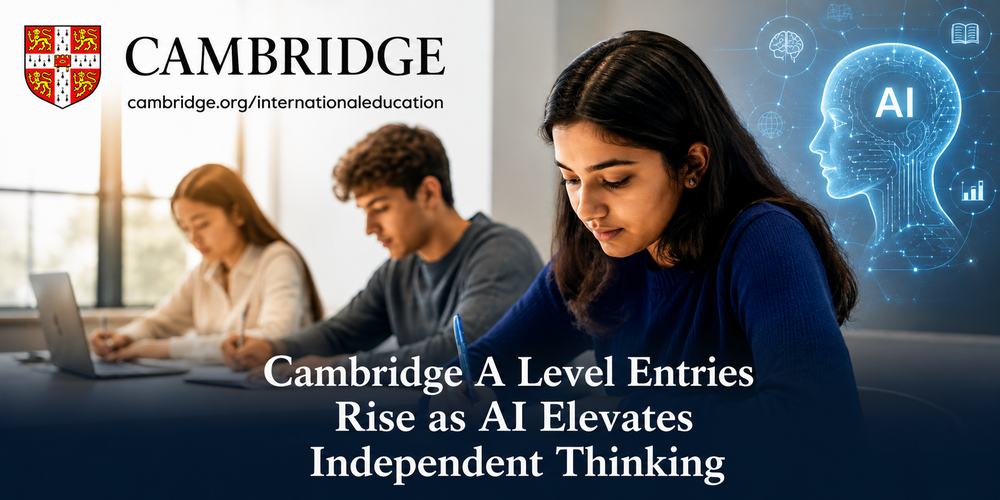
Cambridge International AS & A Level Entries Rise 5% as Global Demand for Flexible Education Grows
Students seek globally recognised, skills-focused pathways to university.
Cambridge International AS & A Level qualifications are continuing to gain ground internationally, with entries for the June 2026 examination series rising by 5% year-on-year. The latest results, released on August 11, come as students increasingly seek qualifications that can provide both a strong academic foundation and a flexible pathway to higher education. Around 368,000 students across 3,492 schools worldwide are receiving Cambridge International AS & A Level results, while nearly 705,000 students across 148 countries sat Cambridge examinations during the June series. Across its programmes, Cambridge recorded approximately 1.7 million examination entries, highlighting the continuing scale of demand for internationally recognised school qualifications.
The growth comes at a time when students are preparing for an increasingly unpredictable academic and professional landscape. University admissions are becoming more competitive, employers are placing greater emphasis on transferable capabilities, and artificial intelligence is changing how knowledge is accessed and used. Against this backdrop, qualifications that combine subject knowledge with independent thinking, research and problem-solving are gaining renewed attention. Cambridge says the latest increase reflects growing recognition of the value of this combination, particularly as students look for education that can prepare them not only for university admission but also for the changing demands of life beyond school.
Cambridge A Levels Strengthen Their Global University Pathway
Cambridge International AS & A Levels are recognised by more than 2,500 universities worldwide, extending their reach well beyond traditional destinations such as the UK, United States, Canada and Australia. This broad recognition gives students greater freedom when considering where to pursue higher education and allows them to keep multiple academic pathways open after completing secondary school.
For students and families, international recognition can be particularly valuable when plans are not yet fixed. A student may complete school in their home country before deciding to apply to a university overseas, or they may choose to remain closer to home for higher education. A qualification that is understood across different education systems can provide greater flexibility in making that decision. Cambridge International Education Group Managing Director for International Education Rod Smith said the continued growth demonstrates that more students are recognising the value of combining deep subject knowledge with skills that universities and employers increasingly seek.
Recent admissions data also indicates the qualification's standing in the UK. According to UCAS application data cited by Cambridge, 98% of Cambridge International A Level students who applied to UK universities in the 2025 cycle received at least one offer. Cambridge also reports that its learners account for approximately one in eight international students entering UK universities, reinforcing the role of the qualification as a significant pathway for internationally mobile students.
Why Skills-Based Qualifications Matter in the Age of AI
The latest figures arrive as education systems around the world reconsider what students need to learn in an environment increasingly shaped by artificial intelligence. AI tools can now generate information, write content, summarise complex material and support problem-solving in seconds. This has made the ability to simply access information less distinctive, while increasing the importance of knowing how to assess, interpret and apply that information.
This is where the emphasis on independent thinking becomes particularly significant. Students need to be able to question assumptions, evaluate evidence, identify reliable information and develop their own conclusions. Cambridge International AS & A Levels aim to develop these capabilities alongside academic knowledge, with problem-solving and independent learning forming an important part of the wider educational experience.
The shift also raises a broader question for education: If technology can increasingly provide answers, should schools focus more strongly on teaching students how to ask better questions? The growing interest in research-oriented and project-based qualifications suggests that students and institutions may increasingly value opportunities to demonstrate curiosity, judgement and intellectual independence rather than relying exclusively on conventional examination performance.
Flexibility Becomes an Increasingly Important Part of International Education
Cambridge's model also reflects a changing understanding of what international education means. Students do not necessarily have to leave their home country to access an internationally recognised curriculum or create a pathway towards overseas university study. Cambridge qualifications can be completed locally, after which students can use them when applying to universities in their own country or abroad.
This flexibility can be particularly meaningful for families considering the financial and practical demands of international mobility. Studying overseas can involve tuition fees, living expenses, relocation and significant personal adjustments. Being able to pursue a globally recognised qualification at home allows students to gain international academic recognition while postponing or reconsidering the decision to move abroad.
Cambridge describes this approach as making international education "as international as necessary, but as local as possible." The idea reflects a wider trend in global education, where students increasingly expect their qualifications to create international opportunities without necessarily requiring immediate geographical mobility.
Cambridge Project Qualification Entries Jump 68%
One of the strongest indicators of changing student interests comes from the Cambridge International Project Qualification (IPQ), which recorded a 68% increase in entries during the June 2026 series. The qualification gives students the opportunity to undertake independent research and develop a sustained academic project, helping them build skills in self-directed learning, investigation and academic communication.
The sharp rise is notable because project-based learning can provide students with an opportunity to demonstrate qualities that are difficult to capture through conventional examinations alone. A long-term research project requires students to identify a question, investigate evidence, manage their time, overcome challenges and develop a reasoned conclusion. These experiences can help demonstrate intellectual curiosity and academic independence, particularly for students preparing for competitive university applications.
The increase in IPQ participation therefore, complements the broader rise in A Level entries. Together, the figures suggest that students may be looking for educational experiences that demonstrate not only what they have learned, but how they think and what they can do with their knowledge.
Key figures from the June 2026 Cambridge examination series
- 5% increase in Cambridge International AS & A Level entries
- Around 368,000 students receiving AS & A Level results
- 3,492 schools represented among AS & A Level students
- Nearly 705,000 students sat Cambridge examinations across 148 countries
- Approximately 1.7 million total Cambridge examination entries
- 68% increase in Cambridge International Project Qualification entries
- More than 2,500 universities recognise Cambridge International A Levels
- 98% of Cambridge International A Level applicants to UK universities received at least one offer in the 2025 cycle
Exam Flexibility Helps Students Navigate Disruption
The June examination series also demonstrated the importance of having flexible systems when students face circumstances beyond their control. In parts of the Middle East, regional conflict and resulting school closures meant that almost 30,000 Cambridge students were unable to sit examinations safely under normal arrangements.
Cambridge worked with affected schools to use its Portfolio of Evidence contingency process, through which students' work could be assessed by Cambridge examiners. Universities recognise results awarded through this route, helping ensure that students' academic progress is not lost because of circumstances unrelated to their performance.
The situation highlights an important dimension of international education. Flexibility is not simply about allowing students to choose between subjects, study locations or examination formats. It can also mean ensuring that students have a fair opportunity to complete their education when unexpected events disrupt conventional learning and assessment.
On-Screen Exams Introduce Another Choice
The June series also marked the first Cambridge examinations delivered on screen across a range of subjects. Developed in collaboration with schools, the digital assessment programme is being introduced as an additional option alongside paper-based examinations.
The move reflects the growing role of technology in education, where students increasingly research, communicate and complete academic work digitally. Offering different assessment formats can give schools and students greater choice while recognising that learners may have different preferences and circumstances.
Rather than replacing traditional examinations entirely, Cambridge is presenting on-screen assessment as an additional option. This approach reflects the broader theme running through the June 2026 results: greater flexibility while maintaining a consistent academic standard.
What the Growth Signals for the Future of Education
The latest Cambridge figures point towards a wider shift in what students and families may expect from internationally recognised qualifications. Academic rigour remains central, but students are also looking for opportunities to develop research skills, independent thinking and adaptability while keeping their higher education options open.
The growth of A Level entries and the even sharper increase in IPQ participation are particularly relevant in an era when students are being asked to prepare for careers that may not even exist in their current form. Education cannot predict every future job, technology or economic shift, but it can help students develop the intellectual foundations needed to navigate change.
Cambridge International's latest figures, therefore represent more than a rise in examination participation. They reflect continuing demand for an educational model that combines global recognition, academic depth, flexibility and future-ready skills.
Looking Ahead to IGCSE and O Level Results
The next major Cambridge results announcement will take place on August 18, 2026, when more than 315,000 students across 4,949 schools are scheduled to receive their Cambridge IGCSE and O Level results. Cambridge currently serves nearly two million students annually and has more than 160 years of experience in international education. Its programmes include Cambridge Checkpoint, IGCSE, O Level, International AS & A Level, AICE and the International Project Qualification.
As international education continues to evolve, the latest A Level results suggest that students are increasingly looking for qualifications that do more than meet university entry requirements. They want credentials that preserve choice, demonstrate meaningful skills and help them approach an uncertain future with greater confidence.
Editor's Note
The most interesting part of Cambridge's latest results may not actually be the 5% growth. It is what that growth represents. That makes the growing emphasis on independent thinking particularly important. We are entering an era in which information is no longer scarce. AI can retrieve, organise and generate it at extraordinary speed. The real advantage may therefore belong to people who can pause before accepting an answer, question its assumptions and decide whether it actually makes sense.
Perhaps that is why the 68% rise in project qualification entries deserves as much attention as the headline A Level growth. Research requires patience. It requires students to sit with uncertainty, make mistakes, change direction and eventually build something that reflects their own thinking. Those are difficult qualities to automate.
The idea of flexibility also deserves closer attention. International education has traditionally been associated with leaving home and crossing borders. But perhaps the future is less about how far a student travels and more about how many possibilities their education creates. A qualification that allows a student to remain at home while keeping doors open to universities around the world can be just as international in its impact.
Ultimately, the purpose of education may be shifting from preparing students for a particular destination to preparing them for change itself. The strongest qualification may not be the one that predicts exactly where a student will go, but the one that gives them the confidence and intellectual independence to navigate wherever they eventually find themselves.
Frequently Asked Questions
1. How much did Cambridge International AS & A Level entries increase?
Cambridge International AS & A Level entries increased by 5% compared with the previous year for the June 2026 examination series.
2. How many students received Cambridge A Level results?
Around 368,000 students across 3,492 schools worldwide received Cambridge International AS & A Level results in August 2026.
3. How many students sat Cambridge examinations in June 2026?
Nearly 705,000 students across 148 countries sat Cambridge examinations during the June series, with total entries reaching approximately 1.7 million.
4. How widely are Cambridge International A Levels recognised?
Cambridge International A Levels are recognised by more than 2,500 universities worldwide, including institutions across major international higher education destinations.
5. Are Cambridge A Levels recognised by UK universities?
Yes. Cambridge reports that 98% of Cambridge International A Level students who applied to UK universities in the 2025 cycle received at least one offer.
6. What skills do Cambridge International A Levels develop?
Alongside subject knowledge, Cambridge International A Levels focus on skills including independent thinking, problem-solving, research and analytical ability, helping students prepare for higher education and future careers.
7. What is the Cambridge International Project Qualification?
The Cambridge International Project Qualification is an independent research-based qualification designed to develop self-directed study, research and academic curiosity.
8. How much did IPQ entries increase?
Cambridge International Project Qualification entries increased by 68% during the June 2026 examination series.
9. Can students study Cambridge qualifications in their home country?
Yes. Students can study Cambridge International qualifications locally and use them to apply to universities both domestically and internationally.
10. When will Cambridge IGCSE and O Level results be released?
Cambridge IGCSE and O Level results are scheduled to be released on August 18, 2026, to more than 315,000 students across 4,949 schools.

Skoobuzz
 Skoobuzz
 Skoobuzz
 Skoobuzz
 Skoobuzz


0 Comments (Please Login To Continue)