








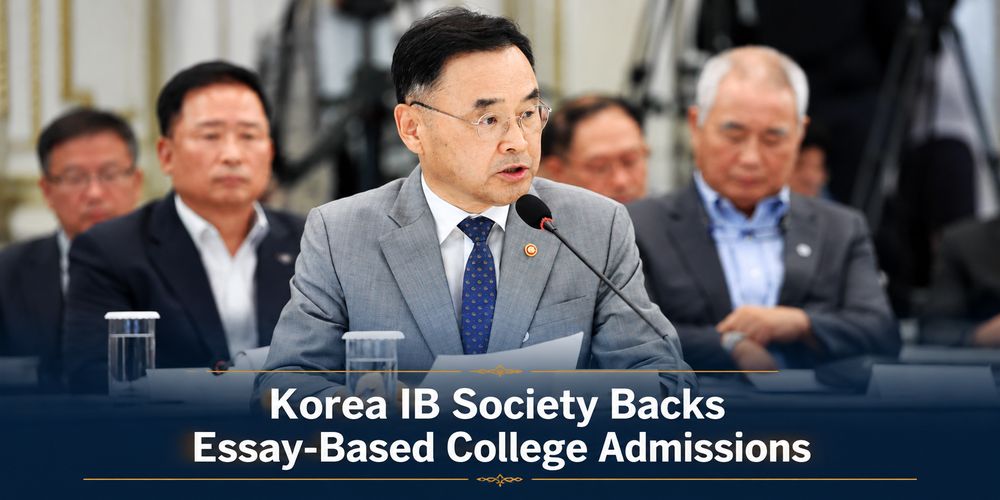
Korea IB Education Society Supports Essay-Based College Admissions, Calls for Deeper Education Reform
The society urges faster admissions reform, promoting critical thinking and AI-ready education.
The Korea International Baccalaureate (IB) Education Society has welcomed South Korea's proposal to introduce essay-based assessments into the university admissions process, describing the move as an important opportunity to fundamentally rethink how students are evaluated.
In a public statement released on August 6, the organisation argued that the country needs more than a simple change in examination format. Instead, it called for a "qualitative shift" in education—one that prioritises critical thinking, creativity, and independent inquiry over rote memorisation and multiple-choice testing.
The statement follows the National Education Commission's recent announcement that essay-based assessments and absolute grading will be included in public discussions surrounding future university admissions reforms.
IB Education Society Welcomes Admissions Reform
The organisation praised the National Education Commission for initiating a national conversation about moving beyond South Korea's long-standing admissions model. According to society, the current system—centred on multiple-choice examinations and relative grading—has become increasingly outdated and no longer reflects the skills students need in today's rapidly evolving world.
The group noted that similar systems are uncommon across many OECD member countries and argued that meaningful reform can no longer be delayed.
A Shift Towards Critical Thinking
Rather than focusing solely on exam performance, the IB Education Society believes university admissions should encourage students to ask meaningful questions, think independently, and develop original perspectives.
The organisation stressed that as artificial intelligence reshapes education and employment, students will need abilities that machines cannot easily replicate, including:
- Critical thinking
- Independent inquiry
- Analytical reasoning
- Creativity
- Effective communication
It argued that these competencies are becoming essential for long-term academic and professional success.
Fairness Remains Central to Reform
While acknowledging concerns that essay-based admissions may introduce subjectivity into university selection, the society believes fairness and reliability can be maintained. It recommended studying international education systems that already operate essay-based, absolute-grading admissions and gradually implementing carefully designed reforms suited to South Korea's education landscape.
The society emphasised that successful reform would require clear assessment standards, teacher training, and transparent evaluation methods.
More Than Replacing Multiple-Choice Questions
The IB Education Society cautioned against simply replacing multiple-choice questions with short-answer responses that still reward predetermined answers. Instead, it argued that genuine reform should encourage students to:
- Formulate their own questions
- Develop original arguments
- Demonstrate critical analysis
- Present independent perspectives
According to the organisation, admissions reform should transform the learning experience itself rather than simply altering examination formats.
Calls for Faster Public Discussion
The society also urged policymakers to accelerate the national consultation process on admissions reform. It encouraged balanced public debate grounded in evidence rather than fear, expressing hope that the discussion would create lasting improvements to South Korea's education system after decades of reliance on competitive, exam-centred admissions.
Why This Matters
Around the world, universities are increasingly recognising that success depends not only on memorising information but also on analysing complex problems, communicating ideas clearly, and adapting to changing circumstances. South Korea's discussion around essay-based admissions reflects a broader international trend toward evaluating the skills most relevant for higher education and future careers.
If implemented thoughtfully, the proposed reforms could reshape classroom teaching, student learning, and university admissions by placing greater emphasis on creativity, critical thinking, and intellectual curiosity.
Editor's Note
For decades, university entrance examinations have rewarded students for finding the correct answer as efficiently as possible. Yet the world they are preparing to enter increasingly rewards those who can ask better questions.
Artificial intelligence has made information more accessible than ever before. What distinguishes future graduates may no longer be how much they can memorise, but how well they can interpret, evaluate, challenge, and create knowledge. Essay-based assessment, when thoughtfully designed, has the potential to measure these qualities more effectively than traditional standardised testing.
However, changing an examination format is easier than changing an educational culture. True reform will require classrooms that encourage discussion over memorisation, teachers who assess reasoning rather than repetition, and universities willing to value originality alongside academic achievement. The success of South Korea's proposed reforms will depend not simply on introducing essays, but on redefining what meaningful learning looks like in the age of artificial intelligence.
Frequently Asked Questions (FAQs)
1. What did the Korea IB Education Society announce?
The organisation welcomed South Korea's proposal to introduce essay-based assessments into university admissions and called for broader education reform focused on critical thinking.
2. Why does the society support essay-based admissions?
It believes essays better assess creativity, reasoning, communication, and independent thinking than traditional multiple-choice examinations.
3. What concerns have been raised about essay-based admissions?
Some stakeholders worry about fairness and consistency in grading, though the society argues these concerns can be addressed through well-designed assessment frameworks.
4. What does the society mean by a "qualitative shift"?
It refers to transforming education so that students develop original ideas, ask meaningful questions, and think critically rather than simply memorising correct answers.
5. How does artificial intelligence influence this debate?
The society argues that AI increases the importance of uniquely human skills such as creativity, critical thinking, and problem-solving, making education reform increasingly necessary.
6. What is the National Education Commission proposing?
The commission has proposed opening public discussions on introducing essay-based assessments and absolute grading into South Korea's university admissions system.
7. How could these reforms affect students?
Students may experience a greater emphasis on analytical writing, discussion, independent research, and critical thinking throughout their education.
8. Has South Korea decided to implement essay-based admissions?
Not yet. The proposal is currently part of an ongoing public consultation and policy discussion.

Skoobuzz

 Skoobuzz

 Skoobuzz
 Skoobuzz
 Skoobuzz


0 Comments (Please Login To Continue)