








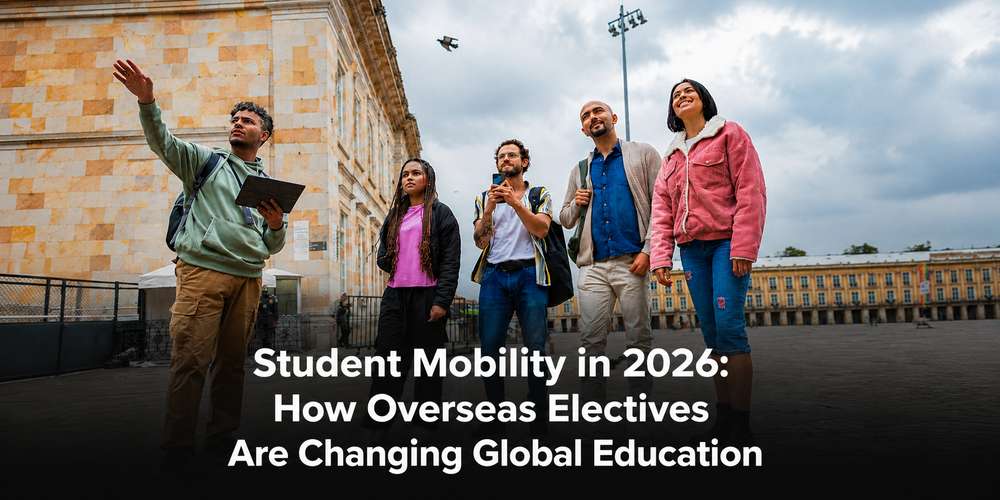
How Short-Term Overseas Electives Could Redefine Student Mobility in 2026
Short-term overseas electives are helping universities make international education more accessible
International education has long celebrated semester-long student exchanges as the gold standard of global learning. However, shifting student priorities, rising costs, and geopolitical uncertainty are challenging that model.
For many students today, studying abroad still represents an important aspiration—but committing to six months overseas has become increasingly difficult. Financial pressures, employment commitments, family responsibilities, and concerns about global instability are prompting universities to rethink how international experiences are delivered.
One emerging solution is the short-term overseas elective: intensive academic programmes lasting one to three weeks that combine international travel, classroom learning, and cross-cultural engagement without requiring students to relocate for an entire semester.
According to Lucas Lixinski of UNSW Sydney, these programmes may represent one of the most practical ways to expand access to international education while preserving the transformative benefits of studying abroad.
Why Traditional Student Exchanges Are Facing New Challenges
For decades, semester-long exchanges formed the backbone of outbound student mobility. They offered cultural immersion, academic collaboration, and international networking opportunities.
Today, however, universities are seeing declining participation for several reasons.
Rising Financial Pressures
The increasing cost of living means many students simply cannot afford months abroad. Even when tuition agreements exist between universities, accommodation, travel, insurance, and daily expenses remain significant barriers.
Greater Uncertainty About International Travel
Students entering university in 2026 have grown up during a period marked by:
- global pandemics
- geopolitical conflicts
- economic instability
- travel disruptions
These experiences have made many students more cautious about extended periods overseas.
Balancing Study with Work and Family
Many students now work part-time or full-time alongside their degrees. Others have caregiving responsibilities or financial obligations that make long absences unrealistic. For these students, shorter international experiences are considerably more achievable.
The Global North–Global South Imbalance
Another issue facing international education is the unequal flow of students between regions. Traditional exchange programmes rely on reciprocity. While many students from the Global South continue travelling to universities in North America, Europe, and Australia, significantly fewer students are choosing to study in the opposite direction.
This imbalance creates two major concerns:
- exchange agreements become increasingly difficult to sustain
- knowledge continues flowing predominantly from South to North, reinforcing longstanding inequalities within higher education
Universities are therefore exploring new models that encourage more balanced international engagement.
What Is an Overseas Elective?
An overseas elective is a short academic programme led by a faculty member from the student's home university. Rather than independently enrolling at another institution, students travel together with their professor for approximately two weeks.
During the programme, they typically:
- attend lectures hosted by the partner university
- participate in workshops and seminars
- complete assessments administered by their home institution
- engage in cultural activities and academic visits
The host university provides teaching facilities and local expertise, while the home university maintains academic responsibility for the course. This structure removes much of the complexity associated with traditional exchanges.
Why Students Feel More Comfortable
One of the biggest advantages of overseas electives is the built-in support system. Students travel as part of a familiar cohort alongside an academic they already know. This significantly reduces anxiety associated with travelling abroad for the first time.
Instead of navigating an unfamiliar country independently, students receive continuous academic and pastoral support throughout the programme. Interestingly, surveys conducted at UNSW found that students often cared less about the destination itself than they did about timing, affordability, and how the experience aligned with their career goals.
This suggests many students are willing to explore less familiar countries when adequate support exists.
Learning Across Cultures—Even in Two Weeks
Although overseas electives are shorter than semester exchanges, they can still foster meaningful intercultural learning. One effective approach involves creating mirror courses at both institutions. Students from the host university enrol alongside visiting students, creating mixed classrooms where everyone learns together.
These shared learning environments encourage:
- intercultural communication
- collaborative problem-solving
- international friendships
- diverse classroom discussions
The relationships formed can extend far beyond the classroom. In one example shared by Lixinski, a former participant later returned to the host country to attend the wedding of a classmate they met during the programme—illustrating how even brief international experiences can create lasting personal connections.
Not Every Subject Fits the Model
While collaborative classrooms work exceptionally well in many disciplines, they are not universally suitable. Courses introducing students to a specific country's legal system, culture, or history may offer less value to domestic students who already possess extensive local knowledge.
However, subjects centred on global issues—such as sustainability, human rights, business, public policy, or technology—often create balanced learning environments where students from both institutions contribute equally.
A More Affordable Path to International Education
Short-term programmes dramatically reduce many of the barriers associated with studying abroad. Compared with semester exchanges, students benefit from:
Traditional Exchange | Overseas Elective |
4–6 months abroad | 1–3 weeks abroad |
Higher living costs | Lower accommodation costs |
Significant time commitment | Fits around work and studies |
Greater administrative complexity | Simpler enrollment process |
Independent travel | Faculty-led group support |
For many students, this makes international education possible for the first time.
Universities Benefit Too
The advantages extend beyond students. Faculty members often develop:
- international research partnerships
- collaborative teaching opportunities
- joint curriculum development
- future exchange agreements
Universities can also alternate hosting responsibilities, allowing students from each institution to visit one another in different years while strengthening institutional relationships.
The Next Evolution: International Work-Integrated Learning
Universities are already exploring ways to combine overseas electives with practical industry experience. Future programmes could allow students to:
- complete internships abroad
- participate in international consulting projects
- undertake field research
- earn work-integrated learning credits overseas
Achieving this will require stronger collaboration between international offices, academic departments, and career services—but it represents a promising direction for global education.
Why This Matters
Student mobility is changing—not because students value international education less, but because their realities have changed. Universities that continue relying exclusively on traditional semester exchanges risk excluding students who cannot afford lengthy or expensive overseas experiences.
Short-term overseas electives demonstrate that meaningful global learning does not necessarily require months abroad. With thoughtful programme design, strong institutional partnerships, and intentional cross-cultural engagement, universities can create international experiences that are more inclusive, flexible, and accessible than ever before.
Editor's Note
International education has often been measured by distance travelled or time spent abroad. Yet perhaps the more meaningful question is not how long students are overseas, but how deeply they engage while they are there.
As financial realities reshape higher education, universities have an opportunity to move beyond viewing student mobility as an all-or-nothing experience. Short-term programmes challenge the assumption that transformation only happens over months. Sometimes, a carefully designed two-week experience can spark lifelong friendships, reshape worldviews, and inspire future careers.
The future of international education may not depend on sending fewer students farther away—but on creating more opportunities for more students to experience the world in ways that fit the realities of modern life.
Frequently Asked Questions (FAQs)
1. What is an overseas elective?
An overseas elective is a short-term, faculty-led international academic programme where students travel abroad for one to three weeks while remaining enrolled at their home university.
2. How is an overseas elective different from a traditional student exchange?
Unlike semester exchanges, overseas electives are shorter, involve group travel with faculty members, and are administered by the home institution.
3. Why are universities promoting short-term mobility?
Growing financial pressures, work commitments, and global uncertainty have reduced student interest in long-term study abroad programmes, making shorter experiences more practical.
4. Do students still gain intercultural experience from short programmes?
Yes. When programmes include interaction with local students through shared classes and collaborative learning, participants can develop meaningful intercultural skills and lasting international relationships.
5. What benefits do universities receive?
Institutions strengthen international partnerships, expand research collaboration, develop joint teaching initiatives, and create more accessible global learning opportunities for students.
6. Could overseas electives include internships?
Many universities are exploring ways to integrate work placements, field experiences, and international internships into short-term mobility programmes.

Skoobuzz

 Skoobuzz
 Skoobuzz
 Skoobuzz
 Skoobuzz


0 Comments (Please Login To Continue)