








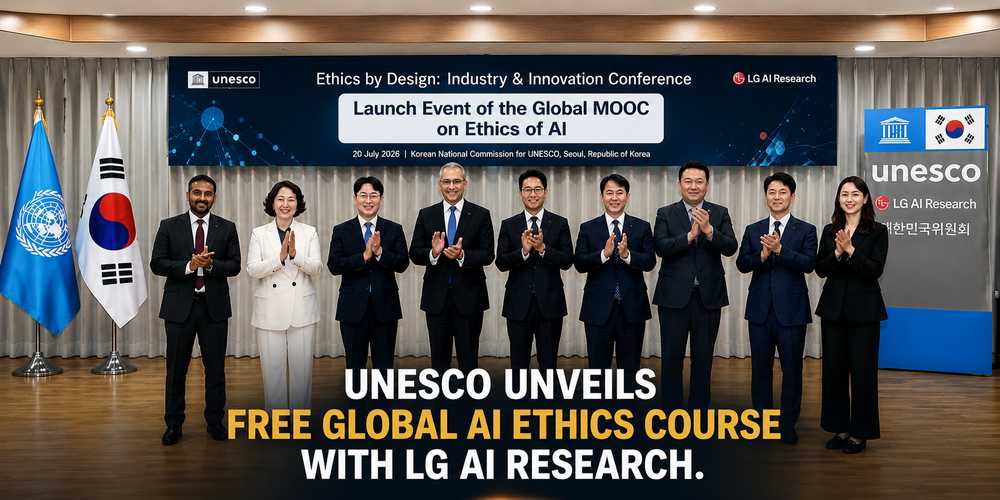
UNESCO and LG AI Research Launch Free Global AI Ethics Course on Coursera
New UNESCO AI Ethics Course Aims to Bridge Principles and Practice
To promote responsible artificial intelligence worldwide, UNESCO and LG AI Research have jointly launched the Global MOOC on the Ethics of Artificial Intelligence, a free online course designed to help learners translate AI ethics principles into practical decision-making.
Announced during the Ethics by Design: Industry and Innovation Conference in Seoul, South Korea, the course is hosted on Coursera and is freely accessible to learners across the globe. The initiative seeks to bridge the gap between policy and practice by equipping professionals, students, researchers, and policymakers with the knowledge needed to develop, deploy, and govern AI responsibly.
Turning Global AI Ethics Principles into Practical Learning
The course is based on the UNESCO Recommendation on the Ethics of Artificial Intelligence, unanimously adopted by all 193 UNESCO Member States in 2021 as the world's first global normative framework for AI ethics.
Rather than focusing solely on theoretical principles, the programme encourages learners to apply an ethics-by-design approach throughout the AI lifecycle—from development and deployment to governance and regulation.
Speaking at the launch, UNESCO Director-General Prof. Khaled El-Enany emphasised the importance of translating ethical commitments into action.
"Principles alone do not build ethical AI, people do. Through this course, UNESCO is taking the next step in its leadership on AI ethics by translating ethical principles into practical learning that empowers people to apply them throughout the AI lifecycle."
A Course Designed for the Global AI Workforce
The Global MOOC has been developed for a broad audience, including:
- AI developers and engineers
- Researchers and academics
- Policymakers and regulators
- University students
- Technology professionals
- Business leaders working with AI systems
The programme aims to ensure that ethical considerations become an integral part of AI innovation rather than an afterthought.
Ten Modules Covering the Foundations of Responsible AI
The curriculum is organised into ten comprehensive modules, each addressing one of the core pillars of ethical AI. Key topics include:
- Fairness and inclusion
- Privacy and data governance
- Transparency and accountability
- AI safety and security
- Environmental sustainability
- Global AI governance
- Ethics-by-design practices
- Real-world ethical case studies
- Decision-making frameworks
- Responsible AI implementation
The course combines practical examples, reflective exercises, and adaptable frameworks to help learners navigate the complex ethical challenges surrounding AI technologies.
A Global Collaboration for Ethical Innovation
The programme was co-developed by UNESCO and LG AI Research, with Coursera serving as the global learning platform. Officials described the initiative as a model of public-private collaboration, demonstrating how international organisations, governments, academia, and industry can work together to create educational resources that benefit society.
The curriculum has also been shaped by an international advisory group comprising independent experts and specialists from leading institutions worldwide, ensuring the content reflects diverse cultural, regional, and professional perspectives.
Supporting Human-Centred AI Development
Addressing the launch, Dr. Kyung Hoon Bae, Deputy Prime Minister and Minister of Science and ICT of the Republic of Korea, reaffirmed the country's commitment to responsible AI development.
"This open online course will serve as a global public good that enables people across borders and generations to learn about and practice AI ethics. The Korean government will continue to work closely with UNESCO and the international community to contribute to human-centred AI development and broader digital inclusion."
Meanwhile, Dr. Woohyung Lim, President of LG AI Research, noted that while international consensus on ethical AI already exists, practical implementation remains the next major challenge.
According to Lim, the course aims to help developers and researchers integrate responsible AI practices throughout the entire technology lifecycle, ultimately fostering a more trustworthy AI ecosystem.
Why This Matters
As artificial intelligence becomes increasingly embedded in education, healthcare, finance, governance, and everyday life, technical expertise alone is no longer sufficient. Organisations and professionals must also understand how AI systems affect privacy, fairness, accountability, and human rights. By making high-quality AI ethics education freely accessible worldwide, UNESCO's latest initiative helps democratise responsible AI knowledge while supporting more inclusive and trustworthy technological innovation.
Editor's Note
The conversation around artificial intelligence has evolved beyond whether AI should be developed to how it should be developed responsibly. Ethical frameworks provide essential guidance, but they only create impact when people possess the skills to apply them in real-world contexts. UNESCO's Global MOOC recognises this reality by treating ethics not as a compliance checklist, but as a professional competency. As AI increasingly shapes education, employment, healthcare, and public services, widespread AI literacy must include ethical literacy. The future of AI will ultimately be defined not only by technological breakthroughs, but by the values embedded within the systems society chooses to build.
Frequently Asked Questions (FAQs)
1. What is the Global MOOC on the Ethics of Artificial Intelligence?
It is a free online course launched by UNESCO and LG AI Research to help learners understand and apply ethical AI principles in real-world settings.
2. Where is the course available?
The course is hosted on Coursera and is available free of charge to learners worldwide.
3. Who is the course designed for?
It is intended for AI developers, researchers, policymakers, students, educators, business professionals, and anyone working with or impacted by AI technologies.
4. What topics does the course cover?
The programme includes ten modules covering fairness, inclusion, privacy, transparency, accountability, AI safety, sustainability, global governance, ethics-by-design, and practical AI ethics applications.
5. What is the UNESCO Recommendation on the Ethics of AI?
Adopted unanimously by UNESCO's 193 Member States in 2021, it is the world's first global normative framework outlining ethical principles for the development and governance of artificial intelligence.
6. Why is this initiative important?
The course helps bridge the gap between AI ethics principles and practical implementation by providing accessible, globally relevant education that supports responsible AI development.

Skoobuzz

 Skoobuzz
 Skoobuzz
 Skoobuzz
 Skoobuzz


0 Comments (Please Login To Continue)