








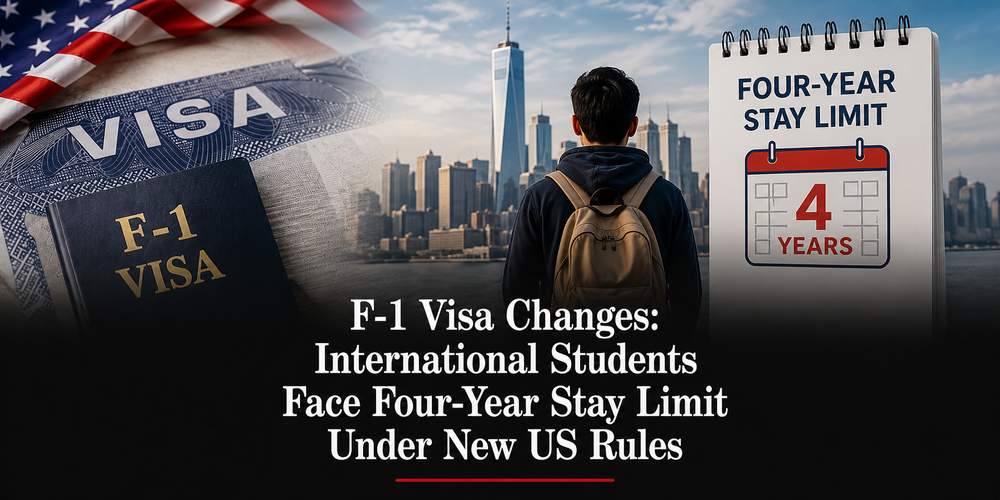
US to End 'Duration of Status' Rule, Introduce Four-Year Cap for International Students from September 15
Most F-1 and J-1 visa holders entering the US after September 15 will receive fixed-term admission of up to four years
The US Department of Homeland Security (DHS) is set to introduce one of the most significant immigration policy changes for international students and academic scholars in decades by ending the long-standing 'Duration of Status' (D/S) system.
Beginning September 15, most students entering the United States on F-1 visas and exchange visitors on J-1 visas will no longer receive open-ended permission to remain in the country while pursuing their studies. Instead, they will be granted admission for a fixed period based on the expected duration of their academic programme, subject to a maximum initial stay of four years.
The policy is expected to affect hundreds of thousands of international students and scholars, including one of the largest international student communities in the US—students from India.
What Is Changing?
For decades, international students entering the United States under the Duration of Status (D/S) system could legally remain in the country for as long as they continued to meet the requirements of their academic programme. This flexible arrangement allowed students to complete their education without a predetermined expiration date on their admission.
Under the revised regulations, however, the D/S framework will be replaced with a fixed-term admission system. From September 15, newly arriving students will receive an admission period considered sufficient to complete their programme, with an initial maximum limit of four years. Students whose programmes require additional time will need to apply for an extension through the US Citizenship and Immigration Services (USCIS) before their authorised stay expires.
Current Students Will Not Immediately Lose Their Status
The new rules will not automatically affect every international student already studying in the United States. Students who are lawfully present under the existing Duration of Status system on September 15 will generally be allowed to complete their current academic programme or an approved period of Optional Practical Training (OPT) under the existing rules.
However, DHS has introduced an important condition regarding international travel. Students who leave the United States and re-enter after September 15 will no longer be eligible for admission under the D/S system. Instead, they will be placed under the new fixed-term admission framework.
As a result, universities and immigration advisers are encouraging students to carefully evaluate overseas travel plans, especially visits to their home countries during academic breaks.
Four-Year Admission Limit May Affect Longer Degree Programmes
The introduction of a four-year cap could present new challenges for students enrolled in programmes that typically extend beyond four years. These may include:
- Certain undergraduate programmes
- Dual-degree courses
- Professional and medical programmes
- Research-intensive academic pathways
Students who need additional time to complete their studies must submit an extension request to USCIS before their authorised stay expires. The extension process may involve:
- Additional government filing fees
- Supporting documentation
- Administrative review
- Possible processing delays
Students are therefore encouraged to begin planning well before the end of their authorised admission period.
Post-Study Grace Period Reduced to 30 Days
Another significant change affects international students after graduation. Previously, F-1 students generally received a 60-day grace period after completing their studies. During this time, graduates could:
- Prepare to leave the United States
- Transfer to another educational institution
- Apply for a change in immigration status
- Organise employment or future academic plans
Under the new regulations, this grace period will be reduced to 30 days. The shorter timeframe means graduates will have considerably less time to make important decisions regarding employment, higher education, visa changes, or departure from the country.
New Restrictions Extend Beyond Students
The revised immigration rules also introduce changes for foreign media personnel entering the United States. Under the proposal:
- Foreign journalists travelling on I-category visas will receive an initial admission period of 240 days.
- Journalists representing Chinese media organisations will be limited to an initial stay of 90 days.
These measures form part of a broader effort by DHS to standardise admission periods across different visa categories.
Why Is DHS Making These Changes?
According to the Department of Homeland Security, the changes are intended to strengthen immigration oversight and reduce misuse of the student visa system. Federal officials argue that the existing Duration of Status policy allowed some foreign nationals to repeatedly enrol in academic programmes primarily to extend their stay in the United States rather than pursue genuine educational objectives.
By introducing fixed admission periods, DHS believes immigration authorities will have greater visibility over how long international students remain in the country and improve compliance monitoring.
Indian Students Could Be Among the Most Affected
India remains one of the largest contributors of international students to US higher education, with more than 300,000 Indian students studying at American colleges and universities each year. Due to their significant presence across undergraduate, postgraduate, and doctoral programmes, Indian students are expected to experience a substantial impact from the policy changes.
Immigration advisers are particularly urging students to pay close attention to travel dates surrounding the September 15 implementation deadline. Students currently studying in the United States who travel abroad after the new rules take effect could lose the protections of the existing Duration of Status system and instead become subject to the four-year admission limit upon re-entry. Similarly, students preparing to begin their studies in the US should ensure they understand how the new regulations apply to their visa and programme duration.
Universities Advise Students to Plan Ahead
Universities across the United States are encouraging international students to consult their campus international student offices before making overseas travel arrangements. Students enrolled in programmes expected to exceed four years are also being advised to familiarise themselves with the extension process well in advance to avoid disruptions to their studies.
For many students, particularly those from India, the new policy could result in additional paperwork, higher administrative costs and stricter immigration planning throughout their academic journey.
Key Changes at a Glance
Current Rule | New Rule (From September 15) |
Duration of Status (D/S) admission | Fixed-term admission |
No fixed stay limit while enrolled | Initial stay capped at four years |
60-day post-study grace period | 30-day grace period |
Existing students remain under D/S | New entrants receive fixed admission |
Re-entry under D/S possible | Students returning after Sept. 15 shift to new system |
Extensions rarely required | Longer programmes require USCIS extensions |
Why This Matters
The end of the Duration of Status system marks one of the most consequential changes to US student immigration policy in recent years. While the new framework aims to improve immigration oversight, it also introduces tighter timelines and additional administrative requirements for international students.
For prospective applicants and those already studying in the United States, careful planning around travel, programme duration and post-graduation options will become increasingly important. With Indian students representing one of the largest international student groups in the country, the policy could reshape how many approach their academic and career plans in the years ahead.
Editor's Note
Studying abroad has never been solely about earning a degree—it is also about building careers, expanding perspectives, and contributing to research and innovation across borders. Immigration policies naturally evolve to address administrative and security concerns, but they also shape the educational journeys of millions of students who invest years of planning and significant financial resources to pursue opportunities overseas.
As these new rules come into effect, universities, policymakers, and students alike will need to strike a careful balance between effective immigration oversight and maintaining the openness that has long made international education a driver of global collaboration. The question moving forward is not simply how long students can stay, but how policies can continue to support academic excellence while providing clarity, fairness and stability for those choosing to study abroad.
Frequently Asked Questions
Q1. What is changing for F-1 and J-1 visa holders?
The US will replace the Duration of Status (D/S) system with fixed-term admission periods, with most new students receiving an initial stay of up to four years.
Q2. When do the new rules take effect?
The revised regulations are scheduled to take effect on September 15.
Q3. Will current international students be affected immediately?
No. Students already in the US under the D/S system on September 15 can generally complete their current programme or approved OPT under the existing rules, unless they leave and re-enter after the deadline.
Q4. What happens if a degree takes longer than four years?
Students must apply to USCIS for an extension before their authorised stay expires.
Q5. How has the post-graduation grace period changed?
The grace period for F-1 students after completing their studies will be reduced from 60 days to 30 days under the new regulations.

Skoobuzz

 Skoobuzz
 Skoobuzz
 Skoobuzz
 Skoobuzz


0 Comments (Please Login To Continue)