








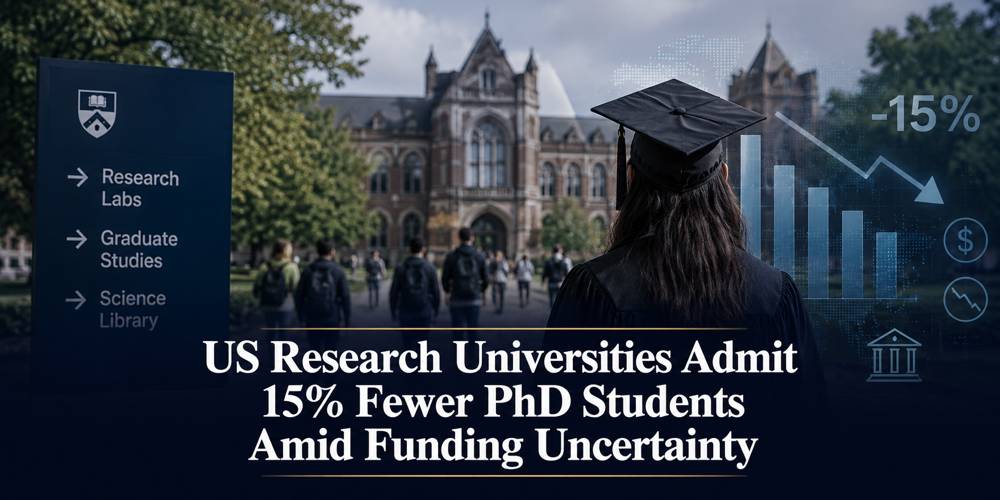
US Research Universities Admit 15% Fewer PhD Students Amid Funding Uncertainty
Declining doctoral admissions to federal research funding uncertainty and falling international student interest
Leading research universities across the United States have admitted 15% fewer students to PhD programmes for the 2026 academic year, according to a new analysis by the Association of American Universities (AAU). The report points to growing financial uncertainty, shifting immigration policies, and reduced international interest as key factors behind the decline.
Based on admissions data from 55 AAU member institutions, the analysis suggests that changes affecting research funding and international student mobility are reshaping the country's doctoral education landscape, raising concerns about the future of scientific research and innovation.
International Applications Decline as Domestic Interest Holds Steady
The study found that international demand for doctoral education experienced the sharpest decline. Applications from international students fell by 21% compared with the previous admissions cycle, while applications from domestic students increased modestly by 3%.
Researchers believe the contrasting trends reflect changing perceptions of the United States as a destination for advanced research, particularly among international STEM students who increasingly have alternative study destinations to consider.
The analysis was conducted jointly by the Association of American Universities and the Association of American Universities Data Exchange (AAUDE), using admissions data collected specifically to assess trends in the incoming 2026 doctoral cohort.
Funding Uncertainty Reshapes Graduate Admissions
According to AAU officials, universities are becoming increasingly cautious about expanding doctoral enrolment due to uncertainty surrounding federal research funding. Since President Donald Trump's return to office, the administration has proposed substantial budget reductions for major research agencies, including the National Science Foundation (NSF) and the National Institutes of Health (NIH). Although Congress blocked the proposed cuts for the 2026 fiscal year, uncertainty surrounding future funding has continued to influence university planning.
AAU leaders Emily Miller and Tobin Smith argue that institutions are reluctant to make long-term commitments to doctoral students whose education is heavily supported through competitive research grants.
In addition to funding concerns, universities have also faced delays in research grant approvals following the introduction of new federal requirements for grant proposals, creating uncertainty over the continuity of research projects.
Immigration Policies May Be Influencing Student Decisions
The report also suggests that recent changes to US immigration policies have affected international student confidence. AAU officials argue that evolving visa and immigration policies have made many prospective students feel less certain about pursuing doctoral education in the United States, particularly as competing study destinations continue expanding opportunities for international researchers.
Countries across Europe, Canada, Australia, and parts of Asia have increased efforts to attract global STEM talent, creating a more competitive international higher education market. Researchers believe this combination of domestic policy uncertainty and growing global competition has contributed to the decline in international doctoral applications.
Ripple Effects Extend Beyond Graduate Education
The report highlights that funding reductions have consequences throughout the research ecosystem. One example cited involved a university researcher whose pending National Science Foundation grants were cancelled because of funding limitations. As a result, nearly a dozen undergraduate research assistants lost financial support, while several research staff and postdoctoral scholars employed through the programme were also affected.
The findings suggest that funding instability not only limits doctoral admissions but also disrupts research opportunities across multiple stages of the academic pipeline.
Researchers Warn of Long-Term Talent Loss
AAU officials caution that continued reductions in doctoral admissions could have lasting consequences for the United States' scientific workforce. They argue that talented undergraduate students may increasingly choose careers in industry immediately after graduation or pursue doctoral studies in countries offering greater funding stability and research opportunities.
According to the report, prolonged uncertainty risks weakening America's ability to attract, train, and retain the next generation of scientists, engineers, and researchers.
Why This Matters
Doctoral programmes form the foundation of scientific discovery, technological innovation, and advanced research. A sustained decline in PhD admissions could affect the future supply of researchers who drive breakthroughs across healthcare, engineering, artificial intelligence, climate science, and other critical sectors.
The report also highlights the growing connection between higher education policy, immigration strategy, and national competitiveness. As countries compete globally for highly skilled researchers, predictable research funding and welcoming immigration policies are increasingly becoming strategic advantages in attracting international talent.
Editor's Note
The decline in doctoral admissions reflects more than a temporary admissions cycle—it signals growing uncertainty within the United States' research ecosystem. Universities rely heavily on stable federal investment to recruit doctoral candidates, sustain laboratories, and advance long-term scientific projects. When funding becomes unpredictable, institutions naturally reduce graduate intake, affecting the entire research pipeline from undergraduate assistants to postdoctoral fellows.
At the same time, the global competition for research talent has intensified. Nations across Europe, the Middle East, Asia, and Oceania are investing aggressively in research infrastructure, scholarships, and immigration pathways designed to attract highly skilled scientists. If the United States cannot provide funding stability alongside a welcoming environment for international scholars, it risks ceding scientific leadership to countries that are actively positioning themselves as the next global hubs for research and innovation. The findings, therefore raise broader questions about how public policy influences not only higher education but also long-term economic competitiveness, technological leadership, and national innovation capacity.
Frequently Asked Questions (FAQs)
Q1. Why did US universities admit fewer PhD students in 2026?
The AAU attributes the decline primarily to uncertainty surrounding federal research funding, delays in grant approvals, and changing immigration policies that have affected international student interest.
Q2. How much did PhD admissions decline?
Admissions to doctoral programmes at participating AAU universities fell by 15% compared with the previous academic year.
Q3. What happened to international PhD applications?
International applications declined by 21%, while domestic applications increased by 3%, according to the analysis.
Q4. Which organisations conducted the study?
The analysis was carried out by the Association of American Universities (AAU) in collaboration with the Association of American Universities Data Exchange (AAUDE) using admissions data from 55 research universities.
Q5. Why is the decline in PhD admissions significant?
Doctoral students are central to scientific research and innovation. A prolonged decline could reduce the future supply of researchers, weaken university research capacity, and affect the United States' global competitiveness in science and technology.

Skoobuzz

 Skoobuzz

 Skoobuzz
 Skoobuzz
 Skoobuzz


0 Comments (Please Login To Continue)